Tuesday, March 31, 2015

James Baldwin's "Go Tell It On the Mountain"

Currently, I'm rereading James Baldwin's Go Tell it On the Mountain (1953), and while working on my paper for an upcoming conference, I noticed some things that I would like to talk about briefly here on the blog. I've written about Baldwin and the southern landscape on this blog before. Today, I want to expand upon that to a certain extent by looking at Florence and Deborah in Baldwin's first novel. Trudier Harris notes that fears of the South “whether manifested in lynching or rape, had a direct impact upon black bodies” (13). For Florence and Deborah, the fear of rape is what drives them, one to leave the South, and the other to become subjected to the power of Gabriel Grimes. 


Farah Jasmine Griffin, in "Who Set You Flowin'?: The African-American Migration Narrative, talks about Florence's decision to migrate North while only touching briefly on Deborah and her non-movement. Griffin notes that in order to better understand what caused individuals to migrate to the North, especially females, we need to pay attention to the non-economic motives. For Florence, this motive included the fear that she would be raped by her "master." At home, Florence's place within the family can be seen as nothing more than tenuous because she must give up her self for Gabriel's success. Gabriel becomes the one that their mother dotes on, pushing Florence to the side. The sexism she experiences at home only exacerbates what possibly awaits her at her job in the white man's house.

When she was twenty-six years old in 1900, Florence decided to leave for New York. As she worked as a "cook and serving-girl" in a white home, "her master proposed that she become his concubine" (emphasis added 75). At that moment. Florence chose to escape. She bought a train ticket for New York and left the very next day. One important aspect to note in the above quote is that Baldwin uses the term "master" for Florence's employer. This event occurred 35 years after the Civil War, but he still chooses that term here. Griffin astutely notes that "Baldwin uses this term to denote that the South from which Florence flees is the same South as that which enslaved her mother" (38). The only impetus for Florence escaping is the threat of sexual exploitation by her master, not the death of a family member by violence or monetary desires.  

Florence's friend Deborah actually experiences sexual trauma at the hands of white southerners, but she does not leave as a result. At sixteen, Deborah "had been taken away into the fields the night before by many white men, where they did things to her to make her cry and bleed" (69). After Deborah's father confronts the whites, they beat him and left him for dead. From that moment on, no one in the community would touch Deborah because they viewed her as unclean and a harlot. These experiences caused Deborah to believe that all men were only after her for her body, nothing more. She turned to the Lord, and eventually, after Gabriel's conversion, she marries the supposed man of God. Their relationship involved Deborah praising Gabriel, Gabriel accepting the praise, and not much more. In essence, Gabriel begins to lord over her with his power that purportedly came from God. Unlike Florence, though, Deborah stays in the South with Gabriel, never attempting to escape.

Along with Florence and Deborah, another woman experiences sexual exploitation. Esther, the woman who works with Gabriel and has an affair with him while he is married to Deborah, chooses to flee the South after her encounter with Gabriel leaves her pregnant. While Florence's and Deborah's instances of sexual subjugation occurred at the hands of white men, Esther's happened at the hands of an African American. The congress between Esther and Gabriel is consensual; however, once Gabriel finds out that Esther is pregnant and that she wants to leave, his power begins to show. He tries to reason that she is not pregnant and that she is just being naive, but Esther stands firm and starts to batter Gabriel's pride. She tells him that he needs to give her money so she can leave, or she will go through town telling everyone about "the Lord's anointed" and his actions. Gabriel acquiesces, and he steals the money Deborah had saved and gives it to Esther.

What makes Esther interesting is the fact that like Florence and Deborah she encounters sexual subjugation. Unlike Florence and Deborah, though, she experiences it not at the hands of whites but at the hands of an African American man. Along with this aspect, the results of her encounter with Gabriel mirror what happens with Florence. Even though Florence does not physically get raped, the mere thought of it causes her to migrate. The consensual congress of Esther and Gabriel causes her to flee because of the resulting pregnancy.

I'm not sure what to entirely make of this right now, but it's something that I noticed. What are your thoughts on this? Share them below.

Baldwin, James. Go Tell it On the Mountain. New York: Dell, 1985.
Griffin, Farah Jasmine. "Who Set You Flowin'?: The African-American Migration Narrative. New York: Oxford University Press, 1995. Print.        

Thursday, March 26, 2015

"A Visitation of Spirits" and the Past

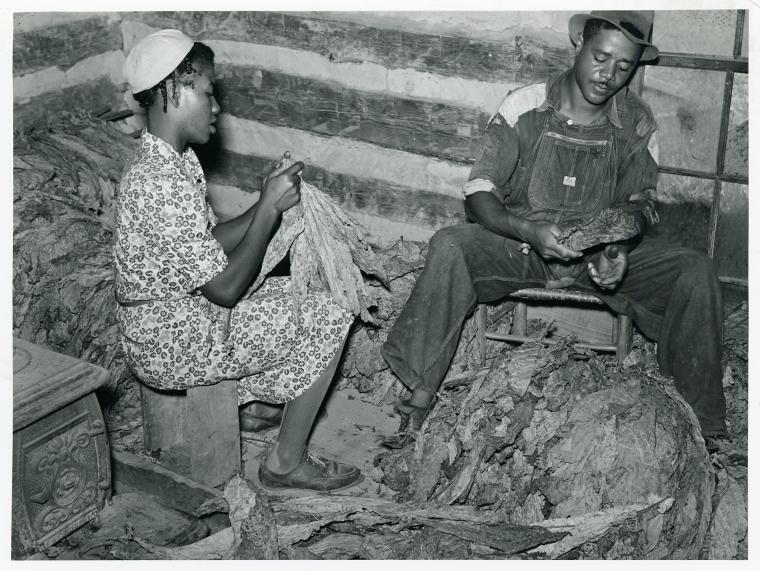
African American sharecropper and wife
grading tobacco in North Carolina (New York Public Library)
On Tuesday, I wrote about the idea of "the One" in Randall Kenan's A Visitation of Spirits and in the works of Ernest Gaines. Today, I want to briefly touch on another aspect of Kenan's novel that bears similarities to Gaines's work, specifically his descriptions and ruminations on the changing landscape and movement away from the past. There are numerous points in the narrative that focus on the changing land, but perhaps the most important is the conclusion of the book, Horace's confession and more importantly the section entitled "Requiem for Tobacco." As Thadious Davis notes, this section can be seen in relation to Gaines because "the nature of the rural and the farming communities is past, but it provides a space from which to understand the present" (333).

"Requiem for Tobacco" begins nostalgically, almost like a myth that was once true but as of now no longer exists.
You remember, though perhaps you don't, that once upon a time men harvested tobacco by hand. There was a time when folk were bound together in a community, as one, and helped one person this day and that day another, and another the next, to see that everyone got his tobacco crop in the barn each week, and that it was fired and cured and taken to a packhouse to be graded and eventually sent to market. But this was once upon a time. (254)
"Once upon a time," as Davis notes, carries with it a note of mythologizing the harvest. The phrase, in one form or another, appears twice in the paragraph above, once at the beginning and once at the end. Along with this phrase, there is also a focus on community. Looking to the past, the narrator points out that it "was a time when folk were bound together in community." Community plays a major role in Gaines's work, and in Kenan's novel, the community that "Requiem for Tobacco" recalls does not exist anymore. Instead, the community does not help one another out; in fact, it hinders the psychological growth of the presumed One, Horace.  

After speaking about the planting, harvesting, and drying of the tobacco. Men like Edgar Harris and George Pickett would plant and harvest the tobacco then bring it to the barn where the women would tie the tobacco together. Underneath the tin ceiling, time would fade away, problems would be solved, and the older women would "impart good and practical wisdom to younger girls" (256). All of this though, happened in the past. Over time, the land, and who cultivated it, changed. The encroachment of modernity upon the rural North Carolina community recalls the continued approach of mechanized farming in Catherine Carmier and A Gathering of Old Men.  Now, Edgar Harris lies in a grave somewhere and "George Pickett has leased his land and now drives a bus" (256). Pickett's land then became divided again, sold to someone who had a lot of land, "someone who is no one at all, but many in the name of one," a corporation like the one that harvests sugarcane in Attica Locke's The Cutting Season (256). Instead of hands doing the work, "the clacking metal and durable rubber of a harvester that needs no men, that picks the leaves, stores the leaves, slaps them into small bulk barns that looks like chicken coops that cure quicker, easier, cheaper" replaced the people in the fields (256-57). The increase in mechanized farming and corporations concerned more with profit margins than with people push the memories of Hiram Crum, Ada Mae Philips, Jess Stokes, Henry Perry, and Lena Wilson to the side, letting them drift in the wind like the dust kicked up by a laboring tractor.

"Requiem for Tobacco," and the novel, concludes with paragraph that laments the passing of time. Even though machines make farming "less torturous," they also erased the past. With the movement of modernity, the past becomes forgotten, only to be recalled when modernity causes us to feel more disoriented then ever from trying to keep up. That is when we turn to the rural, the pastoral, for an escape from the overwhelming onslaught. That should not be the only time. As the narrator concludes, "And it is good to remember that people were bound to" the process of growing tobacco "for too many forget" (257). This is what Gaines writes for. This is what Kenan's A Visitation of Spirits does. They cause us to remember, to look at the past and to recall how we made it to the present.

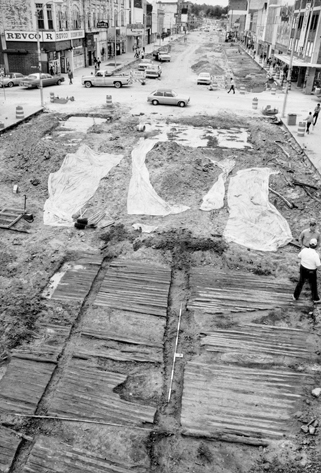
Wood Plank Road in Fayettville, NC (1984)
There are other scenes throughout the novel that deal with the changing land. Specifically, I am thinking about Jimmy, Ruth, and Zeke's drive to see Asa in the hospital. During the drive, Zeke begins to think about the past and how much things have changed. He contemplates the road between Fayettville and Wilmington. Zeke recalls when the road was nothing more than a "wood-plank" and a man would be better off "tak[ing] a train than drive a mule and cart all them seventy-so miles" (47). He continues by thinking that today people take cars, making the trip between the two town so much easier. They get in, start the car, then drive. People "[t]ake them for granted" (47). Zeke highlights the movement of time and the increased mechanization of the world, in this instance with the automobile.

What other instances in Kenan's novel highlight the changing times? Are there other instances that remind you of Gaines or other Southern authors? If so, what are they?    


Davis, Thadious M. Southscapes: Geographies of Race, Region, & Literature. Chapel Hill: University of North Carolina Press, 2011. Print.
Kenan, Randall. A Visitation of Spirits. New York: Grove Press, 1989. Print.