Showing posts with label the sound and the fury. Show all posts

Tuesday, November 18, 2014

Dilsey and Miss Jane

Scene from James Farnco's adaptation of The Sound and the Fury (2014).
Lorretta Devine plays Dilsey. 
The previous post, "Benjy Compson and Sonny" explores the correlations between William Faulkner's The Sound and the Fury and Ernest Gaines' "A Long Day in November," specifically focusing on the stylistic similarities between Benjy's section and Sonny's narration. For this post, I would like to focus on another aspect of Faulkner's novel that some have brought up in relation to Gaines' The Autobiography of Miss Jane Pittman. This aspect deals with the "similarities" between Faulkner's Dilsey and Gaines' Miss Jane. 

In 1945,  Faulkner added an appendix to The Sound and the Fury (1929) to help clarify some aspects of the novel. Entitled "Compson: 1699-1945," the appendix chronicles the Compson family lineage from 1699 through World War II. The events of the novel conclude in 1928, so the appendix helps to fill in the information about what happens to Mrs. Compson, Benjy, Jason, Caddy, and others. Faulkner concludes the appendix with a section on Dilsey and her family. Even after he goes into detail about what happens to the other characters in the novel, Faulkner simply states, before discussing Dilsey's family, "And that was all. These others were not Compsons. They were black." Here, he only provides a couple of sentences for T.P., Frony, Luster, and Dilsey. He doesn't even provide information for Roskus or Versh. For Dilsey. all Faulkner says is "They endured."

Dilsey, throughout The Sound and the Fury, is the mainstay. She even comments in the final section, "I've seed de first en de last" (297). Dilsey takes care of the Compson family, looking after Mrs. Compson, making sure Benjy is taken care of, stepping in between Quentin and Jason at certain points, and ultimately keeping the house in order. While she deals with the decaying Compson household, Dilsey maintains strength; she endures. Even though Dilsey endures, Faulkner does not provide her with a large amount of space in the novel. She remains, for the most part, in the background, more specifically in the kitchen.  Divided into four sections, the Compson sons (Benjy, Quentin, and Jason) narrate the first three sections of the novel and the fourth section is told by an omniscient third person narrator. Many call this section "Dilsey's section"; however, I have qualms with that label because the final section, while focusing on Dilsey partly, mainly revolves around Jason's attempt to retrieve the money from Quentin and the man she ran off with. Compounding Dilsey's lack of voice in the final section, Faulkner tells the other three sections from the first person point-of-view of male protagonists, not providing Dilsey, or even the Compson women, an adequate voice throughout the narrative. Herman Beavers notes, "Faulkner's decision not to provide [Dilsey] a section of her own in the novel, while it marks off her moral strength, likewise swears her to secrecy," concluding that Dilsey's narrative "will take place in the world beyond" (129).

Ad for The Autobiography
of Miss Jane Pittman
Even though Faulkner does not portray Dilsey as intricately as he could have, she remaines a memorable character in modern American literature. During its promotion of The Autobiography of Miss Jane Pittman, The Dial Press used a quote from Geoffery Wolff's Newsweek review that compares Miss Jane to Dilsey. Wolff writes: 
This is a novel in the guise of the  tape-recorded recollections of a black woman who has  lived 110 years, who has been both a slave and a  witness to the black militancy of the 1960's. In this  woman Ernest Gaines has created a legendary figure,  a woman equipped to stand beside William  Faulkner's Dilsey in  The Sound And The Fury. Miss Jane Pittman, like Dilsey, has  'endured,' has seen almost everything and foretold the rest.
While understandable for marketing purposes, Wolff even compares the novel to Homer's The Odyssey and Mark Twain's Huckleberry Finn in its scope and subject matter, the comparisons between Dilsey and Miss Jane can only go so far. Gaines makes known that as a Southern writer and an African American writer he cannot escape writing back to Faulkner

Gaines told John Lowe in 1994 that an interviewer once asked him if he had Disley in mind when writing Miss Jane's Story. Gaines simply replied, "No, I did not have Dilsey in mind" (313). Gaines goes on to say that Dilsey tells her story not from her own kitchen but from Compson's, and "Miss Jane is talking to a black teacher in her kitchen" (313). Essentially, Gaines allows Miss Jane to tell her own story, unlike Faulkner who fails to provide Dilsey with a voice in his novel like Benjy, Quentin, and Jason. Disley becomes relegated, as stated earlier, to the background, the servant who maintains the family's secrets and endures as they wither away.

More could be said here, but I would like to leave the discussion here to see what you have to say. Make sure to post your thoughts and comments down below.

Beavers, Herman. Wrestling Angels into Song: The Fictions of Ernest J. Gaines and James Alan McPherson. Philadelphia: University of Pennsylvania Press, 1995. Print.
Faulkner, William. The Sound and the Fury. New York: Vintage, 1994. Print.
Lowe, John. "An Interview with Ernest Gaines." Conversations with Ernest Gaines. Ed. John Lowe. Jackson: University of Mississippi Press, 1995. 297-328. Print.



Thursday, November 13, 2014

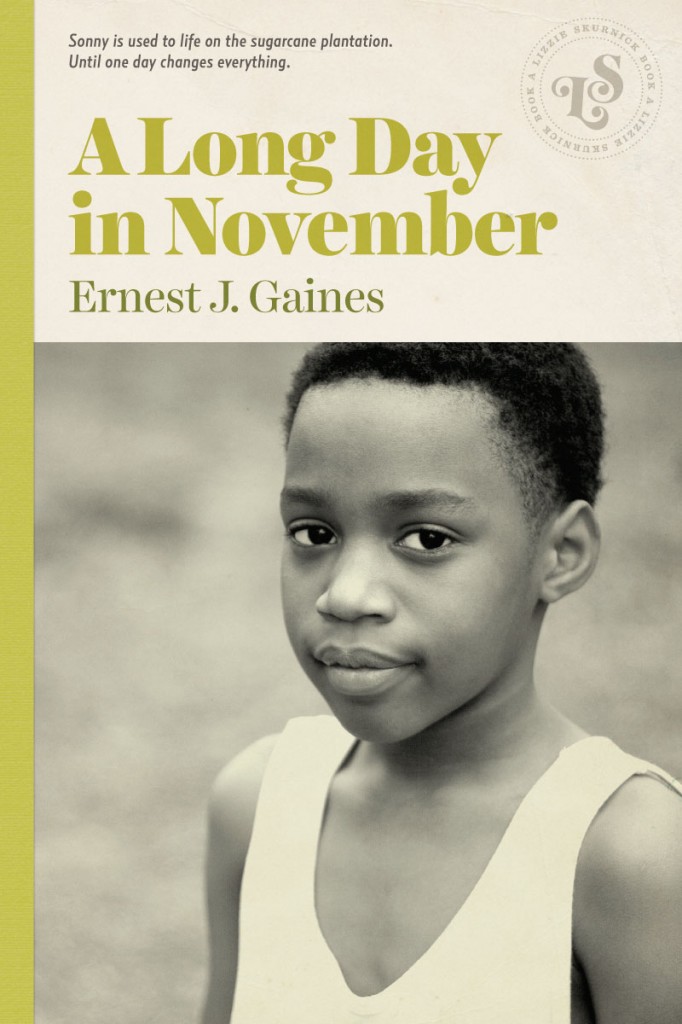
Benjy Compson and Sonny

"Somebody is shaking me but I dont want get up now, because I'm tired and I'm sleepy and I don't want get up now" (Bloodline 3). So begins Gaines' short story "A Long Day in November," a story narrated by five-year-old Sonny. The boy tells about the relationship between his father and mother, their conflicts then their eventual reconciliation. For this post, I do not want to focus on the narrative of the story. Instead, I want to talk briefly about the narrative voice that Gaines constructs to tell the story.

Reading Sonny's voice for the first time, I could not help but think that something felt eerily similar to me. As I kept reading, I finally began to figure out that Sonny's narration reminded me of Benjy Compson's from William Faulkner's The Sound and the Fury. In fact, a couple of pages into "A Long Day in November," I scribbled "kinda like Benjy narrating" in the margins. Specifically, what sparked this connection came from Sonny's narration when describes his dream the waking up from it. There are not clues that Sonny awakes. The narration moves fluidly from sleeping dreams of Billy Joe Martin, Sonny, and Lucy playing to "Somebody's beating on the door. Mama, somebody's beating on the door" (7). Sonny's seamless movement from sleep to being awake is not as abrupt as Benjy's leaps over the course of thirty years, but it is similar. Along with this type of subtle shift, Sonny also takes on some of Benjy's linguistic style.

Even though Benjy is thirty three, his decreased mental capacity makes him appear as if he is merely a child. For example, he can only mumble and cry when he hears Caddy's named mentioned. In fact, the family doesn't even say her name when she is gone so Benjy will keep quiet. Opening his section, Benjy states, "Through the fence, between the curling flower spaces, I could see them hitting. They were coming towards where the flag was and I went along the fence" (3). Just like Sonny's initial sentence, Benjy's contains a simplicity, even though both also have a subordinate clause. Their apparent simplicity arises from the structure (a subject followed directly by a verb). This structure allows both Sonny and Benjy to sound like a five-year-old boy and a thirty-three year old man child respectively.

Responding to a question about writing from the point of view of a young boy in "A Long Day in November," Gaines responded by saying "we have all been children once" and because of that, the viewpoint is there somewhere. Even though this voice resided within Gaines, and us, he had to find out a way to bring it out. To do that, he received help from both Joyce and Faulkner. Joyce helped Gaines write about events that span a day. From Faulkner, Gaines said he found out how to write in the voice of a five-year-old Sonny.
In the first part of Faulkner's The Sound and the Fury the Benjy part, Benjy uses the simplest terms to express his feelings: "the gate is cold," "the fire is good," "I stamped my shoes on," all this sort of thing. This childlike section is so convincing that I really fell in love with it. I really did. (Fitzgerald and Marchant 11)    

I am in the process of rereading The Sound and the Fury, so in a couple of days I may have more to say about the novel and Gaines. However, at this point, I just wanted to note the similarities in regards to the way that Gaines structures Sonny's narration and the way Faulkner structures Benjy's. If you have any comments or questions, remember to leave them below. 

Faulkner, William. The Sound and the Fury. New York: Vintage, 1994. Print.
Fitzgerald, Gregory and Peter Marchant. "An Interview: Ernest J. Gaines." Conversations with Ernest Gaines. Ed. John Lowe. Jackson: University of Mississippi Press, 1995. 3-15. Print.
Gaines, Ernest J. "A Long Day in November." Bloodline. New York: W.W. Norton & Company, 1976. 3-79. Print.