Thursday, May 28, 2015

First Ever Ernest J. Gaines Society Panel at ALA 2015

May 23, 2015, saw the first ever panel of the Ernest J. Gaines Society. The panel took place at the American Literature Association and involved three papers on the continued importance of the works of Ernest J. Gaines. Each paper brought new perspectives to Gaines scholarship and opened new avenues for examining Gaines's works in relation to the American and African American literary tradition. The panel, entitled "Rethinking Race and Culture in the Fiction of Ernest J. Gaines," explored differing thematic elements in Gaines;s works. Covering "A Long Day in November," The Autobiography of Miss Jane Pittman, and Catherine Carmier, the papers varied from discussing marital traditions, literary genres, and social hierarchies. Overall, the panel presented eye-opening avenues to expand Gaines scholarship. For this post, I would just like to briefly discuss the papers, providing a little information about each of them.

Pearlie Peters's "Rekindling Old Marital Traditions in African American Folk Culture, Southern Style: Domestic Violence in Selected Fiction of Ernest J. Gaines and Zora Neale Hurston" opened up the panel. In her paper, Peters discussed the closing scene of Gaines's "A Long Day in November" where Amy tells Eddie that he needs to beat her in order to save face in the community. When Amy threatens to leave Eddie again at the end of the end of the story, she tells him that he better stop her before she leaves for good. Eddie picks a switch off the floor and hits her twice. Amy tells him, "Beat me," and he proceeds to beat her even harder (74). After he beats her, Eddie runs towards Amy and picks her up to take her to bed. At dinner, Amy's face is swollen and she's been crying. Eddie finally asks Amy why she wanted him to beat her, even when he didn't beat her for that thing with Freddie Jackson; she responds by saying, "Because I don't want you to be a laughingstock of the plantation" (75).

Upon first reading this scene, it confounded me because I did not understand why Amy wanted Eddie to beat her so he would not be the laughingstock of the community. Perters's presentation covered this topic in some detail, even bringing in examples from Zora Neale Hurston's Their Eyes Were Watching God. Amy's request, as Peters argues, comes from a space that conflates the public and the private. Everything in the quarters becomes public in some form or another, so if Eddie does not rectify the situation of his wife deciding to leave him, the whole community will see him as a laughingstock because his masculinity has been contested. Peters draws on Robert Hemenway's "Are You a Flying Lark or a Setting Dove" and Hurston's "Story in Harlem Slang" and "Characteristics of Negro Expression" to show that the domestic violence portrayed at the end of "A Long Day in November" and in Hurston's novel was once perceived as being good, respectful domestic violence. This does not justify domestic violence in any way; she just maintains that the situations shown within these texts have precedent in socio-cultural folk communities.

Erin Salius's "Rethinking Historical Realism in The Autobiography of Miss Jane Pittman" argues that the way we typically read Gaines's famous 1971 novel needs to be altered. Instead of reading Pittman as historical realism, Salius proposes that we read it as a precursor to more disruptive neo-slave narratives such as Octavia Butler's Kindred, Charles Johnson's Middle Passage and Ishmael Reed's Flight to Canada. Scholars place Gaines's novel at the forefront of the neo-slave narrative genre; however, they do not typically see it as novel that mirrors either Butler's or Toni Morrison's Beloved because it is a straightforward, chronological narrative. Other neo-slave narratives contain disruptions and temporal overlap, and they work to, as Dubey argues, to fill gaps in existing historical narratives. Salius argues that we should read The Autobiography of Miss Jane Pittman in this way.

Salius proposes that we should read Gaines's novel like a "palimpsest novel." Ashraf Rushdy argues that this form of neo-slave narrative is a novel "in which a contemporary African American subject describes modern social relations that are directly conditioned or affected by an incident, event, or narrative from the time of slavery" (535). This comes from the fact that during Part III of the novel there are numerous references to characters appearing possessed by forces beyond their control. During the scenes with Tee Bob and Mary Agnes this possession appears. Ultimately, the residual effects of slavery come into play withing the novel in regards to the "rules" that Jules Raynard and Jimmy Caya espouse in regards to what Tee Bob can, and should, do with Mary Agnes. To find out more about Salius's argument, check out the summer 2015 issue of Callaloo where her paper will appear.

Matthew Teutsch's "'They want us to be Creoles. . . There is no in-between': Creole Representations in Gaines's Catherine Carmier and Lyle Saxon's Children of Strangers" looks at what Keith Byerman calls "the death of the Creole" in Gaines's and Saxon's novels. To highlight the decline of the Creole community, Teutsch focuses on the trope of passing in both novels. He looks at Famie's son Joel in Children of Strangers and how Joel's desire to pass for white in California ultimately causes him to lose all contact with his mother Famie. He essentially separates himself from her and from the rest of the community in order for him to pass as white. Lillian does the same thing in Gaines's Catherine Carmier. She talks about being unable to live a life between the black and white world, so she ultimately decides to pass as well, leaving her family behind.

Teutsch opens up new ways to look at Gaines's work by exploring it in relation to other writers in Louisiana their treatment of Creole communities. Both Saxon and Gaines explore Creole communities in their works, and both discuss the insular aspects of the people, shunning both black and white penetration into the group. This insulation leads to a gradual decline that ultimately causes the death of the community. Both Joel and Lillian show this because they both decide to pass, and in so doing, they sever all ties with the community itself.

This is just a brief overview of the first annual Ernest J. Gaines Society panel. Next year, there will be two panels at the American Literature Association in San Francisco, CA and one at the Society for the Study of Southern Literature Conference in Boston, MA. Make sure to check back on the center's website for the CFPs.

Gaines, Ernest J. "A Long Day in November." Bloodline. New York: W.W. Norton & Company, 1976. 3-79. Print.

Tuesday, May 26, 2015

Robert Olen Butler's "Crickets"

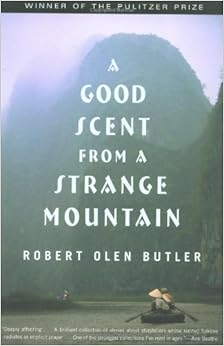
The other day, someone told me about Robert Olen Butler's Pulitzer Prize Winning A Good Scent from a Strange Mountain (1992), a collection of short stories that chronicles the lives of Vietnamese immigrants in Louisiana. I've only had the chance to read a couple of the selections, and today I would like to briefly write about one of them, "Crickets." Told from the point of view of a Vietnamese immigrant named Thiệu, the story centers around Thiệu trying to instill a sense of Vietnamese culture and history into his son Bill. The story, only six pages in length, contains numerous themes that are worth exploring; however, I will only focus on a couple of them today.


The opening paragraph of "Crickets" sets the stage for what will follow between Thiệu and his son Bill. Thiệu begins by saying, "They call me Ted where I work and they've called me that for over a decade now and it still bothers me, though I'm not very happy about my real name being the same as the former President of the former Republic of Vietnam [Nguyễn Văn Thiệu]" (59). From the first sentence, we know that the narrative will focus on tensions within the narrator regarding him and his wife's escape to America after the fall of Saigon and their struggles to live within a different culture while maintaining a sense of their identity. In America, Thiệu does not go by his original name; instead, he goes by an Americanized version, Ted, partly out of a desire to assimilate but partly because even though he points that Thiệu  is a common name in Vietnam many people in America associate it with Nguyễn Văn Thiệu. After fleeing Vietnam, Thiệu and his wife ended up in Lake Charles, Louisiana, "where there are rice paddies and where the water and the land are in the most delicate balance with each other, very much like the Mekong Delta, where [Thiệu] grew up (60). (Mike Tidwell's Bayou Farewell discusses these similarities.)

Thiệu's Americanization comes at an expense, his son. On their first night in Lake Charles, Thiệu and his wife conceived their son, and both decided to name him Bill. They chose Bill because it is "an American name," and Thiệu and his son became "Bill and his father Ted" (60-61). While names do not tell the whole story of a person's life or past, Bill and Ted connote an Americanized identity that is devoid of any reference to the past life that Thiệu had in Vietnam. This lack of connection, especially with his son, aggravates Thiệu. He wants Bill to understand his culture and his heritage; however. Bill "is proud to be born in America, and when he leaves in the morning to walk to the Catholic school, he says, 'Have a good day, y'all'" (60). When Thiệu tells Bill goodbye in Vietnamese, Bill looks at him and says, 'Aw, Pop" as if it's a joke (60). In regards to him not speaking Vietnamese, Thiệu's wife simply responds by telling him that Bill is American. This statement reminds me of Stanley's comments about being Polish in Tennessee Williams's A Streetcar Named Desire. Stanley simply says, "I'm American."

Getting frustrated with his son's lack of cultural identity with his Vietnamese roots, Thiệu suggests that they find crickets to have them fight one another. This was something that Thiệu and his friends used to do in Vietnam, finding charcoal crickets and fire crickets to put in the ring. Thiệu walks a fine line trying to convince his son to find crickets to fight, even thinking about how he is struggling against the Saturday morning cartoons that pit superheroes and robots against each other. after finding only charcoal crickets, Bill begins to get bored, asking how many they need. Thiệu sits beside the house and looks in the shoe box. He notices that they have only gathered up six charcoal crickets and no fire crickets. You need both, according to Thiệu, to fight each other because the crickets balanced one another out. While he ponders the shoe box full of charcoal crickets, Bill exclaims, "Oh, no," and Thiệu thinks that Bill understands the need for both types of crickets. However, Bill only points to his shoes and says, "My Reeboks are ruined!" (64). Thiệu acquiesces to defeat and tells his son he can leave. 


The story ends the next morning with Bill leaving for school. His mother cleaned his shoes, and as he walks out the door, Thiệu tells him, "See you later, Bill" (64). With this final line, Thiệu relinquishes his desire to instill in Bill a sense of tradition and history. His son is American, without a care in the world for his Vietnamese heritage. This does not mean that Bill will not one day care about his heritage, but at this time, as a ten year old, he does not. In many ways, this story reminded me of a recent episode of Fresh off the Boat where Jessica (the mother) is afraid that her sons will not know anything about their Chinese heritage so she panics and starts to make everything about China. The family moved from Washington D.C. to Orlando, FL.  Ultimately, the episode explores the melding of cultures and how one, especially Jessica's son, can have knowledge of and respect his Chinese heritage while also being American.

This is a topic that I've thought about with the Indian Removal Act in the 1800s and other topics. What are your thoughts? What other works that focus on assimilation and cultural heritage could we examine? I know there are many. Are here any that specifically focus on Louisiana?


Butler, Robert Olen. "Crickets." A Good Scent from a Strange Mountain. New York: Henry Holt and Company, 1992. 59-64. Print.