Showing posts with label louisiana. Show all posts

Tuesday, May 26, 2015

Robert Olen Butler's "Crickets"

The other day, someone told me about Robert Olen Butler's Pulitzer Prize Winning A Good Scent from a Strange Mountain (1992), a collection of short stories that chronicles the lives of Vietnamese immigrants in Louisiana. I've only had the chance to read a couple of the selections, and today I would like to briefly write about one of them, "Crickets." Told from the point of view of a Vietnamese immigrant named Thiệu, the story centers around Thiệu trying to instill a sense of Vietnamese culture and history into his son Bill. The story, only six pages in length, contains numerous themes that are worth exploring; however, I will only focus on a couple of them today.


The opening paragraph of "Crickets" sets the stage for what will follow between Thiệu and his son Bill. Thiệu begins by saying, "They call me Ted where I work and they've called me that for over a decade now and it still bothers me, though I'm not very happy about my real name being the same as the former President of the former Republic of Vietnam [Nguyễn Văn Thiệu]" (59). From the first sentence, we know that the narrative will focus on tensions within the narrator regarding him and his wife's escape to America after the fall of Saigon and their struggles to live within a different culture while maintaining a sense of their identity. In America, Thiệu does not go by his original name; instead, he goes by an Americanized version, Ted, partly out of a desire to assimilate but partly because even though he points that Thiệu  is a common name in Vietnam many people in America associate it with Nguyễn Văn Thiệu. After fleeing Vietnam, Thiệu and his wife ended up in Lake Charles, Louisiana, "where there are rice paddies and where the water and the land are in the most delicate balance with each other, very much like the Mekong Delta, where [Thiệu] grew up (60). (Mike Tidwell's Bayou Farewell discusses these similarities.)

Thiệu's Americanization comes at an expense, his son. On their first night in Lake Charles, Thiệu and his wife conceived their son, and both decided to name him Bill. They chose Bill because it is "an American name," and Thiệu and his son became "Bill and his father Ted" (60-61). While names do not tell the whole story of a person's life or past, Bill and Ted connote an Americanized identity that is devoid of any reference to the past life that Thiệu had in Vietnam. This lack of connection, especially with his son, aggravates Thiệu. He wants Bill to understand his culture and his heritage; however. Bill "is proud to be born in America, and when he leaves in the morning to walk to the Catholic school, he says, 'Have a good day, y'all'" (60). When Thiệu tells Bill goodbye in Vietnamese, Bill looks at him and says, 'Aw, Pop" as if it's a joke (60). In regards to him not speaking Vietnamese, Thiệu's wife simply responds by telling him that Bill is American. This statement reminds me of Stanley's comments about being Polish in Tennessee Williams's A Streetcar Named Desire. Stanley simply says, "I'm American."

Getting frustrated with his son's lack of cultural identity with his Vietnamese roots, Thiệu suggests that they find crickets to have them fight one another. This was something that Thiệu and his friends used to do in Vietnam, finding charcoal crickets and fire crickets to put in the ring. Thiệu walks a fine line trying to convince his son to find crickets to fight, even thinking about how he is struggling against the Saturday morning cartoons that pit superheroes and robots against each other. after finding only charcoal crickets, Bill begins to get bored, asking how many they need. Thiệu sits beside the house and looks in the shoe box. He notices that they have only gathered up six charcoal crickets and no fire crickets. You need both, according to Thiệu, to fight each other because the crickets balanced one another out. While he ponders the shoe box full of charcoal crickets, Bill exclaims, "Oh, no," and Thiệu thinks that Bill understands the need for both types of crickets. However, Bill only points to his shoes and says, "My Reeboks are ruined!" (64). Thiệu acquiesces to defeat and tells his son he can leave. 


The story ends the next morning with Bill leaving for school. His mother cleaned his shoes, and as he walks out the door, Thiệu tells him, "See you later, Bill" (64). With this final line, Thiệu relinquishes his desire to instill in Bill a sense of tradition and history. His son is American, without a care in the world for his Vietnamese heritage. This does not mean that Bill will not one day care about his heritage, but at this time, as a ten year old, he does not. In many ways, this story reminded me of a recent episode of Fresh off the Boat where Jessica (the mother) is afraid that her sons will not know anything about their Chinese heritage so she panics and starts to make everything about China. The family moved from Washington D.C. to Orlando, FL.  Ultimately, the episode explores the melding of cultures and how one, especially Jessica's son, can have knowledge of and respect his Chinese heritage while also being American.

This is a topic that I've thought about with the Indian Removal Act in the 1800s and other topics. What are your thoughts? What other works that focus on assimilation and cultural heritage could we examine? I know there are many. Are here any that specifically focus on Louisiana?


Butler, Robert Olen. "Crickets." A Good Scent from a Strange Mountain. New York: Henry Holt and Company, 1992. 59-64. Print. 


Tuesday, April 14, 2015

Marie Adrien Persac and Riverlake Sugarhouse

Marie Adrien Persac--an itinerant painter, cartographer, photographer, and lithographer--detailed nineteenth century Louisiana life. One aspect that he captured in his paintings was plantation life in Louisiana during the mid-nineteenth century. Born on December 14, 1823 in Saumur, France, Persac left for America, family legend contends, around 1843, a year after his father passed away (3). We do not know precisely when Persac came to Louisiana, but we do know that he married Odile Daigre in Baton Rouge in 1851. Between 1857 and 1861, Persac painted landscapes; these images present "the image and indeed the very feel of Louisiana plantations on the eve of the Civil War" (9). Persac painted plantations such as the Shadows-on-the-Teche in New Iberia and Faye Plantation in St. Mary Parish. Among these landscapes, Persac also painted Riverlake Plantation, specifically the sugarhouse.


The exact date of Riverlake Sugarhouse in not known. Persac painted it anywhere between 1855-1861. What we do know, though, is that the painting provides us with a picture of Riverlake Plantation, a plantation that once occupied three thousands acres of land in Pointe Coupee Parish. This is the plantation where Gaines grew up, where he was born, in 1933. The painting shows the plantation, and one of the key structures on the plantation, almost seventy years before Gaines's birth. Persac's painting shows the sugarhouse, "the most important building on any sugarcane plantation, for it was here that the sweet but comparatively worthless cane juice was rendered into money-making crystal sugar and the less-valuable but still profitable by-product molasses" (70). In the foreground, rows of sugarcane can be seen. Some rows have slaves harvesting the cane with wagons being pulled behind them to collect the cut cane. In the back left of the panting, a slave cabin can be seen, and next to that, a pile of bagasse (crushed cane pulp) that would be used as fuel for the plantation instead of timber. Inside the sugarhouse, the cut cane would be boiled to extract the sugar.


The Riverlake sugarhouse continued to stand into the twentieth century, and Robert Koch's pictures here show it as it stood in 1935, two years after Gaines's birth. In fact, "[s]ugar brought prosperity to south Louisiana in the nineteenth century," and specifically to Pointe Coupee Parish (70).  This prosperity, though, did not occur on backs of the landowners; instead, the slaves, and later sharecroppers, who worked the land bore the weight of the prosperity with little to nothing to show for their efforts. Today, the sugarhouse is not there; however, the fields remain covered in sugarcane year after year, and grinding season, the time when the cane gets harvested and processed, still occurs in the fall.

Why is it important that we remember images like Persac's or Koch's? Apart from being images of the land where Gaines grew up, what importance do they serve? In regards to Gaines, the importance is obvious. They show us an historical account of "his people," the ones who lived on and worked the land of Riverlake Plantation. In a broader sense, the paintings and photographs provide us with an historical account not just of the plantation system but also an account of the aftermath of the Civil War, Reconstruction, and through the Great Depression. To understand where we are today, and how we got here, we must understand the past and images like these help us to do that.

Bacot, H. Parrott, Barbara SoRelle BAcot, Sally Kittredge Reeves, John Magill, and John H. Lawrence. Marie Adrien Persac: Louisiana Artist. Baton Rouge: LSU Press, 2000. Print.


Thursday, January 29, 2015

Arna Bontemps "Why I Returned (A Personal Essay)"

Arna Bontemps left Louisiana for California around the age of three. He talks about this movement in "Why I Returned (A Personal Essay)" which opens his 1973 collection of short stories The Old South. In many way, Bontemps reasons for returning can be seen in a similar manner to those of Gaines. While Bontemps came from a middle-class family and Gaines from a family of sharecroppers, both started their lives in Louisiana, moved away, then eventually either returned to their home state or to the Deep South. Bontemps, after going to New York, returned to the South teaching in Alabama (during the Scottsboro Boys trial) from 1931-1934. For the next two posts, I want to speak briefly about what Bontemps' essay says about African American literature and the "arts" and how it relates to not just Gaines' life but to the lives of many others as well.

Originally published in 1965, Bontemps' essay focuses on a major debate regarding African American literature that raged during the Harlem Renaissance regarding whether or not "art" should maintain its link to "folk heritage" or whether it should link itself to more Eurocentric forms of artistic expression. From the outset, it is clear which position Bontemps sided with. He applauds and quotes from Langston Hughes' "The Negro Artist and the Racial Mountain":
We younger Negro artists who create now intend to express our individual dark-skinned selves without fear or shame. If white people are pleased we are glad. If they are not, it doesn't matter. We know we are beautiful. And ugly too. The tom-tom cries and the tom-tom laughs. If colored people are pleased, we are glad. If they are not, their displeasure doesn't matter either. We build our temples for tomorrow, strong as we know how, and we stand on top of the mountain free within ourselves. (958)
Bontemps' struggle to determine whether or not he should break with the "folk heritage" manifests itself in his father's and great-uncle's (Buddy) differing views on what to do with the South once they start their lives in California. Bontemps recalls dinner conversations where Buddy and his father brought up the South. When reminiscing about Louisiana, Bontemps' father would say, "Sometimes I miss all that. If I was just thinking about myself, I might want to go back and try it again. But I've got the children to think about--their education" (8). For Buddy, he would simply reply by saying, "Folks talk a lot about California . . . but I'd a heap rather be down home than here, if it wasn't for the conditions" (8-9). In some ways, both men miss their home in Louisiana, but due to differing circumstances both do not wish to return.

Bontemps' father had to think about his children. He continually approved of Buddy's ability to read and write well, but he disparaged Buddy for his "casual and frequent use of the word nigger;" for his love of "dialect stories, preacher stories, ghost stories, slave and master stories;" and for his belief "in signs and charms and mumbo jumbo" (9). Not wanting his son to look at Buddy for an example and to better his education, Bontemps' father sent him to a white boarding school for high school. He told his son, "Now don't go up there acting colored" (10). The tension between hanging on to the "folk heritage" of Louisiana and the South manifests itself in Bontemps' father and great-uncle. As Bontemps says, "In their opposing attitudes towards roots my father and my great-uncle made me aware of a conflict in which every educated American Negro, and some who are not educated, must somehow take sides" (11).

Portrait by Weinold Reiss
Bontemps concludes his essay by providing examples of African Americans staying or leaving the South, and he states, "The southern Negro's link with the past seems to me worth preserving" (23). In support of this statement, Bontemps talks about those who have migrated away from the South and now talk about "Soulville," "Soulbrothers," and "Soulfood." The South and its "folk heritage" serve as a source of inspiration and as means of connection with the past. Bontemps taps this in the in the stories collected in The Old South, and like Gaines, even though he may have, at times, tried to distance himself from the region, he kept returning, both physically and mentally. In the next post, I will delve more into Bontemps' relation to Gaines. I did not do this here, but this post will serve as a background to expand the discussion next time.


Bontemps, Arna. The Old South: "A Summer Tragedy" and Other Stories of the Thirties. New York: Dodd, Mead & Company, 1973. Print.
Hughes, Langston. "The Negro Artist and the Racial Mountain." The Prentice Hall Anthology of African American Literature. Eds. Rochelle Smith and Sharon L. Jones. Upper Saddle River: Prentice Hall, 2000. 955-958. Print.

Tuesday, August 12, 2014

Creoles in Catherine Carmier

Over the past couple of posts, I have written about the changing land in Catherine Carmier, Jackson's relationship to the community upon his return, and the "idle white rich." In this post, I will discuss the Carmiers's place within the social structure of the Louisiana community that can be found in the novel. As a Creole, Raoul, the family's patriarch, maintains a place in between both the black and white communities. When Robert Carmier, Raoul's father, moved the family into the house that he acquired from Mack Grover, it didn't take the people in the quarters long to see "that the Carmiers had little use for dark-skin people" (12). Upon moving in, the bridge that led to the yard collapsed as the wagon carrying the family's possessions tried to cross it. Robert told the family they would have to carry the furniture to the house themselves, and when people in the quarters offered to help, he refused. The bridge collapsing becomes symbolic of the way that Robert, and later Raoul,  view themselves in relation to the society around them. The collapsed bridge separates Robert and his family from the rest of the community, both black and white.

Even though Mack Grover sold the house to Robert and allowed him to farm the land, Mack did not view Robert as anything other than a "nigger": "But that ain't enough for a nigger, no matter how white he is" (11) Even though Robert has fair skin, and his granddaughter Catherine could pass for "an Indian," Mack still views him in relation to the other African Americans in the community. Because of this, Robert set his family apart, hiring only other Creoles to help with the farming, never blacks.  As a Creole, Robert and his descendants occupy a "liminal" space in between the white and black communities. Lillian,after telling Catherine that she "hate[s] black worse than the whites hate it," voices this  position:
I haven't opened my heart out to that white world either. But I'm going there because I must go somewhere. I can't stand in the middle of the road any longer. Neither can you, and neither can you let Nelson. Daddy and his sisters can't understand this. They want us to be Creoles. Creoles. What a joke. Today you're one way or the other; you're white or you're black. There is no in-between. (48) 
Talking about Lillian and her decision to get off of the fence with Marcia Gaudet and Carl Wooton, Gaines says that Lillian gets fed up with not living either in the black or white world. She says, "I cannot live in this middle-of-the-road kind of situation. . . . I'm white enough to go over there, and I'm going to make this choice" (229).Lillian doesn't want to hide behind her racial identity as mixed. She wants to decide which way to go, the white world or the black. Many, according to Gaines, "hide behind [the term Creole] until it becomes necessary, in politics or whatever, in order to get what [they] need to accomplish" (230). Raoul doesn't do this. Throughout  the novel, he does not side with whites or blacks. He hires Creoles instead of blacks to help with the farming, and he will not let Catherine date blacks, including Jackson. With whites, he wants to prove that he is just as capable of producing crops as they are. Talking about Raoul, Madame Bayonne tells Jackson that he is the last remaining farmer on Bud Grover's land other than the Cajuns. The whites, however, just toy with him like a fish, dragging him along.

All of this causes Raoul to stick to himself, and other Creoles. Mary Ellen Doyle argues that Raoul's position brings about the three racial conflicts in the novel: "Creole versus landowning white (Robert Carmier versus Mack Grover), Creoles versus blacks (the Carmiers versus their neighbors in the quarters), and Creoles versus Cajuns (the race to the derrick)" (82). The Creole communities insulation and tensions with both black and white communities can be seen in the discussion of Creole Place  in The Autobiography of Miss Jane Pittman,  the mention of a Creole school teacher who must be buried in the black cemetery because her people do not want her back in A Gathering of Old Men, and in the Free LaCove community in A Lesson before Dying.

There is much more that can be said here, and that has been said by other scholars. However, before leaving, I would like to point out that Creole in Gaines' text means something different than it originally did. The original definition refers to native born Louisianans of French or Spanish descent during the Colonial Period. For examples of this use of the term, see Charles Chesnutt's Paul Marchand F.M.C. and works by George Washington Cable. In Gaines' work, however, Creole refers to mixed-race individual who have a close community and ancestral tie that keeps them together as a community in between the white and black communities. For more on this, see Thadious M. Davis' "Headlands and Quarters: Louisiana in Catherine Carmier" or her book Southscapes.

Doyle, Mary Ellen. Voices from the Quarters: The Fiction or Ernest J. Gaines. Baton Rouge: Louisiana State University Press, 2003. Print.
Gaines, Ernest J. Catherine Carmier. New York: Vintage Books, 1993. Print.
Gaudet, Marcia and Carl Wooton. "Talking with Ernest Gaines." Conversations with Ernest Gaines. Ed. John Lowe. Jackson: University of Mississippi Press, 1995. 221-240. Print.


Tuesday, July 8, 2014

Willie Francis and Jefferson

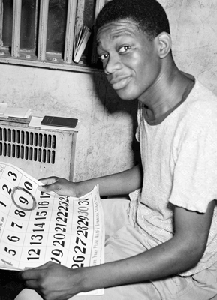
Willie Francis
The Autumn 2005 issue of the Southern Review and the book Mozart and Leadbelly (2005) both contain Ernest Gaines' essay "Writing A Lesson Before Dying." Quotes from the essay come from Mozart and Leadbelly. In the essay, Gaines talks about the process of writing the 1993 novel. Originally, Gaines wanted to set the novel in the early 1980s. However, after speaking with Paul Nolan about the Francis case, Gaines' vision started to change. Gaines writes, "There were so many similarities [between the Francis case and his previous works]--the work, religion, the food that people ate, everything. The case Paul recommended could have happened in the parish where I grew up" (53). Looking at Gaines' other works, this comment comes as no surprise. Francis resembles characters like Proctor Lewis in "Three Men" and Marcus in Of Love and Dust; the only difference, however, is that Jefferson dies in the electric chair at the end of the novel. Proctor and Marcus both have the opportunities to get bonded out of jail, Jefferson does not.

When thinking about Francis' case, Gaines says, "If I put the story in the forties, there was so much material I could use. . . . I could use the church school for background, the church where generations of my folks had worshipped and where I had attended school my first six years. I could use the crop as background. . . I knew the food the people ate, knew the kind of clothes they wore, knew the kind of songs they sang in the fields and in the church" (54). In essence, as stated earlier, the Francis case could have occurred in the parish where Gaines grew up. Along with talking about these items, Gaines also discusses Gruesome Gertie and its reputation, explaining how it traveled from parish to parish and how the generator caused it to be heard all over town.

Gruesome Gertie
Looking at the Francis case and Jefferson, some striking similarities arise. The state accused both men of murdering a white man, both had state appointed attorneys who did not really defend them, both were nearly illiterate, both were judged by a jury of twelve white men (no women or African Americans), both were condemned to die in the electric chair, and both wrote narratives about their experience (Francis' "My Trip to the Chair" and Jefferson's diary in chapter 29). One read through Francis' pamphlet solidifies the similarities even more. Francis says he wanted ice cream for his last meal, a priest told him to "stand like a man," he says the sheriff and deputies treated him well, and he concludes by stating, "Mr. Montgomery says that in writing this I may have helped someone, somehow. I hope so" (16). Jefferson's diary, and the mere fact that he walks to the chair upright, accomplishes the same things that Francis hoped his pamphlet would.


For more information on the Willie Francis case and A Lesson before Dying, look at Jason Stupp's "Living Death: Ernest Gaines's A Lesson before Dying and the Execution of Willie Francis" in Demands of the Dead: Executions, Storytelling, and Activism in the United States (2012). In 1982, the DePaul Law Review carried Arthur S. Miller and Jeffrey H. Bowman's "'Slow Dance on the Killing Ground': The Willie Francis Case Revisited."

Gaines, Ernest J. "Writing A Lesson Before Dying." Mozart and Leadbelly. New York: Vintage Books, 52-62. Print.