Showing posts with label a lesson before dying. Show all posts

Tuesday, June 23, 2015

The Confederate Battle Flag and Its Portrayal in Gaines's Work


The horrendous events in Charleston, SC, last week at the Emmanuel African Methodist Episcopal Church cannot be erased from our collective consciousness. Following the attack on the church and the killing of nine innocent African American victims, debates over a continued symbol of hate and prejudice arose. That symbol, of course, is the Confederate Battle Flag which flew at full staff over the Confederate Soldier Monument near the State House. The pole lacks a pulley system, and in order to remove the flag, it has to be approved by two thirds of the state legislature. Approval by any part of the state legislature appears absurd, but two thirds means that nothing can be done to the flag in question unless sixty six percent of the elected officials in the legislature approve it. The flag stands for the South, yes, but it stands for the South that oppressed and kept others in chains to benefit its own avaricious desires. It stands for a South that labeled Africans and later African Americans as chattel, property that could be treated however the owner saw fit. It stands for a Jim Crow society that decided "separate but equal" accommodations for African and Anglo Americans. It stands for a reminder of a South that continually saw African Americans and others as inferior to themselves and strove to maintain its power through violence, intimidation, and coercion. 

For today's post, I just want to show a couple of examples where the Confederate Battle Flag appears in Gaines's works and the characters's reactions to it. Reading through Gaines's works, the flag flies above the courthouse in Bayonne, and various characters encounter it. In "The Sky Is Gray," the eight year old narrator James does not know what to make of the flag. As his mother, Octavia, walks him through the streets of the town, he stares up at the courthouse and sees the flag at the top. "We come up to the courthouse, and I see the flag waving there," James says, "This flag ain't like the one we got at school. This one here ain't got but a handful of stars. One at school got a big pile of stars--one for every state" (93). Even though James doesn't realize its meaning, he differentiates the flag from the United States flag that hangs in the classroom in the quarters. James does not comprehend that the flag represents hatred, oppression, and subjugation and flies as a symbol of what some wished still existed. This is James's only contact with the Confederate Battle Flag in "The Sky is Gray." 


Grant, in A Lesson before Dying, discusses the flag in more specific terms. From the very beginning of the novel, the segregation of African Americans and whites becomes evident. Speaking about Jefferson's trial, Grant comments that Miss Emma "never got up once to get water or go to the bathroom down in the basement" (3). When grant comes to the courthouse in Bayonne himself, he describes it by saying, "A statue of a Confederate soldier stood to the right of the walk that led up to the courthouse door. Above the head of the statue, national, state, and Confederate flags flew on long metal poles" (68-69). Grant understands what the Confederate flag represents because he has lived in its shadow everyday of his life. Like Miss Emma, he must go to the fountain and bathroom in the courthouse's basement, he must wait endlessly for Henri Pichot to speak with him, and he must endure other forms of subjugation as well. Grant knows these things, but he feels he does not have any power to change them. Through teaching Jefferson, and his own students, he works to rectify the situation and to escape the shadow casts by the flag that waves above Bayonne's courthouse. 


Earlier in the novel, Grant recalls leading the Pledge of Allegiance to the United States flag in his classroom in the quarters. There, the students stood and addressed the Stars and Stripes. "The flag," Grant recalled, "hung limp from a ten-foot bamboo pole in the corner of the white picket fence that surrounded the church" (emphasis added 33). The key words here are "hung limp." While the Confederate flag, and others, "flew" above the courthouse, indicating movement and agency, the flag hanging on the bamboo pole along the fence only hangs limply, not moving at all. Past the limp flag, Grant "could see smoke rising from the chimneys in the quarter, and beyond the houses and the chimneys [he] could hear the tractors harvesting sugarcane in the fields" (33). As the flag dangles, listlessly, on the pole, Grant sees beyond it to the people who occupy the quarters and to their impending displacement to agricultural expansion. In this instance, the flag appears powerless because it does not move, failing to provide power to those who pledge their allegiance to it.  


There are other instances where the Confederate Battle Flag appears in Gaines's works, but the ones discussed above are two of the main ones. Gaines does not delve into the historical context of the flag, he lets it wave above the courthouse as a symbol of what African Americans had to endure in the South before, during, and after the Civil War. He confronts the flag, and the past it represents, in his writing by showing that those who lived under its reign survived with dignity and power. Others, like Frank Laurent and Miss Jane's mistress, pleaded for it to remain. As Miss Jane's mistress watched the Confederate soldiers march away from her plantation, she cried, “Sweet, precious blood of the South; sweet precious blood of the South” (5).  She does not want her way of life to end, and those who argue that the Confederate Battle Flag represents a heritage of the South, as Lindsey Graham notes in the clip below, resemble her in some way. 


The clip is from John Oliver's Last Week Tonight where he discusses the flag and the debate surrounding its presence in South Carolina and the South in general.  What are your thoughts on this topic? Let us know in the comments below.    


Gaines, Ernest J. The Autobiography of Miss Jane Pittman. New York: Bantam Books, 1972. Print.
Gaines, Ernest J. A Lesson before Dying. New York: Vintage Books, 1993. Print.
Gaines, Ernest J. "The Sky is Gray." Bloodline. New York: W. W. Norton & Company, 1976. 83-117. Print.

Tuesday, June 2, 2015

‘Deep in You:’ Encountering Gaines—Katharine Henry

Today's blog post comes to us from the Ernest J. Gaines Center's Summer Research Fellow from Cal State LA Katharine Henry. She will be with us at the center helping to transcribe manuscripts, conduct research, and encounter Gaines's works. In today's post, she speaks about her initial encounters with Gaines and his work. 


Katharine's Picture of the Miss Jane Pittman Oak

"Deep in you, what you think? Deep in you?" (A Lesson Before Dying 100)

My first encounter with Ernest J. Gaines’s literary work was earlier this year with A Lesson Before Dying (1993). In my undergraduate and graduate studies, I deeply admired the works of William Faulkner who became a gateway for my strong desire to explore more literature written by Southern authors, especially in Louisiana, a place whose astounding natural beauty was quite different from my native California desert and immediately captured my admiration. During my frequent travels from one “LA” (Los Angeles) to another (Louisiana), I was captivated by the unique culture of Acadiana and thrilled to discover another treasure in the region: a profound and extraordinary writer living near New Roads, Louisiana. Born and raised in Louisiana until he left at the age of 15 for California, Gaines returned decades later following what he stated as, “this Louisiana thing that drives me” (Rowell 87). I thought it special that I might have this small fact in common with Mr. Gaines, that we have moved back and forth between California and Louisiana. Turning the pages of A Lesson Before Dying, I was immediately drawn to its deceptively simple narration, vernacular dialogue and its compassion, each ingredient endowing the work with poetic power. Hungry for more stories like these, I pursued Gaines’s masterful storytelling through Catherine Carmier (1964), Of Love and Dust (1967) and Bloodline (1968).

When I consider one of the most powerful underpinnings of Gaines’s works thus far, I recall Reverend Mose Ambrose in A Lesson Before Dying. Concerned with the soul of Jefferson, a young death row inmate whose execution is set the second Friday after Easter, Rev. Ambrose emerges out of the darkness of Miss Emma’s kitchen to ask Grant Wiggins about Jefferson. He asks Grant, “What’s he thinking? What’s he thinking deep in him? Deep in you, what you think?” (100). There are levels of depth, not just deep, but deep deep, and those private ideas and desires that dwell within Grant, Jefferson and so many of Gaines’s characters are frequently in conflict with their community’s immediate needs for security. In Of Love and Dust, Marcus Payne is at war against the world once he is bailed from jail by a wealthy plantation owner and exchanges the imprisonment of his cell for indentured servitude. In return, Marcus seeks revenge on his unyielding Cajun overseer Sidney Bonbon and for whomever else may suffer in that scheme, he cares not. But when his vengeful plans to take Bonbon’s wife, Louise, materialize, his impulse towards her evolves immediately into a feeling the novel challenges us to accept as love. Marcus imagines and plans for a life lived with and for Louise, her daughter Tite and himself as husband and father. With Marcus we find that isolation is not the means to self-validation. Stripping ourselves from all people and things to recover a bare, authentic, solitary self is a fiction. Rather, getting to the soul, ‘deep in you,’ requires community with others so that Rev. Ambrose’s challenge to Grant, “You think a man can’t kneel and stand?”, proves itself true (A Lesson Before Dying 216).

The mode through which many of Gaines’s characters take a stand in their newfound dignity is through acts of love. While violence is at the start of Jefferson’s and Marcus’s journeys, Jefferson’s movement towards a love of self allows him to recognize that he is no hog and that he can stand, walk to and sit in the electric chair, fulfilling his godmother’s insistence, “I want a man to go to that chair, on his own two feet” (A Lesson Before Dying 13). The possibility of transforming the rules that place Jefferson in jail, Grant in the schoolhouse, Marcus on the plantation, and Louise on the porch into circumstances of love underlie Gaines’s self-described interest in exposing how one endures—and might still find possibilities to flourish—under pressure (Rowell 91).

Communities and individuals under an almost intolerable pressure are at the core of Gaines’s dramas. His work illustrates how the ways society sees us, and forces us to see each other, fails to be a language in which we can accurately describe a human person. One particularly powerful example is the mystifying and unsettling relationship between Bonbon and his black mistress Pauline Guerin in Of Love and Dust. Their affair begins forcefully and violently but Bonbon and Pauline quickly fall in love and have been in love for years. Marcus is baffled, as readers are, asking how she could love him. His anger that he cannot have Pauline for himself and his inability to understand her feelings manifests itself in savagery, he knocks her to the ground and denunciates her, “You white man bitch” (Of Love and Dust 98). Reenacting a denial of her agency akin to Bonbon’s initial cruelty, Marcus’s denunciation of Pauline is echoed twenty-eight chapters later when he recounts his youth where he observed that white man have their “number one nigger” who receives special treatment at the expense of other black men and women (250). For Marcus, Pauline holds this role as Bonbon’s mistress and mother to his twins. And she leverages their relationship and is promoted from a field hand to a more comfortable duty as cook in the big house. Her advancement results in the firing of Marcus’s godmother, Miss Julie Rand, who worked on the plantation for 40 years.

Pauline is Bonbon’s pawn and yet this coincides with the uncomfortable acknowledgement that the novel tells us in so many ways that the couple really is in love. Jim Kelly, the young narrator who is trusted and respected within the community, observes how intimate their feelings are. We can be skeptical of each character’s perspectives while simultaneously acknowledging that Marcus simplifies Pauline and Bonbon’s bond in ways that the narrative complicates for readers. In the novel we find that white and black communities accept that black female bodies are the property of men and tolerate sexual violence and yet cannot imagine interracial love. The rules dictate that men can do anything to black women but love them. When Bonbon leaves the plantation and Pauline follows so that they may live together as husband and wife, how do we come to terms with Marcus’s paradigm now? It seems insufficient to working through this complex relationship, especially when Pauline does not see herself as the passive, abused woman that Marcus demonizes her as. We are witnesses to what happens when one begins to see themselves as more than what society first allowed them to be—when Pauline loves Bonbon and endures Marcus’s violence, when Bonbon loves her and becomes the laughing stock of the town and when Louise leaves Bonbon to pursue a life with Marcus at the risk of her father and brothers forcefully dragging her back to her home. Perhaps we might consider the possibility that each person transforms a relationship that the rules deemed should have remained wholly exploitative and violent, into one of care? It’s a challenging and necessary discussion. We become Louise on the porch of her home, staring out to consider the agency and humanity of others at the same time they question and consider her own.

Gaines is a brave writer, writing with critique and compassion in equal parts, asking his readers to think deep about the apparatus which Jim calls “this big thing that said Yes” (Of Love and Dust 269) and which Munford Bazille in “Three Men” calls “they” (140). Yet rather than succumb to the doom inherent in facing this giant, Gaines writes with humanity about the “little people” who endure, acknowledge their participation in the making of tragedies and learn to kneel, stand, walk and sit with dignity like Jefferson (Of Love and Dust 258).

Gaines, Ernest J. A Lesson Before Dying. New York: Vintage, 1994. Print.
 ---. Of Love and Dust. New York: W.W. Norton & Company, 1979. Print.
 ---. “Three Men.” Bloodline. 159-220. New York: W.W. Norton & Company, 1976. Print.
Rowell, Charles. “This Louisiana Thing That Drives Me: An Interview with Ernest J. Gaines.” Conversations with Ernest Gaines. Ed. John Lowe. Jackson: University of Mississippi Press, 1995. 86-98. Print.

Katharine's Picture of Trees Surrounding Area Where
The Overseer's House Was on River Lake Plantation

Tuesday, March 3, 2015

The Importance of Art

Last week, Irvin Mayfield appeared at UL Lafayette as an artist in residence for three days. During that time, he spoke with students in various classes including literature and music classes, he performed with the UL Jazz Combo I and his quintet, and he strengthened my beliefs in the power of the arts and the humanities in society. This post could devolve into a lifelong look at how the arts have affected me throughout my life, but I'm not going to do that. Instead, I'm going to just make a few observations regarding my thoughts about the arts and humanities. He speaks about these ideas in his interview with Judith Meriwether on KRVS. 


To begin with, I've always felt that music resides at the pinnacle or artistic expression in regards to its ability to communicate emotion and feeling to not just an audience but to the performer as well. Without knowing the words, if there are any, a composition can move you in certain ways whether that's making you fell joy, sadness, anger, or any other emotion. At the concert last Tuesday and at the world premier of James Syler's Congo Square on Friday night, this belief struck home with me again. The Irvin Mayfield Quintet performed a piece from Dirt, Dust, and Trees entitled "Angola." The piece explores themes of struggle and persecution that appear in Gaines's works. Speaking about the song, Mayfield said that he asked Gaines why all of the heroes in his novels die, and Gaines replied by simply telling him that they must because they cannot live in a world that treats them the way that it does. "Anogola," which takes its name from the infamous Louisiana State Prison, reluctantly moves the listener through the pain and struggles of numerous individuals, mostly African American males, who are incarcerated in this country for no other reason than their class status or color.

I had heard this song once before at the Ernest J. Gaines Award for Literary Excellence ceremony; however, last week the piece carried a heavier weight for me, not because of anything different since the first time I heard it performed a month earlier, but because of the sounds that evening. It opens with just the drum for a few measures then the piano and bass enter creating an ominous, almost desperate feel. Sitting in Angelle Hall, the Jamison Ross started the song, and all I could notice was that when he hit the bass drum, the snare drum, and the hi hat the sound left the stage, traveled to the back of the auditorium, then returned, albeit a little quieter. At that moment, my mind shifted to Marcus standing before Bonbon's horse in the fields, to Jefferson, feeling like a hog, in the jail cell in Bayonne, to Charles Blow's son being accosted by police at Yale, to mothers and fathers having to tell their sons to keep their hands on the wheel when being pulled over just because of the color of their skin, to rappers being pulled over by police-again because of their skin. The list could go on, and on, and on, and on. Once Max Moran's walking bass line and Joe Ashlar's piano introduced themselves, I began to drift, and get lost, not even recalling much of the song until Irvin and trombonist Michael Watson blared on their horns and brought me out of my thoughts back to that jail cell in Bayonne, a fictional jail cell, where Jefferson anguishes about what has happened and what will eventually happen to him. Jefferson screams in that cell, wanting to be recognized as a man, a person, a human being with thoughts and ideas. He gets that recognition, from Grant, from Paul, and from others, but not until he sits in Gruesome Gertie and perishes. That is what the sounds coming from the stage that night did for me. That is what they said to me at that moment. 


On Monday, Mayfield spoke with an English class about art and its importance. Constructing the class around a conversation, he asked the students to help him define words such as "idea" and "event." As the class progressed, other words appeared and entered the conversation. At one point, the discussion moved towards what constitutes creativity and art; here, the question of whether or not the building the students were sitting in should be considered a form of creative expression. Some students looked puzzled, and others agreed that it should. As the conversation moved towards the planning of cities and neighborhoods, then to the French Quarter and its history, I thought about what architecture says about the society, and specifically I thought about the Louisiana State Capital. I've written about the capital on this blog before, but what I did not mention is the fact that the capital contains numerous carvings relating to Louisiana history. One aspect of that history that does not appear is slavery. There are images of settlers interactions with Native Americans and of what appear to be slaves, but could be share croppers, in the fields. However, there are no images of slave auctions, scourging, of other aspects. History contains the good and the bad, and shouldn't both be exposed lest we forget where we came from? 


Continuing my thoughts about the capital, I had an opportunity to speak with Mayfield at a reception and he started discussing how corporations and the government use art to control. That's why we don't have those images in the state capital. Think about at MLB, NBA, and NFL games. What does art have to do with these events? At each one, every night, someone performs "The Star Spangled Banner." Why? The singing of our national anthem began in earnest in sports in the seventh inning of the first game of the 1918 World Series between the Boston Red Sox and the Chicago Cubs. Why is this important? It's important because America, 17 months earlier, entered World War I. The anthem became a patriotic rallying cry, as we saw after September 11. Once the owners realized that people responded to the song, they began to have it performed again and again. I'm not saying that the anthem is a bad thing; I am only saying that we need to think about how art and artistic expression relate to events that we may not even consider them being a part of and what that incorporation means. The NFL started to get bigger after a couple of specials on NBC that had artistic merit and led to the creation of NFL films. It brought the game closer to the fans by making it personal and artistic.     


With all of that said, I want to leave you with a couple of parting thoughts and questions. What teachers do you remember from your educational career? For me, it's the English teachers. Granted I'm in English, but those are the teachers I remember the most. It can't be a coincidence that others, who do other things, remember them as well. Liberal arts matter. College should, as Frank Bruni says in "College's Priceless Value: Higher Education, liberal Arts and Shakespeare," work to make us better citizens. Literature, and all art, opens our eyes to those around us, that we may see, but more often than not, that we don't see. It relates the human condition to us, and as I have had students tell me, in Bruni's words, "It informed all my reading from then on.

Part of studying literature, art, history, music, etc, is to learn how to see through the noise and make up your own mind about issues and ideas instead of listening to the same old rhetorical bombast and idiocy that spews from the mouths of those that want to either hold on to their power or to grab a piece for themselves. It forces you, sometimes reluctantly, to take the red pill, opening you up to realities that either eluded you or you ignored. Your stomach will wrench, your eyes will cry, your mouth will laugh, and your ears will hear. Most importantly, your heart will expand by studying the liberal arts. 


As I am fond of quoting James Baldwin on this topic, "You think your pain and your heartbreak are unprecedented in the history of the world, but then you read. It was books that taught me that the things that tormented me were the very things that connected me with all the people who were alive, or who had ever been alive."

Thursday, November 20, 2014

The Little Stream: An Early Draft of Catherine Carmier

Box 1-Folder 7 The Little Stream
In preparation for the Second Annual Ernest J. Gaines Lecture tomorrow by Dr. John Lowe, I would like to take the time to do a quick post on one of the early drafts of Catherine Carmier. The draft, entitled The Little Stream, shows Gaines working on his craft, honing it to make it tighter. The draft does not contain the fluidity of the finished novel, but it does shine a light on Gaines' evolution as a writer. The narrator of The Little Stream is third person omniscient, for the most part. At some points within the manuscript, the narration shifts to first person. At times this occurs abruptly, at other times it appears rather seamless and fluid. One such instance occurs in chapter 9 when David (Jackson in the finished novel) goes to church with his Aunt Charlotte. David sits in the back of the church, not wanting to be involved with the service, but just going, partly out of respect for his Aunt. The narrator begins in third person, saying, "He did not relax until an old woman sitting beside his aunt began a song" (141). Immediately after this sentence, the next paragraph switches, without cues, to a first person point of view and we see David's thoughts as the church service commences. The paragraph begins, "Nothing has changed. I got a glimpse of the water cooler as I came in" (141). This shift occurs almost seamlessly, and it can be seen in the picture of the manuscript above.

Along with the shifts in point of view throughout the draft, themes and locations that permeate Gaines oeuvre can be seen throughout as well. One such location appears in the paragraph mentioned above. David, while sitting in the back of the church, begins to think about attending school in the church house as a youngster. Thinking about standing in front of the class and writing on the blackboard while the teacher taught another class, he intones, "Primer, First, Second, Third, Fourth, Fifth, Sixth, Seventh, Eighth--all for one man to teach. How did I do it? How? How could anyone learn anything[?]" (141). David's thoughts here prefigure Grant's thoughts about his teaching condition in A Lesson before Dying (1993). Watching the older boys chop and saw wood as the younger students learn lessons inside the school, Grant ponders whether or not he is actually teaching them, anything. He asks,
What am I doing? Am I reading them at all? They are acting exactly as the old men did earlier. They are fifty years younger, maybe more, but doing the same thing those old men did who never attended school a day in their lives. Is it just a vicious circle? Am I doing anything? (62) 
Continuing this train of thought, Grant thinks back to his classmates, commenting that they had "Gone to the fields, to the small towns, to the cities--where they died" (61). Grant's thoughts here mirror David's from The Little Stream. Both ponder the role of education in the quarters and whether or not it provides anything more than a holding place for students before they go to work in the fields.

After thinking about his own students and classmates, Grant begins to recall his own teacher, Matthew Antoine, and his thoughts on teaching in the quarters. Speaking with the teacher right before his death, Grant says that he asked for advice on teaching in the quarters. Antoine simply said, "Just do the best you can. But it won't matter" (66).  Even though David is thinking about his childhood and questioning how he learned anything in a school like the one he attended, and Grant is thinking about his education and his current position, their sentiments are similar in the fact that they both see the educational opportunities in the community as extremely impoverished. Both David and Grant represent, as well, "the one," like Ned Douglass and Jimmy Aaron, who returns to educate the children. Unlike Douglass and Aaron, David and Grant question their return and whether or not they actually have any impact on the children at all.

The final aspect of the manuscript I want to briefly mention occurs in chapter 6. As Aunt Charlotte unpacks David's suitcase, she discovers a revolver. This is interesting, at least to me, because while guns appear in Gaines' work, I cannot think of instances, if any, where an African American male carries a gun, except for maybe In My Father's House and A Gathering of Old Men. While talking about the gun with David, Aunt Charlotte continually asks him what it is for. He simply replies that it is for protection and that a friend of his in California gave it to him for that very reason. The argument between Aunt Charlotte and David moves into the subject of manhood, and Aunt Charlotte says, "you think you a man, now" because you have a gun (81). David replies, "I am a man" then rattles off that Uncle Sam calls him a man at twenty-one (81). This conversation is interesting because it revolves, essentially, around the definition of manhood. Elsewhere, the topic of manhood appears with the differences between Lil'Bud (Brother in the published novel) and David. The continued struggle of how to achieve manhood, or to define it, appears in these early drafts as it does throughout Gaines' work. For a discussion of manhood in "The Sky is Gray," see the post "You a man, James" post on this blog.

These are just a few of the items I noticed in one of about five early drafts of Catherine Carmier. I have not read all of the early manuscripts, so I cannot comment on all of them. Tomorrow, Dr. John Lowe will comment on some of these drafts and explore how Gaines' first novel evolved from its earliest incarnations to the finished text it is today. Make sure to join us.

Gaines, Ernest J. A Lesson before Dying. New York: Vintage Books, 1993. Print.


Thursday, October 30, 2014

Aunt Augusteen Jefferson

Miss Augusteen Jefferson
In 1971, Gaines dedicated The Autobiography of Miss Jane Pittman to three people: his grandmother Mrs. Julia McVay, his stepfather Mr. Ralph Norbert Colar, Sr., and his aunt Miss. Augusteen Jefferson. All three individuals had a profound impact on his life, but in this post, I would like to speak about the impact that Gaines' aunt Augusteen had on him. Last post I discussed the symbolic nature of the butterfly in A Lesson before Dying and how when Gaines and his wife, Dianne, were walking through the cemetery a butterfly kept returning to the same spot, again and again. Gaines does not know where his aunt is buried, and Dianne intoned that the butterfly appeared to be alighting on the same spot as if to point out the place were her body resides.

After Gaines' mother and stepfather left for California during World War II, his Aunt Augesteen looked after Gaines and his other siblings back in Louisiana until he followed his parents to California. Of this woman, Gaines continually mentions that even though she could not walk she performed all of the tasks necessary to raise Gaines and the rest of the children under her care. She would slide down the steps of the house and work in the garden. She would cook, clean, and do all of the housework needed. When she needed to discipline Gaines, she would whip him. Gaines says, "She could whip hard. I had to go out and break the switch, bring it to her, kneel down, and get my whipping" (50-51). Since she could not go to other people's houses easily, the people in the quarters would come to her house and gather on the porch to talk, and talk, and talk. Gaines would serve them coffee and listen, taking in their stories and speech.     

Along with listening to the people on the porch talk, Gaines read and wrote letters for the people in the quarters. His aunt "made sure" he did this for them. This experience gave Gaines, as Patrica Rickels says, "a feeling for the flavor of their language" and provided him with the sound of the people he wanted to capture (121). Talking about these experiences, Gaines mentions,
I would go to these people and read their letters for them and write their letters for them. In most cases they didn't know how to form the letter. They'd give me a little piece of paper, you know those small, yellow tablets and pencil and say, "Tell Viney" o r"Tell Clara I'm all right. we're doing ok., and the garden's all right." Something like that. Then I would have to form the letter. I'd just write it, and re-write it, and re-write it until I got it right. Then I'd read it back to them. (Rickels 121) 
Writing those letters, in a way, served as an apprenticeship for Gaines' literary career. They provided him wit the opportunity, just as his aunt's porch did, with getting "the sound of my people talking" down on paper. This, of course, is what we see in his novels.

I want to conclude this post briefly with a quote from Sister Mary Ellen Doyle in regards to whether or not Gaines' Aunt Augusteen is in fact a direct correlation to Miss Jane Pittman or not. Gaines continually states that his Aunt is not Miss Jane; however, his Aunt did serve as the moral model for characters like Miss Jane and Aunt Fe in "Just Like A Tree."  As Doyle puts it,
Augusteen Jefferson was the moral model of Jane Pittman and other older women in his fiction; like Jane, she embodied that element of life in the quarters that chiefly caused "J" Gaines to become Ernest J. Gaines the writer--oral tradition. Because Miss Augusteen could not walk, the folk came to her for the visits and long conversations that were their principal recreation. J served them tea or lemonade; he also sat and listened to them talk of old times. (16)
The influence of Aunt Augusteen can be seen throughout Gaines' career. As Doyle puts it, her influence helped to move him from being a precocious young boy to the writer and man he is today. She has served as an inspiration for Gaines, and continues to do so, because she showed him how to have dignity and moral strength.

Doyle, Mary Ellen. Voices from the Quarters: The Fiction of Ernest J. Gaines. Baton Rouge: Louisiana State University Press, 2002. Print.
Ingram, Forrest and Barbara Steinberg. "On the Verge: An Interview with Ernest J. Gaines." Conversations with Ernest Gaines. Ed. John Lowe. Jackson: University of Mississippi Press, 1995. 39-55. Print.
Rickels, Patricia. "An Interview with Ernest J. Gaines." Conversations with Ernest Gaines. Ed. John Lowe. Jackson: University of Mississippi Press, 1995. 119-136. Print.  


Tuesday, October 28, 2014

The Butterfly

I have already posted about the execution of Jefferson and on the disrespect that Grant receives in A Lesson before Dying. These pots leaned more towards the emotionally draining aspects of the novel that make the reader reflect on the racism that inhabits this world and the ability to overcome that oppression. With this post, I would like to draw your attention towards a scene near the end of the book that, while containing heavy emotions, creates an uplifting image among the anguish of the final pages. This small scene may appear innocuous at first, but it contains a lot of symbolism for the novel and for Gaines himself.

In the final pages, Grant leaves his students praying for Jefferson in the schoolhouse and goes outside to meditate about what is happening downtown and awaiting news on Jefferson's execution. Grant says:
Several feet away from where I sat under the tree was a hill of bull grass. I doubted that I had looked at it once in all the time that I had been sitting there. I probably would not have noticed it at all had a butterfly, a yellow butterfly with dark specks like in dots on its wings, not lit there. What had brought it there? There was no odor that i could detect to have attracted it. There were other places where it could have rested--there was the wire fence on either side of the road, there were flowers just a short distance away in [Henri] Pichot's yard--so why did it light on a hill of bull grass that offered it nothing? I watched it closely, the way it opened its wings again, fluttered, closed its wings for a second or two, then opened them again and flew away. I watched it fly over the ditch and down into the quarter, I watched it until I could not see it anymore. (251-252)
Butterflies symbolize rebirth and resurrection, and immediately after describing the butterfly resting of "a hill of bull grass," Grant simply says, "Yes, I told myself. It is finally over" (252). The butterfly symbolizes Jefferson, after death, and his release from the oppressive society that ultimately killed him for simply being black. It also symbolizes a sort of unification between Grant and Jefferson. The butterfly finds Grant and perches itself next to him instead of a "wire fence" or across the road. Throughout the novel, Grant intones that instead of Jefferson sitting in a jail cell awaiting execution it could have just as easily been him.

While the butterfly plays an important role in the novel, this scene also plays an important role to Gaines personally as well. Walking through the sugar cane fields around River Lake Plantation with his wife, he showed her the cemetery where his ancestors and the community he left are buried. The cemetery, as I have explained before, is an important reservoir for Gaines. Gaines' Aunt Augesteen Jefferson is interred there; however, he does not know where she resides because there is no headstone to mark her grave. Gaines' aunt, as he has said repeatedly throughout his life, raised him till he left for California and inspired him tremendously. She could not walk, so she crawled everywhere. She did everything herself, and people would come to her house and sit on the porch an talk, and talk, and talk.

As they walked through the cemetery, Gaines and his wife noticed a butterfly that kept perching itself in a certain place. It would fly away then return. Upon seeing this, Dianne suggested that the butterfly kept alighting on that specific spot because that is where Gaines' aunt is buried. Eventually, Gaines retrieved a camera he had and took a picture of the butterfly. When working on This Louisiana Thing That Drives Me with Dr. Marcia Gaudet, Dr. Reggie Young, and Dr. Wiley Cash, the picture he took of the butterfly was the one picture he wanted in the book. It concludes the books and is displayed with the paragraph above from A Lesson before Dying.  

Gaines, Ernest J. A Lesson before Dying. New York: Vintage Books, 1993. Print. 

Tuesday, September 23, 2014

Film Version of "A Lesson before Dying"

Last week, to kick off the celebration of the 50th anniversary of Ernest Gaines' first novel publication, Catherine Carmier, Dr. Matthew Teutsch and the Ernest J. Gaines Center's graduate assistant Jennifer Morrison appeared on KRVS's Apres Midi and WRKF's The Jim Engster Show. Follow the links above to listen to those interviews.

Last Wednesday, the center kicked off it's events with the film showing of The Sky is Gray at Lafayette Public Library's South Regional Branch. Tomorrow night (September 24), there will be a film screening and discussion of the film version of Gaines' 1993 classic A Lesson before Dying. The film earned two Emmy's in 1999 for Outstanding Made-for-Television Movie and for Outstanding Writing for a Mini-Series or Movie. Around the same time as the film's premier, playwright Romulus Linney, in 2000, premiered the stage adaptation of A Lesson before Dying at the Alabama Shakespeare Festival. A video of him discussing the adaptation is below.

A Lesson before Dying, as has been discussed on this blog previously, is an important book. It was chosen, in 1997, to be part of Oprah Winfrey's Book Club, and it won the National Book Critic's Circle Award in 1993.

Make plans to join us to celebrate the 15th anniversary of this monumental film. Details of the upcoming events can be found on last Tuesday's blog post.


Thursday, September 11, 2014

"Save me, Joe Louis!"

Recalling an execution he read about in Florida, Grant Wiggins thought about the "boy" being dragged to the electric chair. The boys continually screamed, "Please, Joe Louis, help me. Please help me. Help me" (91). Louis never came, and the boy, jolted by the electric current, died. In his 1964 book Why We Can't Wait, Martin Luther King Jr. related the same story, albeit with the gas chamber instead of the electric chair:
More than twenty-five years ago, one of the southern states adopted a new method of capital punishment. Poison gas supplanted the gallows. In its earliest stages, a microphone was placed inside the sealed death chamber so that scientific observers might hear the words of the dying prisoner to judge how the human reacted in this novel situation.
The first victim was a young Negro. As the pellet dropped into the container, and the gas curled upward, through the microphone came these words: "Save me, Joe Louis. Save me, Joe Louis. Save me, Joe Louis..." (129)
Continuing, King states that the boy's helplessness led him to look for someone who cared and he called out to Joe Louis, "[n]ot God, not government, not charitably minded white men, but a Negro who was the world's most expert fighter, in this last extremity, was the last hope" (129). This event, however, never actually happened.

In a November 7, 2005 article entiled "Save me, Joe Louis!" for the Los Angeles Times, David Margolick talks about the true story behind this apocryphal anecdote. It turns out that story originated with an article in The Daily Worker that recorded the execution of Allen Foster, a 19 year old North Carolinian charged with the rape of a white woman in 1936.While chained to the chair in the gas chamber, wearing boxing shorts and shivering with cold, Foster did not call out, "Save me, Joe Louis!" Instead, he spoke of sparring with Louis in Birmingham, AL before Louis became famous. Margolick, in Beyond Glory: Joe Louis and Max Schmeling, and a World on the Brink, mentions that no record indicates that Louis visited Birmingham when Foster claimed that he did and that Foster's mom said her son was "half crazy."    

What does all of this say about the construct of myths and their importance? Obviously Joe Louis held a place in the African American consciousness as I've talked about before. Could that be the reason why The Daily Worker chose to have Foster call out to Louis before his execution? Why does Gaines include a form of this story in A Lesson before Dying? Is it because the community saw Louis as a hero and vicariously defeated oppression when he won? All of these are questions worth thinking about and exploring. As usual, post comments below.


Gaines, Ernest J. A Lesson before Dying. New York:Vintage Books, 1993. Print.
King Jr, Martin Luther. Why We Can't Wait. Boston: Beacon Press, 2010. Print.

Tuesday, August 5, 2014

Jackson, Community, and Teaching

Speaking with Michael Sartisky in 1993, Gaines relates that many African American teachers fell into the profession because someone pushed them in that direction. These teachers were not good teachers, not even mediocre. They wanted to do something else entirely; however, they couldn't because of the racial conditions  that only provided limited opportunities. Moving on, Gaines comments on Grant's return in A Lesson before Dying. He says, "And Grant wants to leave, just wants to get away from it all and yet when he does, he has to come back again. There's that thing that keeps pulling him back. There's that thing that keeps Catherine Carmier from going. There's that thing that keeps Miss Jane from being able to reach Ohio" (274). Gaines says he cannot explain this inexplicable drive to return to Louisiana. I would argue, at least for Grant , Ned, and Jackson, that the desire has to do with the community.

When Jackson returns home after receiving his education in California, Aunt Charlotte becomes excited because she believes he has returned for good to educate the children in the Quarters. His return, however, is for Catherine, not for the children. One of Jackson's struggles throughout the novel is how to tell his Aunt that he does not want to teach and that he wants to leave. He has respect for her and he fears how his decision will affect her. Speaking with Jackson, Aunt Charlotte tells him that nobody else has ever gone as far as he has and that every family needs to have someone who "do something;" for Aunt Charlotte, Jackson is that someone: "But I just want you to know . . . you all they is left, Jackson. You all us can count on. If you fail, that's all for us" (98). Jackson serves, as Grant does, as a "groomed" leader for  the community, one who will educate and uplift.  To a certain extent, Jackson resents this; he tells his Aunt after she questions him about whether or not he still goes to church and believes in God, "You sent me there. . . . I didn't want to go. I cried, I cried to keep from going. So I went. You wanted me to study, so I did" (100). After telling her that he plans to leave, Charlotte faints and while recovering begins to think about the sacrifices she has made: "She had sacrificed too much of herself for him. She had hoped, prayed, waited too long for him to come back just to see him turn around and leave her like this" (169). Aunt Charlotte sets Jackson up as a community leader, one that Jackson does not want to be. Jackson, though, does feel a tie to the community because he does not want to hurt his Aunt or others. However, he does just that.

Jackson's move to California for school opened his mind but it also alienated him from the people back home. He cannot believe as his Aunt does and the others in the Quarters. In many ways, Jackson's place in the community is similar to Raoul's. He is stuck in between two poles: educated and uneducated. After describing how the Cajuns looked at Jackson, the narrator describes how other "Negores" in the community view him: "No, they were no better than the Cajuns. Just as bad. Behind his back they called him 'Mr. Stuck-Up.' He was not 'Mr. Stuck-Up'; he could not think of anything to talk with them about" (175).Even Mary Louise, who Jackson grew up with, becomes alienated from him partly because of his education. She notices that he has been reading and asks him what the book is. Jackson tells her it is a book of Greek poetry; she picks the book up and looks through it: "She had no idea what any word meant, and she looked at him and smiled. He smiled back, assuring her that it really didn't matter" (169).

Throughout Catherine Carmier, Jackson struggles with his place in the community and with his future. He thinks, at points, that he will have to settle down and become a teacher, especially if Catherine decided to leave with him. However, he thinks to himself, "How could he teach when he did not believe in what he was teaching?" (186) As stated earlier, teaching, in the South, was one of the only professions open to someone like Jackson. Would Jackson have made a good teacher? We don't know because we never see him in the classroom, unlike Grant. If he did enter the classroom, would he be similar to Grant, harsh towards his students but eventually learning from them? Would he succumb to the mind-numbing thoughts of nihilism that nothing but pain and suffering await the students he teaches? In the comments, let me know what you think.


Gaines, Ernest J. Catherine Carmier. New York: Vintage Books, 1993. Print.

Sartisky, Michael. "Writing about Race in Difficult Times: An Interview with Ernest J. Gaines." Conversations with Ernest Gaines. Ed. John Lowe. Jackson: University of Mississippi Press, 1995. 253-275. Print.

Thursday, July 24, 2014

Year of Anniversaries


The picture above is one of the display cases in the Ernest J. Gaines Center. It contains items representing four of the major anniversaries related to Gaines and his work this year. From left to right in the case you will see a first edition copy of Catherine Carmier (1964) and a notebook containing one of the first drafts entitled "Barren Summer." Next, there is a first edition copy of The Autobiography of Miss Jane Pittman (1971), a pamphlet celebrating the opening of the Miss Jane Pittman Fountain, and a Miss Jane Pittman Fountain pen. In the center is the National Medal of Arts award that Gaines received in 2013 and immediately below is a two page grant application for The Autobiography of Miss Jane Pittman where Gaines outlines what the novel will be about. On the right is the promotional booklet for HBO's 1999 film version of A Lesson before Dying and a photo and write-up from CBS's 1974 film version of The Autobiography of Miss Jane Pittman.

The four anniversaries are:
  1. The 50th anniversary of the publication of Catherine Carmier (1964)
  2. The 40th anniversary of the film version of The Autobiography of Miss Jane Pittman (1974)
  3. The 25th anniversary of the Miss Jane Pittman Drinking Fountain in Rochester, NY (1989)
  4. The 15th anniversary of the film version of A Lesson before Dying (1999)
Over the next few posts, I will take the time to discuss these anniversaries and their significance, not only to Gaines as a writer but also to culture as a whole. So, stayed tuned, and remember, join in the discussion below in the comments.  

Tuesday, July 22, 2014

The Power of the Word

A few years ago, I taught at an "alternative" school in rural North Louisiana. I've grown to dislike the term "alternative," but that is what it was. While there, I continually dreaded going to work, for various reasons. However, I grew to understand, even more than I already did, that my role as a teacher involves much more than just presenting students with facts and figures. It involves helping students navigate the paths laid out before them. This isn't always easy, especially if I never had to navigate the same paths myself; however, that is where books come in. Books, specifically fiction, provide an escape from reality and also a connection with it. They provide opportunities to learn about the world around you and maps to help you navigate that world. 

Words have power. In a 1983 interview, Gaines said, "I love words, I love looking at words, I love those 26 letters. In my writing, I try to develop character. That way I can learn something about your own character from reading. Millions of people have read Miss Jane or seen the movie, and whether they know it or not, I think that little old lady has done something to their lives" (New Wings, January 1983). In fact, after the publication of The Autobiography of Miss Jane Pittman, news outlets and others kept asking to interview Miss Jane. Gaines' character became a "real" person to the readers. They connected with her in a way that made her come out of the graveyard and live. 


Now, back to that school in North Louisiana. I brought books from home to the school, and one of those books was Gaines' A Lesson before Dying. Looking at most of the students there, I could see that they wanted something. What that something was, I don't know. One student in particular, a student who thought deeply, provided the others with a sort of compass for the period he was there. At some point, I gave him a copy of A Lesson before Dying. Soon after, I asked him if he had read it. He said he was really enjoying it.  The next day, however, he received a second infraction then left the school. for good If a student had multiple infractions, he or she would be removed from the school and expelled for the year.I don't know what effect, if any, Gaines' book had on this young man. I'd like to think that it had some effect, but I can't be sure.


Teaching can be both a rewarding and heartbreaking endeavor at the same time. I've experienced both of these poles on numerous occasions. While I don't know what happened with the student at the school in North Louisiana, I do know what happened to a student I taught in college. A group of middle school student from Shreveport came to the center. The students were taking the day to visit three universities in Louisiana and UL Lafayette was one of them. While touring the center, one of the chaperons approached me and asked if I remembered her. I told her I didn't. She went on to inform me that I had taught he in her freshman composition class at UL Monroe. In that class, I asked the students what there major was and why. Hers was pharmacy. After seeing her writing, I asked her if she ever thought about going in to English as a major. She said she remembers thinking at the time, "This guy doesn't know me. Why would he suggest that?" The next semester, she changed her major to English. Now, she has her MA in English, teaches at the university, and  may pursue her PhD. Even though it was a writing class and not a literature class that affected her, I would say that the overall idea of words as power holds true.    

I'll conclude with this quote from James Baldwin on books, and I would add writing as well. I think it encapsulates the way I feel about them and the way we should view them. "You think your pain and your heartbreak are unprecedented in the history of the world, but then you read. It was books that taught me that the things that tormented me were the very things that connected me with all the people who were alive, or who had ever been alive." 


Thursday, July 17, 2014

"I was crying."

A Lesson before Dying concludes with a simple, three word statement from Grant: "I was crying" (256). Gaines' works deal with manhood, and the achievement of manhood. A Lesson before Dying focuses on Jefferson gaining the strength to walk like a man, and not a hog, to the electric chair. The novel even traces Grant's movement towards manhood. What does crying have to do with the stereotypical view of manhood that society and the media has concocted for us? If we go by the constructed prescription of manhood, crying has nothing to do with it. In fact, crying represents the opposite of manhood. Speaking with John Lowe in 1994, Gaines said, "I think that we think that being a big tough guy, like a football player, or a bully, is being a man" (321). However, this is not the case according to Gaines. Manhood involves taking responsibility: "This is the responsibility of man; taking responsibility for the whole, all humanity, is what I think manliness is" (321). Thinking about Grant in this aspect, he starts to, throughout the novel, take responsibility for the whole. The novel concludes with him in front of his students after Jefferson's execution. He knows that he has a responsibility to the community and to those students to not let Jefferson's death be in vain or forgotten.

Gaines' short story collection Bloodline (1968) can be read partly as a short story sequence that traces the growth of a boy through manhood, even though characters do not repeat in the stories. Crying can be seen throughout the stories, and the majority of the time the ones crying are either boys or men. In "A Long Day in November," Sonny cries when he pees himself at school, and Eddie cries when Gran'mon shoots at him: "We all run out on the gallery, and I see Daddy out in the road crying" (35). Eventually, Eddie realizes that in order to get his wife back he must grow up. He burns his car and Gran'mon says, "I must be dreaming. He's a man after all" (71). Near the end of the story, Amy forces Eddie to grow up and take responsibility for Sonny's education by going to the school and speaking with the teacher. Eddie's crying works towards his realization that he needs to take "responsibility for the whole," not just for himself.

James, in Bloodline's second story "The Sky is Gray," tries his hardest not to cry because he believes it shows weakness and will lower his mother's perception of him. He knows that he must be strong not only for himself but for her as well. At the beginning of the story, he says,
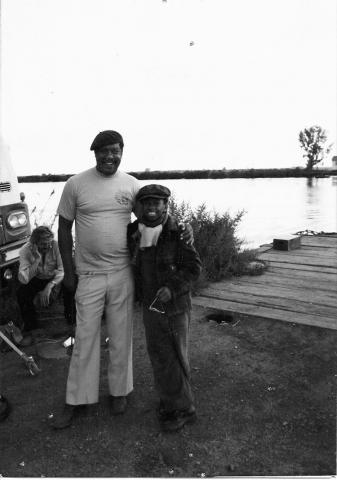
Gaines with James Bond III (Jimmy in film)
I make 'tend I ain't [sacred of ghosts] 'cause I'm the oldest, and I got to set a good sample for the rest. I can't ever be scared and I can't ever cry. And that's why I never said nothing 'bout my teeth. It's been hurting me and hurting me close to a month now, but I never said it. I didn't say it 'cause I didn't want act like a crybaby, 'cause I know we didn't have enough money to go have it pulled. (84) 
Later, as Jimmy and his mother leave the dentist's office, the sleet begins to really fall. Jimmy says, "I look at Mama standing there. I want stand close 'side her, but she don't like that. She say that's crybaby stuff. She say you got to stand for yourself, by yourself" (105-106). Throughout the story, Jimmy learns to stand by himself. He learns to take responsibility and how to mature into manhood. The only time he physically cries is when his mother whips him for not killing the birds. Even in this instance, his crying occurs during a lesson that his mother is trying to teach him, how to stand by himself.

In the third story from Bloodline, "Three Men," Procter Lewis can be seen crying after he decides to take Munford's advice to not let Roger Medlow bail him out of jail. Procter says he got up on the bunk and looked out at the stars. While looking at the heavens, he says, "I felt my throat hurting. I felt water running down my face. But I gripped my mouth tight so I wouldn't make a sound. I didn't make a sound, but I cried. I cried and cried and cried" (151). Even though he cries in his bunk, the paragraph ends with Procter affirming that he "wanted to stand. Because they never let you stand if they [bailed] you out" (152). Procter takes Munford's advice and goes to the pen standing so other will see him as an example. He takes "responsibility for the whole."

This post will possibly turn into something more down the line, but for now I hope it provides you with a little idea concerning manhood and the achievement of it in Gaines' writings. Please leave any thoughts on this topic or on previous topics in the comments below.

Gaines, Ernest. Bloodline. New York: W.W. Norton, 1976. Print.
Gaines, Ernest. A Lesson before Dying. New York: Vintage Books, 1993. Print.
Lowe, John. "An Interview with Ernest Gaines." Conversations with Ernest Gaines. Jackson: University of Mississippi Press, 1995. 297-328. Print.

Wednesday, July 9, 2014

University of Houston-Downtown's "Read Out" for A Lesson before Dying

Posters at the "Read Out"
Yesterday, I had the opportunity to take part in the University of Houston-Downtown's Center for Critical Race Studies' "Read Out" for A Lesson before Dying. The event brought together university professors, college students, high school and middle school students, librarians, and other community members. Participants heard encouraging words about the importance of books, education, and defining yourself from Dr. Vida Robertson and Dean DoVeanna Fulton. After these introductory words of encouragement, the participants broke into small groups for discussions on the novel.

I had the opportunity to walk around to the various groups during this period, and what I heard inspired me regarding the power of the written word. A professor and college student volunteers led each group, and each one had its own unique dynamic. One group encountered more a of a lecture type setting while another could be seen sitting around in a large circle discussing how the participants either define themselves or let others define them. Among the varying settings, students and group leaders broached important topics that arose throughout the novel and how those topics relate to their own day-to-day experiences. One group talked about the setting of the novel, the late 1940s in the Jim Crow South, and how the setting occurred less than 100 years after the "end" of slavery in the United States, seeing the residual effects that slavery has had on our society. Another group talked about defining yourself, and the group brought up the defense attorney's comments where he calls Jefferson a "hog" from the beginning of the novel. Along with these topics, one of the groups discussed the issue of colorism in the novel and that led to them speaking about whether or not colorism still exists or not and whether or not anyone had experienced it. Finally, one group spoke about the creation and destruction of myths and mentors, helping students understand that others work to define them and to comprehend the importance of figures in their life that they can look up to for support and guidance.

After the group discussions and lunch, I had the opportunity to speak with the participants gathered. I spoke broadly on the Ernest J. Gaines Center, Gaines' influences, his global prominence, the land he writes about, and some historical context for the novel. Throughout the day, the participants received much more than just a book discussion. They were able to experience how a novel that takes place in the past can affect and speak to us in our own present lives. Ultimately, the "Read Out" showed participants that books truly do create an "identification" with the character(s), to borrow a term from Kenneth Burke. Dr. Robertson told the participants that all writing is, at its core, a political act, and I would say a rhetorical one. Gaines himself even says as much. When talking about what he wants readers to get out of works, Gaines says:
Number one, I would want the black youth to say, "Hey, I am somebody," and I'd want the white youth to say, "Hey, that is part of me out there, and I could understand myself truly if I can understand my neighbor, if I can understand the person around me." That's the only way one can understand himself, if he can understand other things around him. You know Donne's "No man is an island" and "Don't ask for who the bell tolls"--every little piece of things around us makes us a little bit whole. I mean we can go through the world being half people, and most of us do that most of our lives. But in order to understand more about ourselves and the world, we must understand what's around. So that's what I'd want: the white kid to understand what the black kid is, and the black kid to understand who he is. (Gaudet and Wooton 215-216)
Dr. Robertson concluded by reading Claude McKay's "If We Must Die," a poem he wrote after World War I and in response to the Red Summer of 1919.
If we must die, let it not be like hogs
Hunted and penned in an inglorious spot,
While round us bark the mad and hungry dogs,
Making their mock at our accursed lot.
If we must die, O let us nobly die,
So that our precious blood may not be shed
In vain; then even the monsters we defy
Shall be constrained to honor us though dead!
O kinsmen! we must meet the common foe!
Though far outnumbered let us show us brave,
And for their thousands blows deal one death-blow!
What though before us lies the grave?
Like me we'll face the murderous, cowardly pack,
Pressed to the wall, dying, but fighting back!
Poster at "Read Out"
Challenging the students to define themselves and to think about the communities they inhabit and how to give back to those communities, the event allowed participants to explore Gaines' novel on another level than just textual. It provided a space for the novel to work as a text of rhetorical persuasion and a call to action. Ultimately, this is what all good works of literature do, and the "Read Out" showed that this is what A Lesson before Dying does.


Gaudet, Marcia and Carl Wooton. "An Interview With Ernest Gaines." Conversations with Ernest Gaines. Ed. John Lowe. Jackson: University Press of Mississippi, 1995. 200-216. Print.

Tuesday, July 8, 2014

Willie Francis and Jefferson

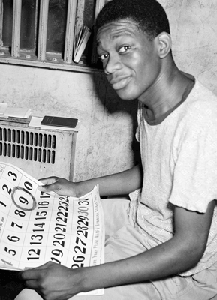
Willie Francis
The Autumn 2005 issue of the Southern Review and the book Mozart and Leadbelly (2005) both contain Ernest Gaines' essay "Writing A Lesson Before Dying." Quotes from the essay come from Mozart and Leadbelly. In the essay, Gaines talks about the process of writing the 1993 novel. Originally, Gaines wanted to set the novel in the early 1980s. However, after speaking with Paul Nolan about the Francis case, Gaines' vision started to change. Gaines writes, "There were so many similarities [between the Francis case and his previous works]--the work, religion, the food that people ate, everything. The case Paul recommended could have happened in the parish where I grew up" (53). Looking at Gaines' other works, this comment comes as no surprise. Francis resembles characters like Proctor Lewis in "Three Men" and Marcus in Of Love and Dust; the only difference, however, is that Jefferson dies in the electric chair at the end of the novel. Proctor and Marcus both have the opportunities to get bonded out of jail, Jefferson does not.

When thinking about Francis' case, Gaines says, "If I put the story in the forties, there was so much material I could use. . . . I could use the church school for background, the church where generations of my folks had worshipped and where I had attended school my first six years. I could use the crop as background. . . I knew the food the people ate, knew the kind of clothes they wore, knew the kind of songs they sang in the fields and in the church" (54). In essence, as stated earlier, the Francis case could have occurred in the parish where Gaines grew up. Along with talking about these items, Gaines also discusses Gruesome Gertie and its reputation, explaining how it traveled from parish to parish and how the generator caused it to be heard all over town.

Gruesome Gertie
Looking at the Francis case and Jefferson, some striking similarities arise. The state accused both men of murdering a white man, both had state appointed attorneys who did not really defend them, both were nearly illiterate, both were judged by a jury of twelve white men (no women or African Americans), both were condemned to die in the electric chair, and both wrote narratives about their experience (Francis' "My Trip to the Chair" and Jefferson's diary in chapter 29). One read through Francis' pamphlet solidifies the similarities even more. Francis says he wanted ice cream for his last meal, a priest told him to "stand like a man," he says the sheriff and deputies treated him well, and he concludes by stating, "Mr. Montgomery says that in writing this I may have helped someone, somehow. I hope so" (16). Jefferson's diary, and the mere fact that he walks to the chair upright, accomplishes the same things that Francis hoped his pamphlet would.


For more information on the Willie Francis case and A Lesson before Dying, look at Jason Stupp's "Living Death: Ernest Gaines's A Lesson before Dying and the Execution of Willie Francis" in Demands of the Dead: Executions, Storytelling, and Activism in the United States (2012). In 1982, the DePaul Law Review carried Arthur S. Miller and Jeffrey H. Bowman's "'Slow Dance on the Killing Ground': The Willie Francis Case Revisited."

Gaines, Ernest J. "Writing A Lesson Before Dying." Mozart and Leadbelly. New York: Vintage Books, 52-62. Print.

Thursday, July 3, 2014

Willie Francis and Gruesome Gertie

On May 9, 1947, Willie Francis sat strapped to Louisiana's traveling electric chair Gruesome Gertie for the second time. A little over a year earlier, Francis sat in the same chair. That time, however, the chair's operator, after a little too much to drink, could not hook up the chair to the portable generator correctly. So, Francis, receiving an initial electrical shock, failed to perish. One year later, and after a trip to the U.S. Supreme Court, Francis once again approached the chair in St. Martinville, LA, sat down, and awaited the shock. This time, the chair performed its duty and Francis died.

Francis' case, which Gilbert King wrote about in The Execution of Willie Francis: Race, Murder and the Search for Justice in the American South (2008), contains so many irregularities, apart from the botched execution, that it illuminates the problems that inhabited the judicial system in the Deep South during the mid-twentieth century. 


Accused of murdering Andrew Thomas in November 1944, Francis did not receive adequate council to mount a defense. Nine months after Thomas' murder, police in Port Arthur, TX picked up Francis and charged him with trafficking. They dropped that charge, after finding out that Francis did not have anything to do with it, then they kept him for a little while longer. During that time, Francis confessed to the November 1944 murder of St. Martinville pharmacy owner Andrew Thomas. The above confession, in Francis' handwriting, is from that incident. Francis admitted to killing Thomas again in the police car back to St. Martinville as well.

 During the trial, Francis' defense did not call any witnesses, contest the fact that the murder weapon became lost in transit to ballistics testing in Washington D.C., that fingerprints could not prove Francis' involvement, and they did not counter Thomas' neighbor who reported seeing a car with headlights in front of Thomas' house when she heard gunshots. Francis, as a fifteen year old African American male at the time of the murder, did not own a car or have easy access to one. The defense did not mention any of this. Instead, they just said they did not have any comments. 

Francis, between his two executions, produced a pamphlet entitled "My Trip to the Chair." The pamphlet recounts Francis' first trip to Gruesome Gertie's lap and what transpired afterwards. He does not talk about the murder of Andrew Thomas, but he does talk about being at peace and gaining the ability to stand like a man on his way to death. He concludes the pamphlet by saying, "Mr. Montgomery [who wrote the pamphlet] says that in writing this I may have helped someone, somehow. I hope so" (16). 

What does all of this have to do with Gaines? In the next post, I will discuss Willie Francis' influence on Gaines and A Lesson before Dying.       


Tuesday, July 1, 2014

A Lesson before Dying and the History of Racism

Valerie Babb, in "Old Fashioned Modernism: 'The Changing Same' in A Lesson before Dying," talks about Ernest Gaines in the modernist tradition. Defining modernism, broadly, "as a severing with traditions of the past and a quest for new forms of expression," Babb argues that Gaines fits this definition and that along with breaking from traditional forms, "modernism [and Gaines] also embraces a break with accepted history" (250, 251). To show this, Babb quotes, at length, from Jefferson's defense attorney at the beginning of the novel. The defense attorney says:
Gentlemen of the jury, look at him--look at him--look at this. Do you see a man sitting here? Do you see a man sitting here? I ask you, I implore, look carefully--do you see a man sitting here? Look at the shape of this skull, this face as flat as the palm of my hand--look deeply into those eyes. Do you see a modicum of intelligence? Do you see anyone here who could plan a murder, a robbery, can plan--can plan--can plan anything? A cornered animal to strike quickly out of fear, a trait inherited from his ancestors in the deepest jungle of blackest Africa--yes, yes, that he can do--but to plan? To plan, gentlemen of the jury? No, gentlemen, this skull here holds no plans. What you see here is a thing that acts on command. A thing to hold the handle of a plow, a thing to load your bales of cotton, a thing to dig your ditches, to chop your wood, to pull your corn. That is what you see here, but you do not see anything capable of planning a robbery or a murder. Ask him to name the months of the year. Ask him does Christmas come before or after the Fourth of July? Mention the names of Keats, Byron, Scott, and see whether the eyes will show one moment of recognition. Ask him to describe a rose, to quote one passage from the Constitution or the Bill of Rights. Gentlemen of the jury, this man planned a robbery? Oh, pardon me, pardon me, I surely did not mean to insult your intelligence by saying 'man'--would you please forgive me for committing such an error? (7-8)
In his comments, the defense attorney basically lays out all of the socially constructed tenets that whites used to keep African Americans in a subservient position. The novel strives to repudiate these myths, and to "break with accepted history." Near the end of the novel, Grant asks Jefferson if he knows what a myth is. Grant elaborates and says, "A myth is an old lie that people believe in. White people believe that they're better than anyone else on earth--and that's a myth. The last thing they ever want is to see a black man stand, and think, and show that common humanity that is in us all. It would destroy their myths" (192).


The defense attorney's speech is at 5:06 in the clip above. While looking at the modernist impulses in Gaines' work is important, the defense attorney's speech above can be used as a pedagogical jumping off point for the history of the oppression of African Americans in the country and in Louisiana. Gaines deftly presents historical arguments regarding race in a succinct paragraph. He moves from phrenology, to "uncivilized" Africa, to African Americans as commodities for work (think slavery), to African Americans as "uncivilized" because they do not know poetry, to the government's "systematic denial of political enfranchisement to African Americans" (Babb 253).

Below, you will find a list of books that will provide more information in regards to the history of racism in the United States and the world.
There are other books that talk about the history of racism. If you know of any that others should look in to post them in the comments and I will add them to this list.