Showing posts with label bloodline. Show all posts

Thursday, May 21, 2015

Langston Hughes's "Mulatto: A Tragedy of the South" and Gaines's "Bloodline"

Ambassador Theater
Playbill for Hughes's Mulatto
Last post, I wrote about Frank Laurent being a representation of the decaying South in Ernest J. Gaines's "Bloodline." Today, I would like to continue that conversation by showing how a similar image can be seen in the character for Colonel Thomas Norwood from Langston Hughes's Mulatto: A Tragedy of the South (1935). Like "Bloodline," Hughes's play takes place on a Southern plantation and involves a mulatto character, Robert, returning and starting to create trouble for the owner of the land, Colonel Norwood. In this case, though, Norwood is Robert's father with Cora, an African American woman who works in the house and has been Norwood's mistress, moving into the house when Norwood's wife passed away. Norwood and Cora have four children together, and Norwood refuses to recognize any of them. He does, however, continually try to support them by providing them with educational opportunities on the property (building a school and staffing it) and allowing them to go North to attend school, even helping to pay for their education there. While he does these things, he refuses to completely recognize them as his progeny, always referring to them as "Cora's kids." Robert, home for the summer, resents this, and the play centers around him seeking recognition from his father.

The character list for the play describes Colonel Norwood as "a still vigorous man of about sixty, nervous, refined, quick-tempered, and commanding" (2). Norwood does embody all of these qualities throughout the play, but I would also say that he becomes a representation of the plantation past losing its grip on the present. At the very beginning of the play, we see Norwood becoming frustrated when he experiences the same things that Frank Laurent does in "Bloodline." Norwood questions whether or not he actually has any control over his house. after ringing for his servant Sam and having to wait for him to arrive, Norwood intones, "Looks like he takes his time to answer that bell. You colored folks are running the house to suit yourself nowadays" (emphasis added 5). After Sam arrives, Norwood asks about the delay; Sam simply says that he was helping Sallie, one of Norwood and Cora's children, with her bags. This leads Norwood to explode: "Huh! Darkies waiting on darkies! I can't get service in my own house" (5). This brief exchange mirrors that of Little Boy and Frank Laurent discussed in the last post. Norwood notices that he does not have the same power he once did.

Part of the conflict surrounding Norwood's recognition of Robert revolves around Robert's arguments that he should be able to enter the house through the front door and Norwood's staunch refusal to allow him to do that. Robert does enter and leave through the front door, and when he goes to the front door and encounters Norwood walking in the front door, the two square off. At the beginning, Norwood only "points toward the door at the rear of the house" when he tells Robert which door to walk through (19). Robert refuses, and he confronts his father, remaining adamant that he will leave through the front door, not the back door. The stage directions during this confrontation are important:
The COLONEL raises his cane to strike the boy. CORA screams. BERT draws himself up to his full height, taller than the old man and looking very much like him, pale and proud. The man and the boy face each other. NORWOOD does not strike. (19)  
As the two continue to square off, Norwood becomes rattled and tells Robert  "(In a hoarse whisper) Get out of here. (His hand us trembling as he points)" (19). Norwood goes from being confident and strong to weak, and as the stage direction says later, filled with "impotent rage." Norwood must look up to Robert in the same way that Frank Laurent does with Copper. He does not have anymore power over Robert or the rest of the people who reside on his plantation.

When Norwood enter for what will become the final confrontation with his son, he looks "bent and pale" (21).   He starts towards Robert and "[s]uddenly he straightens up. The old commanding look comes into his face. He strides directly across the room towards his son" (21-22). This movement causes Robert to become afraid yet still defiant, and when he rises to his full stature, "the white man turns, goes back to a chair near the table, right, and seats himself" (22). Norwood knows that he cannot intimidate Robert with his physical appearance, so he decides to sit and tell Robert what he has done for Cora's children. Robert remains standing, again the tableau resembles the scene between Copper and Frank in "Bloodline." When Robert attempts to leave by the front door, the symbolic threshold of the play, Norwood steps between his son and the door. The two tussle, and Robert grabs his father by the throat, choking the life out of him. Robert symbolically kills the old South that Norwood represents, but in the process, he condemns himself to death as well. The play ends with white men chasing him into the house. He retreats upstairs and shoots himself in a bedroom.

There is a lot, and I mean a lot, more in this play and in Gaines's story. I have not even touched on Cora's thoughts regarding her relationship with Colonel Norwood. The way she describes it appears similar to the relationship between Pauline and Bonbon in Of Love and Dust. Their relationship also contains residual elements of slavery when a slave master could do whatever he wanted to do to his "property." In this way, we could read Hughes and Gaines in relation to someone like Harriett Jacobs. Finally, I do not completely discuss the progeny that arise from the relationships in these texts. Their position, as has been seen some, is precarious at best, existing not as a Creole community but as illegitimate children that the white fathers will never acknowledge, no matter how much people know. Lansgton Hughes tackles this aspect in the play and in his poem "Mulatto." The video below is Hughes reading the poem.

What other items should we discuss with these works? What other works could we examine in correspondence with them? Let us know in the comments below.

Hughes, Langston. Mulatto: A Tragedy of the South. Five Plays by Langston Hughes. Ed. Webster Smalley. Bloomington: Indiana University Press, 1968. 1-35. Print.


Tuesday, May 19, 2015

The Decaying South in "Bloodline"

River Lake Plantation 1938 
This past weekend, I read Gaines's "Bloodline" (1968) alongside Langston Hughes's Mulatto: A Tragedy of the Deep South (1935). Reading these two pieces together, one can see many thematic similarities even though they are ostensibly different genres and appear about thirty three years apart. I do not have time to touch on every similarity between each text. Instead, I just want to focus on one essential aspect that appears in each text, namely the appearance of the central white characters in each story. Both texts center around the return of a "mulatto" character who comes back to the plantation, either to move people to action as in "Bloodline" or to seek what is rightfully his and recognition from his father as in Mulatto.

Frank Laurent owns the plantation in Gaines's "Bloodline," a story that centers of the return of Copper Laurent to the quarters. Frank fears that Copper, who is his nephew from a relationship that Walter Laurent had with Copper's mother, has come back to rile up the inhabitants of the quarter and to start trouble. One must keep in mind that the story appeared in 1968, during the Civil Rights Era, and throughout Gaines's work, whites fear demonstrations occurring on their land and African Americans continually comment that the movement has not reached them yet. Typically, a student who has left the quarters and returns tells the inhabitants about the movement taking place. (Think of Jimmy Aaron in The Autobiography of Miss Jane Pittman.) Felix, the narrator of "Bloodline," even says, "They doing that [demonstrating] everywhere else, 'Mailia. Everywhere else but here" (161).

Over the years, Frank's grip on the plantation fades, representing the changing times that have made their way  into the Deep South. Felix describes "the last of the old Laurents" as feeble and struggling "to look hard" when those around him knew "that hardness had gone" (164, 165). The people who still live on the plantation and work in the big house notice Frank's decline and challenge his "rules" in small ways. For example, whenever Frank tells Little Boy and Joby to go down to the quarters and retrieve Copper, Little Boy looks in the corner to Miss Amalia and asks her if it she is all right with him forcefully bringing her nephew up to the big house to see Frank. The exchange is worth quoting at length:
"You're asking her if it's all right when I told you to do something?" Frank asked him.
"I wouldn't want to do nothing she might not--" Little Boy stopped again before he finished.
"Do like Mr. Frank say," 'Malia said, with her head down.
"Just a minute," Frank said. "Who the hell's running this place, me or Amalia?"
"I guess you, Mr. Frank," Little Boy said.
"You guess, nigger?" Frank said. "You guess?"
Little Bot lowered his head, but Frank kept on looking at him. Then all of a sudden his face changed. Like only now he re'lized maybe he wasn't running the place. Maybe somebody else was running it after all. Or, maybe nobody was running it. Maybe it was just running down." (emphasis in original 173-174)
These types of exchanges also occur between Frank and Felix. One could assume that Little Boy's deference to Miss Amalia does not occur because of Copper's appearance on the plantation; instead, he asks her blessing because he respects her and knows that the man he is about to confront is her nephew.

 Little Boy and Jorby fail to bring Copper back to the big house. In fact, Copper beats them up and ties them together with a chain. Furious, Frank tells Felix to gather up another group of men to go fetch Copper. Like Little Boy and Jorby, the group of six men fail to get Copper to return to the house. Ultimately, Frank must descend to leaving the big house in order to meet Copper; he rides out the quarters and speaks with Copper on the porch of Amalia's house. When he arrives, Felix describes Frank's movements as he extricates himself from the automobile: "The tall, sick, white man went in the yard with his head high. . . Frank stood before Copper, leaning on the cane and breathing hard" (203). Even though Frank's power deteriorates, he remains adamant that he will maintain control until he dies. He approaches the house "with his head high" and at the end of the story he convinces Copper to leave the plantation. However, Copper still reminds Frank that his time has come to an end. Copper looks down at a seated Frank, not on an equal level or up at him, and he informs him, "Your days are over, Uncle" (217). Frank knows that his way of life has come to an end, and he even mentions this at various points throughout the story. Felix's descriptions of Frank, and Frank's comments, illuminate the changing times taking place on the plantation in much the same way that the description of Colonel Thomas Norwood does in Hughes's Mulatto.      

On Thursday, I talk about Hughes's play and how it relates to "Bloodline," specifically in regards to the changing South and to the decaying plantation traditions. Until then, what are your thought's on Gaines's "Bloodline"? What other themes do you see in the story?

Gaines, Ernest J. "Bloodline." Bloodline. New York: W.W. Norton & Company, 1976. 159-217. Print.


Tuesday, January 6, 2015

Second Annual Ernest J. Gaines Summer Teaching Institute


Last June, the Ernest J. Gaines Center hosted the First Annual Ernest J. Gaines Summer Teaching Institute. Over the course of a week, teachers from around the area gathered to read and discuss Gaines' works. We also took the time to talk about how they could teach those works, and others, in their own classrooms. The center provided them with access to archival materials and articles that would help in this endeavor.

This summer, the center, in conjunction with the Louisiana Endowment for the Humanities (LEH), will host the Second Annual Ernest J. Gaines Summer Teaching Institute. The institute will be held June 8-June 12, 2015 from 8:00-12:00 each day. The main goal of the institute is to provide area educators with the opportunity to explore, research, and discuss works by Ernest J. Gaines while focusing on how to bring the information garnered from the institute back to their own classrooms. To accomplish this, the institute will involve lectures from Dr. Marcia Gaudet and Dr. Darrell Bourque. Dr. Gaudet served as the founding director of the Ernest J. Gaines Center from 2008-2012, and she has authored, co-authored, and edited numerous books and articles on the work and life of Ernest J. Gaines. Some of her works include "This Louisiana Thing that Drives Me":The Legacy of Ernest J. Gaines (2009). Mozart and Leadbelly: Stories and Essays (2006), and Porch Talk with Ernest Gaines: Conversations on the Writer's Craft (1990). Dr. Bourque serves on the Ernest J. Gaines Center's Board of Directors, was the Louisiana Poet Laureate, and received the 2014 Louisiana Writer Award. He has written and presented on Gaines's work as well, including presentations on A Lesson before Dying and Catherine Carmier. Along with these, he has also written about Gaines and Modest Mussorgsky and on heroes in Gaines' fiction.  During the institute, Dr. Matthew Teutsch (Interim Director of the Ernest J. Gaines Center) and Jennifer Morrison (Graduate Assistant in the Ernest J. Gaines Center) will also provide insight and information about Gaines' work and the materials housed within the center.

The institute will involve numerous activities including lectures, discussions, use of archival materials, and most importantly the construction of materials for use in the classroom and in professional activities. The materials constructed by participants will also be available to other educators through the LEH. In conjunction with these items, participants will have the opportunity to visit New Roads, LA one afternoon. The trip will provide participants with the chance to see and to walk the landscape and the area that Gaines writes about in his fiction. These places include the cemetery and the church that play such a prominent role in Gaines' writing. Participants will examine four of Gaines' works: Bloodline, The Autobiography of Miss Jane Pittman, A Gathering of Old Men, and A Lesson before Dying.

The deadline to apply for the Second Annual Ernest J. Gaines Summer Teaching Institute is March 18, 2015. The institute will be limited to 10 participants, and each participant will receive a $200 stipend and a certificate showing their participation for professional development purposes. To apply, go the the Ernest J. Gaines Center's website and complete the application form. Participants will be notified by April 15, 2015 on the status of their status. Applicants must provide the following information:

  • name
  • school affiliation
  • phone number
  • email
  • a one page letter stating why you would like to participate in the institute, how you plan to incorporate the information learned into your classroom, and your previous experience (if any) with Gaines' work

For more information, contact Dr. Matthew Teutsch at (337)-482-1848 or at gainescenter@louisiana.edu


Thursday, July 17, 2014

"I was crying."

A Lesson before Dying concludes with a simple, three word statement from Grant: "I was crying" (256). Gaines' works deal with manhood, and the achievement of manhood. A Lesson before Dying focuses on Jefferson gaining the strength to walk like a man, and not a hog, to the electric chair. The novel even traces Grant's movement towards manhood. What does crying have to do with the stereotypical view of manhood that society and the media has concocted for us? If we go by the constructed prescription of manhood, crying has nothing to do with it. In fact, crying represents the opposite of manhood. Speaking with John Lowe in 1994, Gaines said, "I think that we think that being a big tough guy, like a football player, or a bully, is being a man" (321). However, this is not the case according to Gaines. Manhood involves taking responsibility: "This is the responsibility of man; taking responsibility for the whole, all humanity, is what I think manliness is" (321). Thinking about Grant in this aspect, he starts to, throughout the novel, take responsibility for the whole. The novel concludes with him in front of his students after Jefferson's execution. He knows that he has a responsibility to the community and to those students to not let Jefferson's death be in vain or forgotten.

Gaines' short story collection Bloodline (1968) can be read partly as a short story sequence that traces the growth of a boy through manhood, even though characters do not repeat in the stories. Crying can be seen throughout the stories, and the majority of the time the ones crying are either boys or men. In "A Long Day in November," Sonny cries when he pees himself at school, and Eddie cries when Gran'mon shoots at him: "We all run out on the gallery, and I see Daddy out in the road crying" (35). Eventually, Eddie realizes that in order to get his wife back he must grow up. He burns his car and Gran'mon says, "I must be dreaming. He's a man after all" (71). Near the end of the story, Amy forces Eddie to grow up and take responsibility for Sonny's education by going to the school and speaking with the teacher. Eddie's crying works towards his realization that he needs to take "responsibility for the whole," not just for himself.

James, in Bloodline's second story "The Sky is Gray," tries his hardest not to cry because he believes it shows weakness and will lower his mother's perception of him. He knows that he must be strong not only for himself but for her as well. At the beginning of the story, he says,
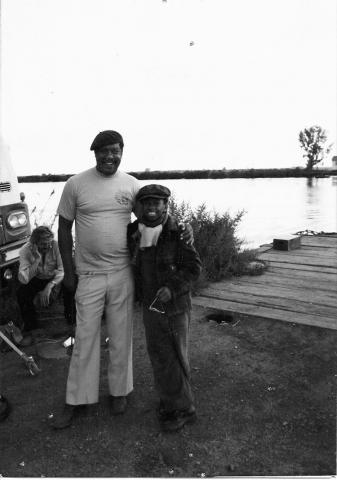
Gaines with James Bond III (Jimmy in film)
I make 'tend I ain't [sacred of ghosts] 'cause I'm the oldest, and I got to set a good sample for the rest. I can't ever be scared and I can't ever cry. And that's why I never said nothing 'bout my teeth. It's been hurting me and hurting me close to a month now, but I never said it. I didn't say it 'cause I didn't want act like a crybaby, 'cause I know we didn't have enough money to go have it pulled. (84) 
Later, as Jimmy and his mother leave the dentist's office, the sleet begins to really fall. Jimmy says, "I look at Mama standing there. I want stand close 'side her, but she don't like that. She say that's crybaby stuff. She say you got to stand for yourself, by yourself" (105-106). Throughout the story, Jimmy learns to stand by himself. He learns to take responsibility and how to mature into manhood. The only time he physically cries is when his mother whips him for not killing the birds. Even in this instance, his crying occurs during a lesson that his mother is trying to teach him, how to stand by himself.

In the third story from Bloodline, "Three Men," Procter Lewis can be seen crying after he decides to take Munford's advice to not let Roger Medlow bail him out of jail. Procter says he got up on the bunk and looked out at the stars. While looking at the heavens, he says, "I felt my throat hurting. I felt water running down my face. But I gripped my mouth tight so I wouldn't make a sound. I didn't make a sound, but I cried. I cried and cried and cried" (151). Even though he cries in his bunk, the paragraph ends with Procter affirming that he "wanted to stand. Because they never let you stand if they [bailed] you out" (152). Procter takes Munford's advice and goes to the pen standing so other will see him as an example. He takes "responsibility for the whole."

This post will possibly turn into something more down the line, but for now I hope it provides you with a little idea concerning manhood and the achievement of it in Gaines' writings. Please leave any thoughts on this topic or on previous topics in the comments below.

Gaines, Ernest. Bloodline. New York: W.W. Norton, 1976. Print.
Gaines, Ernest. A Lesson before Dying. New York: Vintage Books, 1993. Print.
Lowe, John. "An Interview with Ernest Gaines." Conversations with Ernest Gaines. Jackson: University of Mississippi Press, 1995. 297-328. Print.