Showing posts with label baseball. Show all posts

Tuesday, May 12, 2015

Ernest Gaines's Open Letter to Hank Aaron


Ernest Gaines has made his admiration for Major League Baseball Hall of Famers Jackie Robinson and Willie Mays well known. Living in San Francisco, Gaines became a lifelong San Francisco Giants fan, cheering the team on even when he returned to Louisiana to reside permanently. In 2007, Giants slugger Barry Bonds approached Hank Aaron's record of 755 home runs. Aaron told reporters that he would not attend the games where Bonds would possibly break his record, and speculation began to swirl about this decision. Many saw Aaron's refusal to attend the games as a reaction to the numerous rumors of Bonds's steroid use. Mike Gimbel pointed out that reporters overlooked part of Aaron's statements regarding his decision to stay away from the ball field. Instead of taking away from Bonds, Gimbel argues that Aaron chose to not attend so that Bonds could enjoy the full spotlight of his accomplishments. Whether or not this is the case, we may never know. What we do know is that many view Bonds's single season home run record of 73 and career record of 762 as "tainted" because of his PED usage.
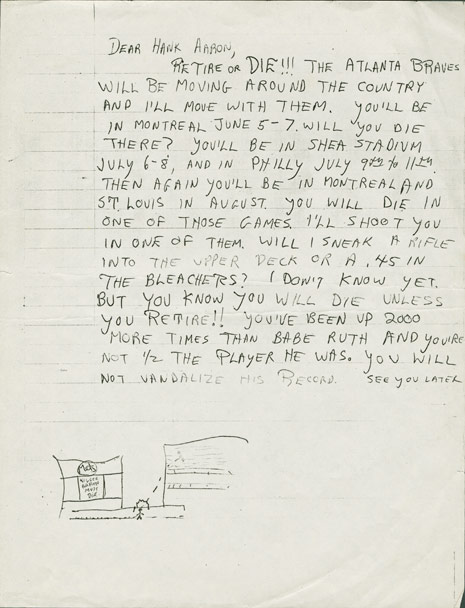

During the lead up to Bonds's surpassing of Aaron's home run record on August 7, 2007, Gaines wrote an open letter to Hank Aaron in The Atlanta Journal Constitution urging him to support Bonds's pursuit of the all time home run record. Gaines draws attention to the vitriol that Aaron endured during his own pursuit of then record holder Babe Ruth in 1974. At the time, in 1973 and 1974, Aaron received numerous death threats. Gaines writes, "How soon people forget. Some. Not all. Because I can remember the days when you were approaching Bab [sic] Ruth's homerun record that some of the same people condemning Bonds today were sending you death threats. Why? I'll tell you why. They did not want to see a Black man break the greatest record set by a White man in sports." The letter to the right shows the hate focused on Aaron and his pursuit of Ruth's record. Just as Aaron received hate mail from individuals who did not want to see him break Ruth's record, Bonds received death threats as well. It is not clear, though, if these were racially motivated. We can presume that the threats contained racist language and overtones.

To me, the most interesting part of Gaines's letter comes when he says that everyone isn't like Aaron, Mays, or Jesse Owens. Gaines says, "Some of us are arrogant. We feel that once we do our work on the field, that should be enough to satisfy the fans." This statement reflects Gaines's thoughts on his own writing as I have written about before on this blog. This arrogance makes some people afraid, though. Gaines continues, "All geniuses are arrogant. Bonds wears his arrogance on his sleeve. And the White world doesn't like it. If you are Black, you are supposed to be humble." He goes on to say that he is not sure whether or not he would even like Bonds if he met him. That, however, is beside the point. The point is that the white media looks upon self-assertive, "arrogant" Black men as a danger. If the player was white, would the media view him the same way?

Aaron did send a message to Bonds when he broke the record. After Bonds's 756 home run, Aaron appeared on the big screen at AT&T Park and said:  
I would like to offer my congratulations to Barry Bonds on becoming baseball's career home run leader. It is a great accomplishment which required skill, longevity, and determination. Throughout the past century, the home run has held a special place in baseball and I have been privileged to hold this record for 33 of those years. I move over now and offer my best wishes to Barry and his family on this historical achievement. My hope today, as it was on that April evening in 1974, is that the achievement of this record will inspire others to chase their own dreams.


Even last year, Aaron received racially charged threats after comments he made regarding politics. These threats came, in 2014, when only 67 African American players held roster spots in the Majors. Three teams did not have any African American players on their rosters: San Francisco, St. Louis, and Arizona. This is a dramatic decrease in the number of African American players who made up on average 16% of the overall players between 1972-1996 in the Majors. Major League Baseball has worked to get more African American youth involved in playing baseball through various programs, but the numbers have not seen any large increase. Last year, an all African American Little League team, Jackie Robinson West, from Chicago was disqualified after allegations of zone tampering appeared. As well, comedian Chris Rock has been vocal about the lack of African American's in MLB baseball.

What are your thoughts? I bring up all of the other items here because of the incidents in Baltimore and the cancellation of two of the Orioles's games against the White Sox and because of Alex Rodriguez passing Willie Mays for fourth on the all time home run list. He accomplished this on May 7, 2015. For article questioning he issue of race in regards to Bonds's pursuit, see this article from 2007 in The Independent.

Tuesday, March 3, 2015

The Importance of Art

Last week, Irvin Mayfield appeared at UL Lafayette as an artist in residence for three days. During that time, he spoke with students in various classes including literature and music classes, he performed with the UL Jazz Combo I and his quintet, and he strengthened my beliefs in the power of the arts and the humanities in society. This post could devolve into a lifelong look at how the arts have affected me throughout my life, but I'm not going to do that. Instead, I'm going to just make a few observations regarding my thoughts about the arts and humanities. He speaks about these ideas in his interview with Judith Meriwether on KRVS. 


To begin with, I've always felt that music resides at the pinnacle or artistic expression in regards to its ability to communicate emotion and feeling to not just an audience but to the performer as well. Without knowing the words, if there are any, a composition can move you in certain ways whether that's making you fell joy, sadness, anger, or any other emotion. At the concert last Tuesday and at the world premier of James Syler's Congo Square on Friday night, this belief struck home with me again. The Irvin Mayfield Quintet performed a piece from Dirt, Dust, and Trees entitled "Angola." The piece explores themes of struggle and persecution that appear in Gaines's works. Speaking about the song, Mayfield said that he asked Gaines why all of the heroes in his novels die, and Gaines replied by simply telling him that they must because they cannot live in a world that treats them the way that it does. "Anogola," which takes its name from the infamous Louisiana State Prison, reluctantly moves the listener through the pain and struggles of numerous individuals, mostly African American males, who are incarcerated in this country for no other reason than their class status or color.

I had heard this song once before at the Ernest J. Gaines Award for Literary Excellence ceremony; however, last week the piece carried a heavier weight for me, not because of anything different since the first time I heard it performed a month earlier, but because of the sounds that evening. It opens with just the drum for a few measures then the piano and bass enter creating an ominous, almost desperate feel. Sitting in Angelle Hall, the Jamison Ross started the song, and all I could notice was that when he hit the bass drum, the snare drum, and the hi hat the sound left the stage, traveled to the back of the auditorium, then returned, albeit a little quieter. At that moment, my mind shifted to Marcus standing before Bonbon's horse in the fields, to Jefferson, feeling like a hog, in the jail cell in Bayonne, to Charles Blow's son being accosted by police at Yale, to mothers and fathers having to tell their sons to keep their hands on the wheel when being pulled over just because of the color of their skin, to rappers being pulled over by police-again because of their skin. The list could go on, and on, and on, and on. Once Max Moran's walking bass line and Joe Ashlar's piano introduced themselves, I began to drift, and get lost, not even recalling much of the song until Irvin and trombonist Michael Watson blared on their horns and brought me out of my thoughts back to that jail cell in Bayonne, a fictional jail cell, where Jefferson anguishes about what has happened and what will eventually happen to him. Jefferson screams in that cell, wanting to be recognized as a man, a person, a human being with thoughts and ideas. He gets that recognition, from Grant, from Paul, and from others, but not until he sits in Gruesome Gertie and perishes. That is what the sounds coming from the stage that night did for me. That is what they said to me at that moment. 


On Monday, Mayfield spoke with an English class about art and its importance. Constructing the class around a conversation, he asked the students to help him define words such as "idea" and "event." As the class progressed, other words appeared and entered the conversation. At one point, the discussion moved towards what constitutes creativity and art; here, the question of whether or not the building the students were sitting in should be considered a form of creative expression. Some students looked puzzled, and others agreed that it should. As the conversation moved towards the planning of cities and neighborhoods, then to the French Quarter and its history, I thought about what architecture says about the society, and specifically I thought about the Louisiana State Capital. I've written about the capital on this blog before, but what I did not mention is the fact that the capital contains numerous carvings relating to Louisiana history. One aspect of that history that does not appear is slavery. There are images of settlers interactions with Native Americans and of what appear to be slaves, but could be share croppers, in the fields. However, there are no images of slave auctions, scourging, of other aspects. History contains the good and the bad, and shouldn't both be exposed lest we forget where we came from? 


Continuing my thoughts about the capital, I had an opportunity to speak with Mayfield at a reception and he started discussing how corporations and the government use art to control. That's why we don't have those images in the state capital. Think about at MLB, NBA, and NFL games. What does art have to do with these events? At each one, every night, someone performs "The Star Spangled Banner." Why? The singing of our national anthem began in earnest in sports in the seventh inning of the first game of the 1918 World Series between the Boston Red Sox and the Chicago Cubs. Why is this important? It's important because America, 17 months earlier, entered World War I. The anthem became a patriotic rallying cry, as we saw after September 11. Once the owners realized that people responded to the song, they began to have it performed again and again. I'm not saying that the anthem is a bad thing; I am only saying that we need to think about how art and artistic expression relate to events that we may not even consider them being a part of and what that incorporation means. The NFL started to get bigger after a couple of specials on NBC that had artistic merit and led to the creation of NFL films. It brought the game closer to the fans by making it personal and artistic.     


With all of that said, I want to leave you with a couple of parting thoughts and questions. What teachers do you remember from your educational career? For me, it's the English teachers. Granted I'm in English, but those are the teachers I remember the most. It can't be a coincidence that others, who do other things, remember them as well. Liberal arts matter. College should, as Frank Bruni says in "College's Priceless Value: Higher Education, liberal Arts and Shakespeare," work to make us better citizens. Literature, and all art, opens our eyes to those around us, that we may see, but more often than not, that we don't see. It relates the human condition to us, and as I have had students tell me, in Bruni's words, "It informed all my reading from then on.

Part of studying literature, art, history, music, etc, is to learn how to see through the noise and make up your own mind about issues and ideas instead of listening to the same old rhetorical bombast and idiocy that spews from the mouths of those that want to either hold on to their power or to grab a piece for themselves. It forces you, sometimes reluctantly, to take the red pill, opening you up to realities that either eluded you or you ignored. Your stomach will wrench, your eyes will cry, your mouth will laugh, and your ears will hear. Most importantly, your heart will expand by studying the liberal arts. 


As I am fond of quoting James Baldwin on this topic, "You think your pain and your heartbreak are unprecedented in the history of the world, but then you read. It was books that taught me that the things that tormented me were the very things that connected me with all the people who were alive, or who had ever been alive."

Thursday, January 15, 2015

"Dirty Rice" and the Act of Naming


Previously, I wrote about Gemar and Mike's visit to the Louisiana State Capitol in Gerald Duff's book Dirty Rice: A Season in the Evangeline League. For this post, I would like to continue part of that conversation; specifically, I want to touch on the act of "naming" in the novel and on Gemar's attempts to navigate the racial landscape that surrounds him after he leaves the Alabama-Coushatta Tribe and heads to Louisiana to play baseball. As Gemar's play on the field begins to draw attention, he inevitably encounters individuals who want to label him and to name him every stereotype in the book.

Every player on the Rayne Rice Birds has a nickname. In fact, no player chose what his name would be; instead, the other players decided and after the "naming" nothing could be done to change it. Upon meeting Dynamite Dunn, the Rice Birds' catcher, Gemar intones that "he didn't call himself [Dynamite]" (18). Journalists, radio broadcasters, fans, and other players came up with the name to use it in stories about the team and in interactions with one another. Gemar continues by saying. "I never met but one or two players in my time in the Evangeline League who would call themselves by their nicknames. Both of them had something wrong with their thinking, too" (18). Early on, Gemar makes a point to let the reader know that names are important and that they carry meaning.  

After a game during the first home stand of the season, Tommy Grenier from the Rayne Tribune comes to the locker room and interviews Gemar for a story. Gemar observes, upon seeing Tommy, that his name does not fit him. Instead of an older man wearing a necktie and sweating profusely, Gemar thinks, "I would've though that the name Tommy was something you'd call a young white kid" (108). As Gemar thinks this, Tommy begins to construct a story that ultimately names Gemar and casts him in a stereotypical light. From the very title, Tommy's piece labels Gemar as something he is not. Gemar comments that the title, "Alabama Indian Tomahawks Cardinals," does not reflect who he is at all, namely that he is part of the Alabama-Coushatta Tribe, not an Alabama Indian. Later in the article, Tommy plays up the fact that Gemar is Native American; he writes, "He's called Chief by his teammates on the Rice Birds roster, . . . He depends on a fastball he calls his Thunder Bolt, mixed in with a curve named Snake Crawler. He was big poison to the Cardinal hitters, and he lets out an authentic Indian war whoop every time he sets a batter down" (emphasis added 109). Ultimately, according to Tommy, the Evangeline League better pay attention because "Big Chief Gemar Batiste is on the warpath, and he's hungry for strike-outs and scalps" (109).

Tommy's article reinforced readers' views of what a Native American should be. "It satisfied the way they wanted to see things," Tommy mentions, "It's a lot more interesting to believe a red man will let out a war whoop when he gets somebody out in a game then than it is to see the truth" (110).  People's preconceived notions of how a Native American like Gemar should act permeates Tommy's article. In many ways, Tommy performs the same act of naming that those like William Apess, David Walker, and Hosea Easton vociferously spoke out against in the early nineteenth century. Gemar continues by saying that he "learned early on in life to take advantage of the way the white folks liked to think about Indians" (110). In essence, Gemar learned to "wear the mask" just like Procter and Grant do in Gaines' works. However, even if Gemar lets himself believe what the white man says about him, he will never let himself truly believe it because "if you don't let yourself start believing you truly are the creature the white man wants you to think you are," he says, "you can get something out of acting the way they expect you to" (110). Gemar gets the ability to make a living during what the whites called the Great Depression and members of his tribe called normal by doing something he enjoys, playing baseball. Gemar allows for the perpetuation of the stereotypes in much the same way that Procter Lewis and Grant Wiggins do, to subvert them.

Concluding, there are numerous other instances of naming in Dirty Rice. The manager and the owners, after Gemar throws a no-hitter, want Gemar to play up his "Indianess" for the fans because his uniqueness will bring in more money. After the no-hitter, Dynamite Dunn and others take Gemar to a cockfight. Here, Gemar reflects on the idea of naming, finding himself drawn to an underdog fighter named Little Red from Alabam just because of the word "Alabam." That word, Gemar says, "was another case that shows how much it means what a living thing is called" (188). Regarding the names the names the chickens received from their owners, Gemar notes, "The naming of a fighting chicken wasn't meant to satisfy the chicken but the man who slapped it on him" (185). Naming works a way to establish control and power over a subject. Gemar feels this throughout the novel, and like the chickens in the cockpit, he plays along. However, unlike the chickens, he plays along because he knows how to navigate the space where he resides.

There is much more that could be said about this novel; however, I will leave that for the comments below. What do you think about the act of naming either in Dirty Rice or elsewhere? What do you see as Gemar's role in the act of naming and going along with it? These and other questions are ones that could be explored in greater detail.

Duff, Gerald. Dirty Rice: A Season in the Evangeline League. Lafayette: University of Louisiana at Lafayette Press, 2012. Print.
Rayne Rice Birds 1937

Tuesday, January 13, 2015

Louisiana State Capitol and Gerald Duff's "Dirty Rice"


The Patriots
The Pioneers


A couple of weeks ago, I made a trip to the Louisiana State Capitol in Baton Rouge. While there, I took the opportunity to look at the architecture of "Huey Long's Monument." The outside contains two sculptures that flank the steps leading up to the capitol's entrance. On the left is the The Pioneers which depicts groups of people such as a Native American, a Spanish conquistador, a Franciscan friar, a backwoodsman, Hernando de Soto, RenĂ©-Robert Cavelier Sieur de La Salle,and others who have contributed to Louisiana's history.  On the right, you will see The Patriots, a sculpture that displays a knight in armor standing on a fallen hero's coffin. Unidentified mourners surround the knight and coffin, and one mourner can be seen behind the knight placing a symbolic wreath to his back.

Why do I even bring up the architecture of the Louisiana State Capitol? I brought it up because in Gerald Duff's Dirty Rice: A Season in the Evangeline League the novel's protagonist, Gemar Batiste (from the Alabama-Coushatta Tribe), and his "Cuban" teammate Mike Gonzales visit the state capitol during their time in Baton Rouge, LA. Batiste and Gonzales were in Louisiana's capitol city because they were both set to take part in the Evangeline League's 1935 All Star Game. Upon approaching the monument, Mike points out the statues flanking the entrance to the building. Instead of the two sculptures mentioned above, Mike asks, "Ain't that a big old statue of an Indian man standing there with a bow and arrow in his hands? What's he doing in Louisiana at the capitol?" (156). Gemar answers by telling Mike that the Native American is doing "the same thing that statue of the colored man is doing" (156). Gemar elaborates by stating that whites put the two statutes there in order "to show what troubles they had to go through to take over the Louisiana country" (156).

The Native American sculpture depicts a man standing with a bow and arrow looking around, as if something is about to come upon him. The African American in the other sculpture is bent over pulling weeds and grass out of the ground. To Mike's observations that one is standing awaiting something that has not arrived and that one is bent over low to the ground extracting weeds and grass. Gemar intones that the statue of the slave "is supposed to let you know how the white man started planting rice and sugarcane and beans and stuff as soon as they could get the Indians herded up and out of the way. See, then that's when they had to bring in the colored folks to tend to the farming, Keep the weeds out so the good crops could grow. Pick that cotton, chop that cane, harvest that rice" (156). After hearing Gemar's description, Mike, who is not Cuban but "redbone," declines to enter the capitol and chooses to get ready for the All Star Game instead. The capitol holds nothing for him or Gemar. Being a redbone from Alabama, Mike knows about discrimination, and being from the Alabama-Coushatta Tribe, Gemar knows about it as well.

Just as John Kennedy Toole changed the geography of New Orleans to fit his needs in A Confederacy of Dunces, Duff erects two new sculptures on the capitol's steps: a Native American and an African American slave bent over working in the ground. These statues serve the purpose of showing how Gemar must navigate residing in a white society. Gemar's assessment that the statues represent the white's displacement of Native Americans and subjugation of African American echoes those of Ned Douglass in The Autobiography of Miss Jane Pittman. During his sermon by the river, Ned preaches," The red man roamed all over this land long before we got here. The black man cultivated this land from ocean to ocean with his back. The white man brought tools and guns" (115). Ned traces the same progression and role of Native Americans, African Americans, and whites that Gemar mentions in regard to the statues.

Along with pointing out the atrocities of white society in relation to its conquering of Louisiana and America, Ned points out that America incorporates all groups. Ned makes this point overtly by stating, "America is for red, white, and black men. . . . America is for all of us" (115). Gemar, on the other hand, does not comment that America is for everyone; in fact, Gemar's and Mike's actions lead towards the realization that it is not. Mike has to lie, as some other African American players did during the early part of the twentieth century, and claim to be from Cuba in order to even play in the Evangeline League, and Gemar has to endure stereotypes in the way that journalists and his teammates label him in order to survive. (Gemar's navigation of these issues will be discussed in the next post.) Mike and Gemar do not enter the capitol after looking at the outside. Gemar asks Mike if he would like to go in or if he has "seen enough to satisfy" his curiosity (156). Mike simply says, "I'm going to pass on walking through that door" (156). Mike's refusal is straight forward and concise; immediately following it, he says he want to go to the baseball field and drops the subject. Gemar and Mike do not have access to the "white" capitol in 1935; however, they do have access to the baseball field and they use that navigate the racist society they reside within.

What are some other instances in books, poems, plays, etc. where state capitols or government buildings are mentioned in a similar manner to how Duff uses them in Dirty Rice? I'm curious to know because I think it would make an interesting study or class.

Duff, Gerald. Dirty Rice: A Season in the Evangeline League. Lafayette: University of Louisiana at Lafayette Press, 2012. Print.
Gaines, Ernest J. The Autobiography of Miss Jane Pittman. New York: Bantam Books, 1972. Print.