Showing posts with label ernest hemingway. Show all posts

Thursday, January 8, 2015

The Short Story and Ernest Gaines Syllabus

Last post, I talked about the Second Annual Ernest J. Gaines Center Summer Teaching Institute. With that in mind, I want to take the time in this blog post to do something a little different. Instead of writing a critical post, I would like to use today's entry to present you with a possible syllabus for teaching Gaines' works either in a secondary or post-secondary setting. When available, I have provided links to the stories below.


The Short Story and Ernest Gaines

Objective:

This course will examine various authors from around the world and how they influenced the writing of Ernest J. Gaines in particular. Along with authors that influenced Gaines, the course will also explore contemporaneous authors with Gaines and his work. Through this examination, we will challenge the monolithic view of literature, and in particular African American literature, by showing that authors do not receive their inspiration from a uniformed sources. While the course center on Ernest Gaines, it will provide us with an opportunity to explore other avenues as well: short story structure, peasantry in Russia and the United States, Modernism, the South as a space of memory, and other topics.

Readings (Chronological Order):

Ivan Turgenev A Sportsman's Sketches (1852)
Leo Tolstoy The Death of Ivan Illych (1886)
James Joyce "Ivy Day in the Committee Room" (1914)
Jean Toomer "Blood Burning Mood" and "Avey" (1923)
Ernest Hemingway "Soldier's Home," "Big Two-Hearted River Part 1," and "Big Two Hearted River Part 2" (1925)
William Faulkner "April 7, 1928" (Benjy's section in The Sound and the Fury) (1929)
Richard Wright "The Ethics of Living Jim Crow" and "Big Boy Leaves Home" (1938)
Eudora Welty "A Worn Path" (1941)
James Baldwin "The Outing" and "Going to Meet the Man" (1965)
Ernest Gaines Bloodline (1968) and The Autobiography of Miss Jane Pittman (1971)
Alice Walker "Everyday Use" (1973)
Children of the Night: The Best Short Stories by Black Writers 1967 to Present Ed. Gloria Naylor (1997)
Growing Up in the South: An Anthology of Modern Southern Literature Ed. Suzanne Jones (2003)

Assignments:

  • Response papers: These will be in the form of blog posts. I will set up a blog for the class, and you will post your responses there. Each post will require you to answer to my prompt and to respond to other students' responses as well. We will discuss how to do this in a proefssional manner during class. (Teachers, see Shannon Baldino's "The Classroom Blog: Enhancing Critical Thinking, Substantive Discussion, and Appropriate Online Interaction" for a discussion of blogs in the high school classroom.)
  • Wiki: Students will be placed into groups of four. Each group will be required to construct a collaborative wiki with ________ components on an author and text that we read in class. 
    • Each student must write a paragraph describing the class discussion for that author. For example, if the class discusses narrative voice in Faulkner, the response should talk about narrative voice and what the class said about it. 
    • The group must come up with five questions to think about based off of the class discussion or research. 
    • The group must construct an annotated bibliography of six sources. The annotations must be 250-500 words and contain a section stating the source's credibility, a summary of the source, a way to use that source in a research project. 
    • The group must construct a list of symbols/allusions/or other references in the stories. The number here will vary, but each entry must provide information about where it comes from (especially for an allusion) and what purpose it serves in the context of the story. 
    • The group must construct a review of the short story. The review must be between 500-1000 words. Remember, a review is not a summary. Some summary is necessary, but the thrust of the review should be about the story's meaning and importance. 
    • The group must construct a creative page. This page can be anything that you desire. For example, it could be a hand drawn map of the setting. It could be sketch of one of the scenes. It could be a Prezi talking about the author and the themes of the story. It could be a video discussion. This page is open to whatever you want to do.   
  • Research paper: the paper must explore connections between at least two of the authors discussed in class. For example, you could explore the pastoral in Turgenev and Hemingway. Or, you could explore representations of the South in Wright and Baldwin. The paper must be 8-10 pages. You must use 4-6 secondary sources as well to support your argument.


What other types of assignments would you require in a class like this? For class discussion, I would incorporate the "fish bowl" activity. The "fish bowl" has worked well for me in the past, especially in my literature classes.  As well, the wiki assignment worked well. After the initial apprehensiveness of students to work together in this way, students created some amazing wikis and creative pages. Plus, the information provided them with a head start on their research papers. The wikis helped to show students that learning and writing are not solitary activities; they require interaction with others.

Regarding the readings above, I chose them because of their relationship to Ernest Gaines. Gaines has stated, at various times, the influence of many of the authors above. Along with his influences, I added contemporaries of Gaines such as Wright, Baldwin, and Walker to show his work in relationship to those he wrote alongside. The two anthologies listed provide short stories by African American writers and Southern writers. There are works in there that could be used to expand upon the themes and topics in the class.

List of previous blog posts that may be of help with the readings in this course:

Please provide your insights and suggestions in the comments below. What other texts would you suggest in a class like the one above? What assignments and activities have worked for you in the classroom when teaching literature? If you have a syllabus or reading list you would like to propose, let me know at gainescenter@louisiana.edu.


Thursday, December 11, 2014

Ernest Hemingway's "Soldier's Home"

Hemingway in World War I
During the Second Annual Ernest J. Gaines Lecture a couple of weeks ago, Dr. John Lowe spoke broadly about Catherine Carmier, its genesis, plot, and early drafts. (The lecture will be available online soon.) Among the myriad of interesting moments from Dr. Lowe's lecture, one comment stuck out to me. When discussing the scene in Catherine Carmier where Aunt Charlotte talks with Jackson to explain to him why she sent him to California and about his lack of faith after his education, Dr. Lowe brought up Ernest Hemingway's "Soldier's Home" from In Our Time. I have written about Hemingway's influence on Gaines and about the role of religion in Gaines' works. Today, I want to examine "Soldier's Home" and the scene mentioned above together. Both contain a maternal figure confronting their charge with questions about religion and faith after traumatic events.


In "Soldier's Home," Harold Krebs, recently returning to his Midwestern town after World War I, tries to come to grips with the things that he experienced. What troubles him throughout the story is the fact that the community he left behind maintains specific ideas about what happened during the war. In order to try and appease those who did not experience the carnage of war, Krebs, like other veterans, lies and exaggerates to placate his listeners. However, "his lies were not sensational at the pool room" where he retreated to because most had already "heard detailed accounts of German women found chained to machine-guns in the Argonne forest" (137). Any story that did not have details like this were not interesting to the men. Telling all of the lies caused Krebs "nausea" because, if truth be told, "he had been badly, sickeningly frightened all the time" (137).

Even though Jackson did not encounter the horrors of war when he left the quarters for California, he still felt "sickeningly frightened." Even though Jackson does not mention racial incidents in California, it can be implied that some occurred. For instance, when speaking with Madame Bayonne, he tells her, "But when we went up there [California], we found it all a pile of lies. There was not truth in any of it. . . . They don't come dressed in white sheets with rope. But there's no truth" (81). Even before he went to California, Jackson was scared. Responding to Aunt Charlotte's speech about him succeeding for the community and about his loss of faith in the church, Jackson informs her, "You sent me there. . . I didn't want to go. I cried, I cried to keep from going" (100). Krebs enlisted to join the war effort, so any fear that he may have had before his deployment is not mentioned. However, Jackson did not have a say in whether or not he would leave for California. The prospect scared him, and he made sure to let his aunt know that it did. Jackson knew that the community wanted him to go. If he failed, Aunt Charlotte says, "that's all for us" (98). Krebs does not have this responsibility hanging over his head, but his father does want him to get a job instead of lying around all day. His father doesn't even care what that job may be, as long as Krebs works.  

These are just a couple of the similarities and differences between Krebs and Jackson. The main similarity that I want to discuss deals with Krebs' and Jackson's dismissal of faith. At the end of "Soldier's Home," Krebs' mother speaks with him about love and faith. Over the breakfast table, Krebs' mother asks, "Don't you love your mother, dear boy?" (143). Coldly, Krebs replies, "No. . . I don't love anybody," as his mother begins to weep (143). After comforting his mother and telling her that he does not really mean that he doesn't lover her, Krebs agrees to kneel and pray with his mother; however, he tells her, "I can't [pray]" (144). Krebs cannot pray because of the trauma he endured during the war. Instead, his mother prays for him.

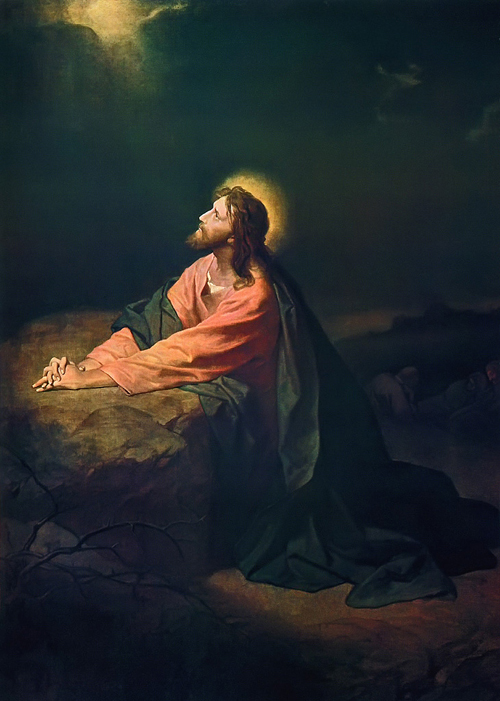
The two incidents between Krebs and his mother are similar to the relationship between Aunt Charlotte and Jackson. After Aunt Charlotte slaps Jackson when he tells her that he doesn't "believe in that bourgeois farce" called church, his aunt asks him to kneel with her and pray (100). Jackson responds in the same manner that Krebs does; he says, "I can't" (100). Jackson's reasons for not being able to kneel and pray differ from Krebs'. While it is implied Krebs does not have the power to kneel because he has lost faith after seeing the destruction of war, Jackson simply refuses because he does not want to show weakness. Aunt Charlotte ultimately kneels and prays for Jackson as he stands there quietly. All the while, Jackson thinks about the calendar in the room. The picture on the calendar is of Christ kneeling in the Garden of Gethsemane. For Jackson, "both the idea and the portrait were disgusting" (99). For Aunt Charlotte, however, the image gave her strength, thinking about "the Master on his knees" (102). Later, when Jackson finally tells Aunt Charlotte that he plans to leave and return to California, he hurts her in the same way that Krebs does when he says, "I don't love anybody." In this scene, Gaines implies part of the conversation between Jackson and Aunt Charlotte in much the same way that Hemingway does in his work: "But he had not said half of what he wanted to say to her when she staggered against the door as if someone had hit her with his fist" (162). Aunt Charlotte maintains her composure and tries to walk into the house, but she falls again. Before getting into the house, she screams, "Get away from me, Jackson" (163).

Both Krebs and Jackson hurt the maternal figures in their lives by denying religion and essentially telling those who love them that they do not reciprocate that same affection. Krebs' reasons, of course, differ from Jackson's. In Europe, Krebs experienced the horrors of war, and those horrors caused him to feel disillusionment and isolation from the community and his family upon his return. Jackson feels isolation from his family and community as well, but for a different reason. Aunt Charlotte sent Jackson away so he could have the opportunity to return to the quarters to teach and uplift those that remained. His education, though, alienated him from the community. After receiving an education, he could no longer accept the beliefs that Aunt Charlotte held or suffer the oppression that he left behind.

What other similarities do you see in these two works? Are there any other stories in Hemingway's In Our Time or elsewhere that you see reflected in Gaines' writings? What are they?

Gaines, Ernest J. Catherine Carmier. New York: Vintage Books, 1993. Print.
Hemingway, Ernest. The First Forty-Nine Stories. London: Jonathan Cape, 1946. 136-144. Print.  

Thursday, June 5, 2014

Visual Art and the Art of Writing Fiction

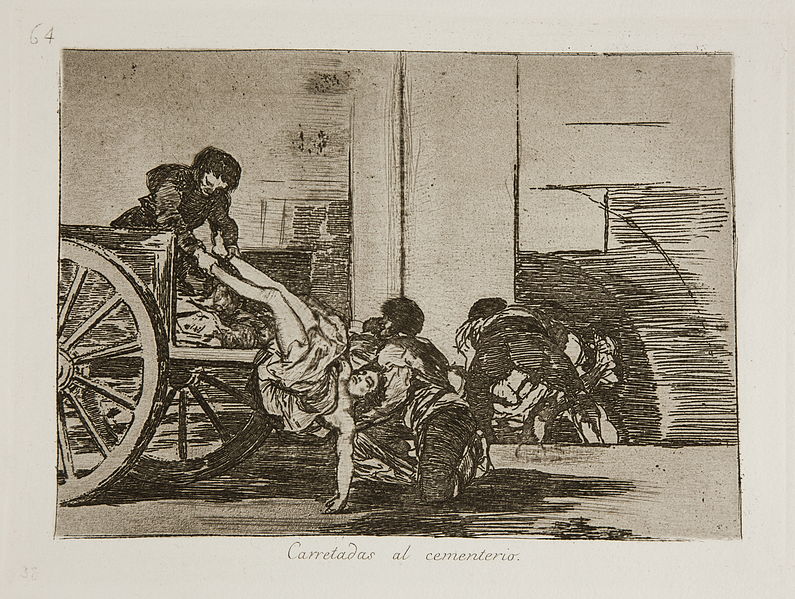
Goya's Carretadas al cementerio
Gaines makes his literary influences known in his copious interviews. In conjunction with the authors who inspired him and taught him how to write, Gaines mentions that music and visual art also provide him with inspiration. He cites Mozart, Leadbelly, Lightnin' Hopkins, and Mussorgsky for musical influences. On the visual side, Gaines mentions Vincent Van Gogh both in interviews and in essays. Talking about the models he emulated in 1986, Gaines said, "I also discovered how music can help, and as Hemingway suggested, paintings can help, just by going to a museum or art gallery" (Gaudet and Wooton 207). 

One needs to only read Hemingway to see the influence of visual art on his writing. The Metropolitan Museum of Art has an article on Francisco Goya's looming presence in For Whom the Bell Tolls (1940). Specifically, Goya's The Disasters of War series can be seen. This series can be seen more directly, though, in Hemingway's short story "A Natural History of the Dead" from Winner Take Nothing (1933). The story describes, in gruesome detail, the ravages of war with mutilated corpses of humans and animals strewn across the fields decaying in the sun. Describing the sight of dead mules, the narrator says, "The numbers of broken-legged mules and horses drowning in the shallow water called for a Goya to depict them" (98). Later in the story, as a doctor examines a wounded patient, once in the daylight and once with a flashlight, the narrator intones, "That too would make a good etching for Goya, the visit with the flashlight, I mean" (103). Hemingway's descriptions of war in "A Natural History of the Dead," and in works such as A Farewell to Arms and For Whom the Bell Tolls, show the influence of artists like Goya who unapologetically displayed the ravages of war in his etchings.    

Like Hemingway, Gaines draws inspiration from visual art. Later in the 1986 interview, Gaines explained, "Just look at paintings and see how you can describe a beautiful room with only two or three things, without having to go through everything in the room. Right now I'm thinking of Van Gogh's painting called 'Vincent's Room' [Bedroom in Arles]--it's a room where he used to live and sleep--and how he could do it so well with only two or three things or pieces of things" (207). Van Gogh painted three versions of Bedroom in Arles, each with slight variations. Reading through Gaines' work, as well as Hemingway's (look at "Homage to Switzerland"), repetition and sparseness play a role. Think about the dialogue of both authors or the repetition of phrases, stated in slightly different ways.  

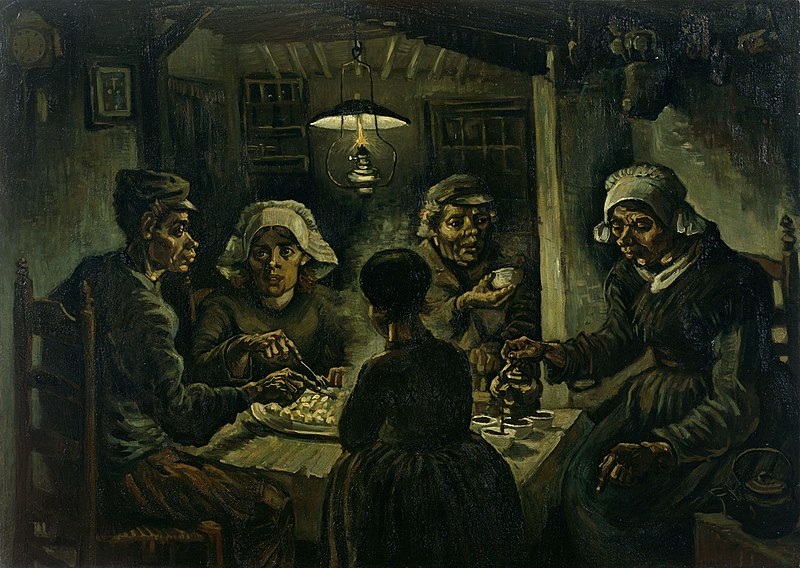
Elsewhere, in "Bloodline in Ink," Gaines states that Van Gogh attracted him more than Modigliani's nudes, in part because of Van Gogh's depiction of country and peasant life. "I like The Potato Eaters," Gaines says, "and the worker's shoes and the people sowing wheat in the field. All this reminded me of home--Van Gogh did, not Modigliani" (42). Just as Gaines' literary influences created vivid depictions of peasants, the visual artists that inspire Gaines do the same thing. In an 1885 letter, Van Gogh wrote about the painting, saying:
 You see, I really have wanted to make it so that people get the idea that these folk, who are eating their potatoes by the light of their little lamp, have tilled the earth themselves with these hands they are putting in the dish, and so it speaks of manual labor and--that they have thus honestly earned their food. I wanted it to give the idea of a wholly different way of life from ours--civilized people. So I certainly don't want everyone just to admire it or approve of it without knowing why. 
Van Gogh's The Potato Eaters

Gaines, Ernest J. "Bloodline in Ink." Mozart and Leadbelly. Eds. Marcia Gaudet and Reggie Young. New York: Vintage, 2005. 37-44. Print.
Gaudet, Marcia and Carl Wooton. "An Interview with Ernest J. Gaines." Conversations with Ernest Gaines.   Ed. John Lowe. Jackson: University of Mississippi Press, 1995. 200-216. Print.
Hemingway, Ernest. Winner Take Nothing. New York: Collier Books, 1986. Print.

Tuesday, May 20, 2014

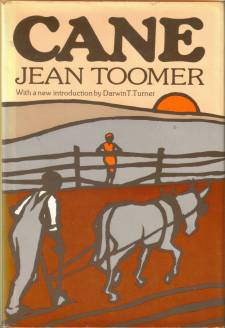
Jean Toomer's Cane and Ernest Gaines

The last blog post pointed out the influence that Ernest Hemingway had on Gaines and his writing. Hemingway influenced numerous black authors from Claude McKay, Ralph Ellison, Gloria Naylor, and Derek Walcott. What some may not know, however, is that an African American author influenced Hemingway himself. Jean Toomer’s Cane (1923) appeared at a time when the short story cycle arose more predominantly in the literary scene.  Sherwood Anderson, the author of the short story cycle Winesburg, Ohio (1919) told Gertrude Stein in 1924 that she should read Toomer’s Cane. Stein and Anderson both mentored Hemingway, so "it is a virtual certainty," as Gary Holcomb writes, that "Hemingway was acquainted with Toomer's book" (311). 

Gaines has stated that African American authors such as Richard Wright did not have an influence on his writing when he started. He has cited Ivan Turgenev, Fydor Dostoyevsky, Leo Tolstoy, James Joyce, Ernest Hemingway, William Faulkner, John Steinbeck, Willa Cather, Sherwood Anderson, and others as influences. Gaines states, “I didn’t read Cane until after I got out of college. I didn’t read Cane until about ’59 or ’60. By then I had developed what I suppose is my way of writing” (Gaudet and Wooton 35). In a 1994 interview with John Lowe, Gaines outlines the relationship between Hemingway and Toomer explicitly: 

I discovered Cane in the sixties. I thought it was so poetic—you know, Sherwood Anderson knew about that book, and I’m almost certain he mentioned it to Gertrude Stein and Hemingway because of those little things in Hemingway’s first collection of stories, In Our Time—he has those little breaks between each one of those stories, and I wonder if he didn’t get that from having read Toomer’s Cane; and of course, Cane came out much earlier. (317)  

Hemingway taught Gaines structure and understatement among other things, and Gaines sites those as characteristics in regards to Toomer’s writing in Cane. Looking at “Karintha” and “Esther” from Cane in comparison with Catherine Carmier one can see how Gaines, through his admiration for Hemingway, indirectly received inspiration from Toomer. 

Gary Holcomb's book, which he co-edited with Charles Scruggs, Hemingway and theBlack Renaissance contains 10 essays that lay out the literary connections between Ernest Hemingway and black authors such as Claude McKay, Ralph Ellison, James Baldwin, Toni Morrison, and others.  

Gaudet, Marcia and Carl Wooten. Porch Talk with Ernest Gaines: Conversations on the Writer’s Craft. Baton Rouge: Louisiana State University Press, 1990. Print. 
Holcomb, Gary Edward. "Race and Ethnicity: African Americans." Ernest Hemingway in Context. Eds. Debra A. Moddelmog and Suzzane del Gizzo. Cambridge: Cambridge University Press, 2013. 307-314. Print. 
Lowe, John. "An Interview with Ernest Gaines." Conversations with Ernest Gaines. Ed. John Lowe. Jackson: University of Mississippi Press, 1995. 297-328. Print.


Thursday, May 15, 2014

The Two Ernests: Gaines and Hemingway

Picture of Ernest Hemingway
that hung in Ernest Gaines' office.
Ernest Gaines has continually pointed to Ernest Hemingway's writing as an inspiration for his own. One needs to only look at interviews where Gaines discusses authors who had and effect on him to see this. When discussing the title of his first novel, Catherine Carmier, with his editor, Gaines originally wanted the title to just be Catherine; however, the editor wanted more. Gaines did not want to change the title because the novel had already had numerous ones. He wanted to keep it as Catherine in part because he had just finished reading Hemingway's A Farewell to Arms. He said:
I figured what was good for Hemingway was good enough for Ernie Gaines, so I said, 'What's wrong with Catherine?' My editor said he thought something else ought to go with it. All right, her last name is Carmier; call her that. Call her anything--as long as I don't have to think up another title. 
So, the book became Catherine Carmier. This is not the only influence that Hemingway has had on Gaines. Throughout his career, Gaines has acknowledged that Hemingway provided him with two very important lessons: how to write about characters who exhibit grace-under-pressure and the value of understatement.

When discussing grace-under-pressure in a 1976 interview with Charles Rowell, Gaines said:
These are things I tell a young writer he can learn from reading Hemingway's stories. Hemingway's characters are white, that's true, but we can learn how to write about our own black characters by reading what he has to say about his white characters--because, as I said, the theme that Hemingway uses is more related to our own condition than that of white Americans. Good examples of Hemingway's themes of grace under pressure can be found in "Fifty Grand," the story about a boxer, and in The Old Man in the Sea, where the character fights sharks and is defeated--physically defeated, but not spiritually defeated--when he loses his great fish. (91-92). 
You can even look at Lieutenant Frederic Henry in A Farewell to Arms and see the same theme that Gaines mentions in regards to Santiago's struggle with bringing the "great fish" back to shore. Henry, through everything he endures, doesn't falter under the pressure. Likewise, the characters in Gaines' work can be seen in the same light. Miss Jane remains strong from the beginning of her autobiography through the end. Jefferson, even though he begins the novel by being compared to a pig, rises up and displays grace under pressure by the end of the novel. Gaines mentions James' resolve in "The Sky is Gray" from Bloodline (1968). James, no matter how much his tooth hurts, never complains. No matter how cold or how hungry he gets, he never complains. James remains strong throughout.

The second item that Gaines draws from Hemingway is the value of understatement. Hemingway has the ability to talk around events without giving the specific event that occurs. Thinking about "The Sky is Gray" again, Gaines has stated that the only white people that Octavia and James come in contact with in the short story are polite and nice. However, the existence of racism and segregation permeate the text. even though it is not explicitly stated, Octavia and James must go to the back of town to eat because of their skin color, and while the white people they come in contact with are nice, there are those, who do not appear, that remain lurking off the margins of the page.

Hemingway, of course, is not Gaines' only influence; however, he has provided Gaines with two major aspects of his writing. These influences cannot be overlooked when talking about the legacy and work of Gaines or any author for that matter.  

Rowell, Charles. “That Louisiana Thing that Drives Me: An Interview with Ernest J. Gaines.” Conversations with Ernest Gaines. Ed. John Lowe. Jackson: University of Mississippi Press, 1995. 86-98. Print.