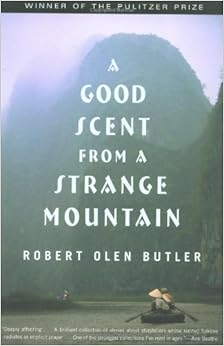
 The other day, someone told me about Robert Olen Butler's Pulitzer Prize Winning A Good Scent from a Strange Mountain (1992), a collection of short stories that chronicles the lives of Vietnamese immigrants in Louisiana. I've only had the chance to read a couple of the selections, and today I would like to briefly write about one of them, "Crickets." Told from the point of view of a Vietnamese immigrant named Thiệu, the story centers around Thiệu trying to instill a sense of Vietnamese culture and history into his son Bill. The story, only six pages in length, contains numerous themes that are worth exploring; however, I will only focus on a couple of them today.
The opening paragraph of "Crickets" sets the stage for what will follow between Thiệu and his son Bill. Thiệu begins by saying, "They call me Ted where I work and they've called me that for over a decade now and it still bothers me, though I'm not very happy about my real name being the same as the former President of the former Republic of Vietnam [Nguyễn Văn Thiệu]" (59). From the first sentence, we know that the narrative will focus on tensions within the narrator regarding him and his wife's escape to America after the fall of Saigon and their struggles to live within a different culture while maintaining a sense of their identity. In America, Thiệu does not go by his original name; instead, he goes by an Americanized version, Ted, partly out of a desire to assimilate but partly because even though he points that Thiệu is a common name in Vietnam many people in America associate it with Nguyễn Văn Thiệu. After fleeing Vietnam, Thiệu and his wife ended up in Lake Charles, Louisiana, "where there are rice paddies and where the water and the land are in the most delicate balance with each other, very much like the Mekong Delta, where [Thiệu] grew up (60). (Mike Tidwell's Bayou Farewell discusses these similarities.)
Thiệu's Americanization comes at an expense, his son. On their first night in Lake Charles, Thiệu and his wife conceived their son, and both decided to name him Bill. They chose Bill because it is "an American name," and Thiệu and his son became "Bill and his father Ted" (60-61). While names do not tell the whole story of a person's life or past, Bill and Ted connote an Americanized identity that is devoid of any reference to the past life that Thiệu had in Vietnam. This lack of connection, especially with his son, aggravates Thiệu. He wants Bill to understand his culture and his heritage; however. Bill "is proud to be born in America, and when he leaves in the morning to walk to the Catholic school, he says, 'Have a good day, y'all'" (60). When Thiệu tells Bill goodbye in Vietnamese, Bill looks at him and says, 'Aw, Pop" as if it's a joke (60). In regards to him not speaking Vietnamese, Thiệu's wife simply responds by telling him that Bill is American. This statement reminds me of Stanley's comments about being Polish in Tennessee Williams's A Streetcar Named Desire. Stanley simply says, "I'm American."
Getting frustrated with his son's lack of cultural identity with his Vietnamese roots, Thiệu suggests that they find crickets to have them fight one another. This was something that Thiệu and his friends used to do in Vietnam, finding charcoal crickets and fire crickets to put in the ring. Thiệu walks a fine line trying to convince his son to find crickets to fight, even thinking about how he is struggling against the Saturday morning cartoons that pit superheroes and robots against each other. after finding only charcoal crickets, Bill begins to get bored, asking how many they need. Thiệu sits beside the house and looks in the shoe box. He notices that they have only gathered up six charcoal crickets and no fire crickets. You need both, according to Thiệu, to fight each other because the crickets balanced one another out. While he ponders the shoe box full of charcoal crickets, Bill exclaims, "Oh, no," and Thiệu thinks that Bill understands the need for both types of crickets. However, Bill only points to his shoes and says, "My Reeboks are ruined!" (64). Thiệu acquiesces to defeat and tells his son he can leave.
The story ends the next morning with Bill leaving for school. His mother cleaned his shoes, and as he walks out the door, Thiệu tells him, "See you later, Bill" (64). With this final line, Thiệu relinquishes his desire to instill in Bill a sense of tradition and history. His son is American, without a care in the world for his Vietnamese heritage. This does not mean that Bill will not one day care about his heritage, but at this time, as a ten year old, he does not. In many ways, this story reminded me of a recent episode of Fresh off the Boat where Jessica (the mother) is afraid that her sons will not know anything about their Chinese heritage so she panics and starts to make everything about China. The family moved from Washington D.C. to Orlando, FL. Ultimately, the episode explores the melding of cultures and how one, especially Jessica's son, can have knowledge of and respect his Chinese heritage while also being American.
This is a topic that I've thought about with the Indian Removal Act in the 1800s and other topics. What are your thoughts? What other works that focus on assimilation and cultural heritage could we examine? I know there are many. Are here any that specifically focus on Louisiana?
Butler, Robert Olen. "Crickets." A Good Scent from a Strange Mountain. New York: Henry Holt and Company, 1992. 59-64. Print.
