|
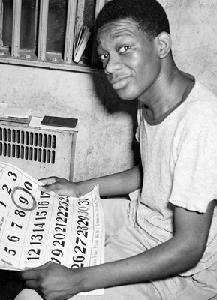
| Willie Francis |
The Autumn 2005 issue of the
Southern Review and the book
Mozart and Leadbelly (2005) both contain Ernest Gaines' essay
"Writing A Lesson Before Dying." Quotes from the essay come from
Mozart and Leadbelly. In the essay, Gaines talks about the process of writing the 1993 novel. Originally, Gaines wanted to set the novel in the early 1980s. However, after speaking with Paul Nolan about the Francis case, Gaines' vision started to change. Gaines writes, "There were so many similarities [between the Francis case and his previous works]--the work, religion, the food that people ate, everything. The case Paul recommended could have happened in the parish where I grew up" (53). Looking at Gaines' other works, this comment comes as no surprise. Francis resembles characters like Proctor Lewis in "Three Men" and Marcus in
Of Love and Dust; the only difference, however, is that Jefferson dies in the electric chair at the end of the novel. Proctor and Marcus both have the opportunities to get bonded out of jail, Jefferson does not.
When thinking about Francis' case, Gaines says, "If I put the story in the forties, there was so much material I could use. . . . I could use the church school for background, the church where generations of my folks had worshipped and where I had attended school my first six years. I could use the crop as background. . . I knew the food the people ate, knew the kind of clothes they wore, knew the kind of songs they sang in the fields and in the church" (54). In essence, as stated earlier, the Francis case could have occurred in the parish where Gaines grew up. Along with talking about these items, Gaines also discusses Gruesome Gertie and its reputation, explaining how it traveled from parish to parish and how the generator caused it to be heard all over town.
 |
| Gruesome Gertie |
Looking at the Francis case and Jefferson, some striking similarities arise. The state accused both men of murdering a white man, both had state appointed attorneys who did not really defend them, both were nearly illiterate, both were judged by a jury of twelve white men (no women or African Americans), both were condemned to die in the electric chair, and both wrote narratives about their experience (Francis' "My Trip to the Chair" and Jefferson's diary in chapter 29). One read through Francis' pamphlet solidifies the similarities even more. Francis says he wanted ice cream for his last meal, a priest told him to "stand like a man," he says the sheriff and deputies treated him well, and he concludes by stating, "Mr. Montgomery says that in writing this I may have helped someone, somehow. I hope so" (16). Jefferson's diary, and the mere fact that he walks to the chair upright, accomplishes the same things that Francis hoped his pamphlet would.
For more information on the Willie Francis case and
A Lesson before Dying, look at Jason Stupp's "Living Death: Ernest Gaines's
A Lesson before Dying and the Execution of Willie Francis" in
Demands of the Dead: Executions, Storytelling, and Activism in the United States (2012). In 1982, the
DePaul Law Review carried Arthur S. Miller and Jeffrey H. Bowman's "'Slow Dance on the Killing Ground': The
Willie Francis Case Revisited."
Gaines, Ernest J. "Writing
A Lesson Before Dying."
Mozart and Leadbelly. New York: Vintage Books, 52-62. Print.