Showing posts with label ernest gaines. Show all posts

Tuesday, June 30, 2015

Stylistic Elements in Bontemps's "Black Thunder"

1968 Beacon Press Edition
At the beginning of February, I did a few posts on Arna Bontemps and his relation to Ernest J. Gaines. Today, I want to look at another one of Bontemps's works, Black Thunder (1936), and briefly examine how it relates to Gaines's A Lesson before Dying stylistically. Black Thunder tells the story of a failed slave rebellion led by Gabriel Prosser in Virginia in 1800. It chronicles the lead up to the revolt, the revolt itself, and Gabriel's capture and execution. When it appeared in 1936, the novel received favorable reviews; however, it did not garner much in regards to sales. In the introduction to the 1968 edition, Bontemps argues that "the theme of self-assertion by black men whose endurance strained to the breaking point was not one that readers of fiction were prepared to contemplate at the time" (xv). Gabriel's "self-assertion," and his survival with dignity even in the face of capture and execution, can be seen, thematically, in relation to Jefferson's "awakening" in A Lesson before Dying and his own "self-assertion" as a man at the end of that novel. I do not wish to explore this element today; instead, I want to briefly look at section right before the rebellion.

The final chapter in Book One "Jacobins," shows Criddle, Ditcher, a mulatto boy, Mingo, Blue, Old Catfish Primus, and Juba preparing to follow Gabriel and overtake Richmond. The chapter only constitutes about four pages, and each of the characters mentioned above gets his or her own little section within the chapter. They do not appear in the space; the third person omniscient narrator moves from one character to another showing each one's preparations. Criddle's movements begin the chapter. He enters Marse Prosser's stable at night, and no one pays any attention to him. He finds a loose board in the floor then removes a "hand-made cutlass" and begins to sharpen it. Next, Ditcher can be seen leaving his cabin and speaking with the moon and a neighbor about the upcoming events. Close to morning, a mulatto boy fishes by the creek and converses with his "mammy" about the upcoming rebellion. The free African American Mingo thinks about his position as a "free" man who owns his own business. However, his wife and children remain slaves. He locks up his shop and thinks back to his wife being whipped mercilessly. After working in the fields, Blue speaks with his mule and contemplates his impending freedom, daydreaming about "riding in a public stagecoach with a cigar in his mouth" and drinking freely in a tavern (79). Next, Old Catfish Primus speaks with another man about conjure and protection for the rebellion. Primus gives the man a "fighting 'hand'" (79). Juba, Gabriel's lover, concludes the chapter. She prepares Araby for the ride to come; Gabriel enters, checks to see if everything is ready, then leaves to prepare for the night ahead.

Gabriel Prosser
The above chapter reminds me a lot of chapter 30 in A Lesson before Dying. There, Gaines changes the point of view from first person (Garnt and Jefferson's Diary) to third person. The chapter details the entrance of Gruesome Gertie into Bayonne for Jefferson's execution. It chronicles citizens reactions to the truck entering town, the chair being removed from the truck, and the chair being set up. There are sections from the Sheriff and Paul, as well as sections from ordinary African American and white citizens. Some shopping in stores and some working in the courthouse. While the novel focuses on Grant's perspective, the shift in chapter 30 allows for a broadened view of how the community relates to the events surrounding Jefferson's execution. For me, this chapter has always been interesting because in the midst of Grant's narrative we see into the heads of others, not through Grant's eyes but through a detached narrator's perspective.

When I read that chapter in Black Thunder, I could not help but recall chapter 30 in Gaines's book. Both let us, as readers, see into the heads of characters as events unfold around them. This is nothing new, of course. What makes it unique, to me, is the fact that Gaines's novel switches its point of view for only one chapter, near the end, and that Bontemps's, while told in third person, takes the time to highlight character's thoughts and preparations for the upcoming rebellion.

For the next post, I want to look at another unique characteristic I picked up on in Black Thunder. As I said earlier, the novel is told from the third person perspective, but the narrator periodically moves in to characters' minds and shows how they think and perceive the events. This technique, which employs stream of consciousness, reminds me of some sections of Toomer's Cane.  

Do you see these stylistic elements in other modernist texts? In other texts in general? What are some examples? Let us know in the comments below.

Bontemps, Arna. Black Thunder. Boston: Beacon Press, 1968. Print.

Thursday, June 18, 2015

Gaines and Visual Art: Depicting Social Landscapes in "A Gathering of Old Men"

Today's blog post comes to us from the Ernest J. Gaines Center's Summer Research Fellow from Cal State LA Katharine Henry. Her previous post, "'Deep in You:' Encountering Gaines," was the June 2, 2015 entry.  In today's post, she speaks Gaines's reference to Pieter Brueghel in A Gathering of Old Men. For further information on Gaines and visual art, see our post on Gaines and Van Gogh from June 5, 2014.  

In Jeanie Blake’s 1982 interview with Ernest J. Gaines, the author describes writing the massacre scene in The Autobiography of Miss Jane Pittman as “a [Pieter] Brueghel painting scene, a very violent scene” (141). One year later, A Gathering of Old Men is published and much of the novel’s violence is psychological with physical abuse chronicled after the fact. Marshall plantation’s brutal Cajun farmer, Beau Boutan, is shot before the novel begins. Once his younger brother, star LSU quarterback Gil Boutan, learns of his death, Gil’s close friend and fellow athlete, Sully, drives them to the crime scene where eighteen old black men with shotguns await the Boutan family patriarch, Fix, to take swift revenge. Sully describes the scene of these men gathered in Mathu’s yard as surreal, “Something like looking at a Brueghel painting. One of these real weird, weird Brueghels” (Gaines 118). Where Gaines aims for “the reader to hear the sounds of people being clubbed to death, to hear how the small animals and birds leave” (Blake 141) in The Autobiography of Miss Jane Pittman, Bruegel is useful for thinking how the old men gathered in Gaines’s subsequent novel commemorate their silencing and vocalize an alternative communal narrative of survival and transcendence.  

The Brueghel family was talented, spawning four generations of Flemish painters that began with the most famous, Pieter Bruegel the Elder. This eldest Brueghel, who later changed his name to Bruegel, produced art in the 16th century, crafting bizarre, masterful landscapes of ordinary peasant life. The Fight Between Carnival and Lent (1559) and The Wine of St. Martin’s Day (1565-1568) are two oil paintings that encapsulate his fascination with mass gatherings of people. The crowding of people and their small scale conveys the public as a chaotic, while coherent, organic machine akin to an ant colony. Musicians, nuns, upper class men, bakers, old and young alike, the impoverished and the disabled all pursue their individual missions on Bruegel’s canvases. The disorder of these gatherings creates a whole, complete vision of European society during the Renaissance. Four centuries later, Gaines’s old men with “Cataracts. Hardly any teeth. Arthritic. Old men. Old black men…Who have been hurt…Tired old men trying hard to hold up their heads” are not the clamored folk of Bruegel’s artworks, but their contradictory testimonies explaining why and how they killed Beau, similarly bolster their collective strength (Gaines 137). Each confession while not the “real” story the sheriff seeks, is just as true, adding a layer to the oral patchwork of American history from the post-emancipation to the post-Civil Rights movement eras.

Netherlandish Proverbs
In Netherlandish Proverbs (1559), Bruegel illustrates his theory of how private and public life continually melt into one another. No edifice, home or barn is safe from his paintbrush, each has an opening, porous to voyeurs and any figures, human or animal, that climbs in through every window and squeezes out from every crevice. Animals and humans dine alongside each other; the pastoral and urbanized blend smoothly. In the plantation quarters, private and public life are equally indistinguishable.  Cherry, who reflects upon the community cemetery, clearly articulates this, “Back there when I was growing up, people didn’t even mark the graves…They had all come from the same place, they had mixed together when they was alive, so what’s the difference if they mixed together now?” (Gaines 44)

Bruegel’s Fall of Icarus recasts the focus away from its mythic, epic title character in favor of the simple farmer and shepherd. These pastoral figures grace the foreground of the composition while Icarus is nearly lost from the painting, were it not for two nearly imperceptible legs splashing humorously in the water. Icarus’s fate is not a dramatic descent from the heavens but a humorous flop into the ocean where he is relegated to a miniature figure and appears to have sooner fallen off the nearby ship than to have fallen from the sky. While Bruegel selects a classical tale for his painting, his composition subverts the mythological narrative to validate human labor and harmony with nature as a worthier existence than a prideful rebellion against nature. In Gaines’s novel, the land is at the center of the community’s sense of identity and those who work it with their bodies, rather than with tractors, better recognize its value as a living organism all its own, not distinct from their human community. Johnny Paul declares he killed Beau because, “I’m the last one left…I just didn’t do it for my own people. I did it for every last one back there under them trees. And I did it for every four-o’clock, every rosebush, every palm-of-Christian ever growed on this place” (Gaines 92). Johnny Paul upholds the trees, plants, flowers, the dead and the living as equals to himself, worth his protection and self-sacrifice. Mapes, the white sheriff and witness to the gathering, is not the only audience for their testimony. Yank “wasn’t talking to us now. He was thinking back, back when he was a younger man,” Coot “was over by the garden fence, looking down the quarters toward the fields,” and Charlie is talking “Not to Mapes, not to us, but to himself” (Gaines 98, 103, 188). Johnny Paul also “wasn’t looking at Mapes, he was looking toward the tractor and the trailers of cane out there in the road” narrating to the land what it has already seen and knows (Gaines 88). His love letter to the land expresses that there is no distinction between the human and natural world and reaches its most intimate gentleness in his claim that he killed Beau, ‘To protect them little flowers. But they ain’t here no more’ (Gaines 90).

The Fall of Icarus
Like Johnny Paul, Yank ‘ain’t thinking ‘bout no progress’ as Mapes and Beau see it, but about how “progress” has lead to regression for blacks (Gaines 99). Johnny Paul most strongly identifies the limits of white knowledge and authority in his simple, powerful statement: ‘No, you don’t see’ (Gaines 88). This moment is the community’s sit-in, their demonstration in a time and place where the Civil Rights movement seems to have never touched fifteen years later—there are no references in the novel to the movement other than local bar owner Tee-Jack’s brief dismissal of “all that desegregation crap” (Gaines 152). The men do not march to a “Whites only” water fountain as one of Jimmy’s protestors does in The Autobiography of Miss Jane Pittman but stand their ground for the younger, vulnerable, fearful men they used to be and for the old men that they are now. Uncle Billy, Gable, Mathu, Dirty Red, Johnny Paul, Yank, Tucker, Coot and others share stories of endurance that challenge how the law and the Old South—via Mapes and Candy, respectively—have viewed them as weeds.

Preceding Sully’s parallel of the gathering of old men to a Bruegel painting, he compares it to “that old TV play Twilight Zone…You would be driving through this little out-of-the-way town, and suddenly you would come upon a scene that you knew shouldn’t be there” (Gaines 118). There is a distinct bizarreness, perversion, and unnaturalness in Bruegel’s paintings—pigs carry knives, foxes sit at the dinner table ready to eat with a bib around their necks, human limbs peak out the crevice of one edifice while the rest of their bodies remain cloistered, eggs walk on tiny feet. The strangeness that Sully witnesses and connects to Bruegel is a conception of black self-defense as a foreign notion, which Mat echoes: ‘Anytime we say we go’n stand up for something, they say we crazy’ (Gaines 37). Akin to Bruegel’s figures who sprawl in every direction in constant movement, against the classical impulse towards order, the old men disband from the orderly and oppressive rules and reassemble into a community of their own making, not Candy’s army but a self-regenerative, dignified, self-sustaining community that boldly claims, as Charlie does, ‘I’m a man’ (Gaines 187).


Blake, Jeanie. “Interview with Ernest Gaines.” Conversations with Ernest Gaines. Ed. John
Lowe. Jackson: University of Mississippi Press, 1995. 137-148. Print.
Gaines, Ernest J. A Gathering of Old Men. New York: Vintage, 1992. Print.

Tuesday, June 16, 2015

Reflections of the Second Annual Ernest J. Gaines Summer Teaching Institute


Last week, the Ernest J. Gaines Center, in conjunction with the Louisiana Endowment for the Humanities (LEH), hosted the Second Annual Ernest J. Gaines Summer Teaching Institute. In June 2014, the center hosted the inaugural institute with four participants from area schools. This year, the institute included nine participants from area schools and universities. One participant even came from Texas to take part. Participants read four of Gaines's works during the week: Bloodline, The Autobiography of Miss Jane Pittman, A Gathering of Old Men, and A Lesson before Dying. Each day, participants heard from the center's staff and two Gaines scholars who are also Gaines scholars: Marcia Gaudet and Darrell Bourque. Participants also had the opportunity, each day, to look at items from the collection and to work on lesson plans that would incorporate their discussion and items from the collection into their lesson plans. These lesson plans will be available on the LEH's website soon. Midway through the institute, on Wednesday, the participants had the opportunity to head out to Oscar and New Roads, LA. There, they sat with Gaines in his house, explored the cemetery and the church, and had the opportunity to eat with Gaines at local restaurant.

Overall, the institute provided lively discussion not just on Gaines's works but also on how to incorporate those works, and the themes he discusses, into the middle and high school classroom as well the university classroom. These discussions arose when the group thought about the importance of Gaines's work in relation to the recent incidents involving African American men and women in the news today. During the discussions, one of the questions that came up felt extremely important. A participant, who taught Gaines in her classroom last year, mentioned that her class was predominately African American. While teaching Gaines, white students in her class asked her why they were reading about the African American experience and used the term "reverse racism" to express how they felt. This anecdote reminded me of my own experiences teaching African American literature in the university classroom. Once, when teaching Langston Hughes, I had a student approach me after class to inquire, and to complain, about why we were reading so much African American literature. Truth be told, Hughes and others were a small part of the class.

What my encounter with that student and the participant's story showed me was that when people come face-to-face with the realities of their situation and place within society they either recognize it and work to make society better from their position or they completely reject the idea that they come from a position of driveler and claim that everyone has a chance at the American Dream. When talking about how to help students who reject the image they see in the mirror, we thought about approaching a text like Gaines through another angle. Gaines recognizes that while the African American experience is unique there are others in the world who have suffered for various reasons as well based on ethnicity or class. He writes about this in "A Very Big Order: Reconstructing Identity" and in Catherine Carmier. With that in mind, a teacher could have students think about Gaines's influences and how they affected his own writing. Russian, Irish, and American writers influenced Gaines. Turgenev, Tolstoy, Joyce, Steinbeck, Cather, and others wrote about the lower classes, and the peasants in their societies. When Gaines read those works, he saw similarities between the people he knew and the ones the other authors wrote about. What he did not see, though, was his own people, the African American community he grew up in rural Louisiana.

Another way to possibly approach Gaines's work, or other African American texts, with students who want to push back because they claim we reside within a post-racial society is to incorporate music. Historically, people viewed punk music as an "other," a subculture of outsiders. Having students enter into Gaines's work through a music that others ostracized and that created a community for its listeners is a way to think about how to help students understand the universality to Gaines's works. Bands like The Descendents, NOFX, Rancid, Reagan Youth, Misfits, Black Flag, Minor Threat, etc. would be good places to look. There are other ways to address students' reluctance to reading authors like Gaines, but these are just a couple we thought of.

Many other discussions took place during the week, but the one above is what really stuck out to me because it is something that I have thought about, especially when teaching Gaines in the region that he writes about. Doing that creates a whole new group of reactions to Gaines and his work. What are your thoughts on getting reluctant students, who feel you are representing one group too much, to understand that we need to read African American, Asian, Chicano, and other literature? How do you respond? I would like to know because this is something I think we all deal with at one point or another in the classroom, or in community talks, and it is something that needs to be addressed.

Thursday, June 11, 2015

Kiese Laymon's "Long Division" and Words


While Mitchell S. Jackson's The Residue Years ultimately won the 2014 Ernest J. Gaines Award for Literary Excellence, there were a few books on the short list for the award. One of those books was Kiese Laymon's Long Division (2013), a novel reminiscent, in some ways, to Octavia Butler's Kindred. Laymon's novel ostensibly takes place in 2013; however, characters oscillate between three different years: 2013, 1985, and 1964. The characters' movements through these varying years works to show that we should pay attention to our history and work to understand it; their time travel also highlights that even though things look like they have gotten better, a lot of the same issues still remain, just in varying ways. In this aspect, Laymon's novel treats some of the same themes that Gaines's work does, that of the changing, yet unchanging, times. I wrote about this last week in regards to In My Father's House.

Laymon's focus on language, and the use of it, should be seen as a discussion of the changing, yet unchanging, times. The 2013 section of the novel begins with the narrator City and LaVander Peeler preparing for a national contest entitled "Can You Use That Word in a Sentence," a contest that started "after states in the Deep South, Midwest, and Southwest complained that the Scripps Spelling Bee was geographically biased" (7). The judges give contestants a word, and the contestants must provide "correct sentence usage, appropriateness, and dynamism" to advance (7). The contest presents an interesting scene because while it supposedly represents those who do not have representation at the spelling bee, it ultimately just parades African Americans, Mexicans, and others in front of a national audience to essentially, as Billy says in Gaines's novel, to give lip service to change while not necessarily adhering to it.  

Part of that change relates to words and language as well. Throughout the novel, the usage and role of specific words gets discussed. Typically, the discussion centers around derogatory words that cause hurt and pain when spoken or written.  When City gets called in to the principal's office at the beginning of the novel, he ruminates on why Ms. Reeves summoned him there. He concludes that LaVander Peeler told her that City "called him a 'nigger'--not'nigga,' 'negroid,' 'Negro,' 'African American,' or 'colored'" (13). I do not want to get into too much detail about the novel, but the "er" at the end of the word above struck me, especially when thinking about it in relation to what happens at the conclusion of the novel when LaVander asks a chained up white man to spell the word. The man spells it with an "er," and LaVander simply replies, "All things considered, I don't think that's right" (252).

City deduces that LaVander turned him in because earlier someone turned LaVander in for calling City a "faggot." After the incident, LaVander began to use the term "homosexual" when taunting City "because he knew Principal Reeves couldn't punish him for using that word without seeming like she thought there was something wrong with being homosexual in the first place" (13). City muses about other derogatory words as well and their semiotic meanings. Ultimately, I think that these thoughts about the role of words, their meanings, and the way the power they have to construct and form people's perceptions of others is partly at the heart of Laymon's novel. Words, and even the correct usage of words, becomes a way that the past remains the same, as I mentioned earlier.

This discussion can be summed up by briefly discussing the "Can You Use That Word in a Sentence" finals. City gets eliminated on the word "niggardly." City provides a sentence that attacks the judges and the system they are perpetuating, using the word colloquially. He says, "I truly hate LaBander Veeler sometimes more than some of y'all hate President Obama and I wonder if LaBander Veeler should behave like the exceptional African-American boy he was groomed to be by his UPS-working father, or the, um, weird, brilliant, niggardly joker he really is when we're the only ones watching" (38). City's sentence gets him eliminated because the term means "stingy, cheap," and he does not use it in that way. Now, when providing a suitable example of the word, the judges highlight the power of language and how, without even referring to the color of the woman being spoken about, they perpetuate stereotypes even when using the term correctly. Their sentence is, "Perspiration covered the children who stared incessantly at the woman in the head wrap since she insisted on being so niggardly with the succulent plums and melons" (38). The sentence oozes with stereotypes by referring to the woman in a "head wrap" who protects her "plums and melons." City knows the word provided a catch 22, and as he leaves the stage, he extols, "I mean, even if I used the word right, I still would've lost" before he goes on a vociferous tirade where he calls out the judges and the audience on their fears (38).

This post barely touches on the role of language and semiotics in Laymon's novel, but I hope it provides a little glimpse into the way we use words and how they have an effect on people. If you haven't already done so, I would strongly suggest picking up a copy of Laymon's essays How to Slowly Kill Yourself and Others in America (2013). (The title essay can be found here.) They are excellent, and extremely reminiscent of James Baldwin and Richard Wright.

Laymon, Kiese. Long Division. Chicago: Bolden, 2013. Print.


Tuesday, June 9, 2015

"The Tenant" in Gaines's "In My Father's House"


There are varying things I could discuss for today's post in regards to In My Father's House (1978). However, I think for right now I just want to focus on a stylistic element of the novel that caught my attention on this read through. Specifically, I became intrigued by the elements of mystery and suspense that permeate the first parts of the novel but also continue through until the end of the novel. These elements appear in relation to the mysterious character who knocks on Virginia Colar's door on a rainy, winter night.

The stranger knocks on Virginia's door, and when she opens it, she sees "a thin, brown-skinned young man standing before her in a wet overcoat" with a "scraggly beard" and "Army field cap" asking if she has any rooms available (3). Virginia questions whether or not she should entertain providing a room for the young man, but her conscience overcomes her because she does not know where else he will go. Even though by-law the white motel should accept him, she knows that they will not do it. After agreeing to rent a room out to the man, he provides Virginia with some information. He tells her he is from Chicago, and she doesn't believe him. He tells her his name, Robert X, and she thinks about which group of people use "X" for their last name. At this point, Virginia again questions her decision to let Robert stay, but she acquiesces by continuing to wonder where else he will go.

From the opening scene, we, as readers, are left asking who Robert X is and why he has come to St. Adrienne. People see him walking through town at all hours of the night, Virginia hears him screaming in his sleep, and he stands out in the cold and rain in various spots throughout the community. All of this arouses suspicion among St. Adrienne's inhabitants, causing them to continually ask why Robert X has come to town. Robert tells them that he came to St. Adrienne to attend a men's conference and to meet a man. Robert X's appearance creates a sense of mystery at the beginning of the novel, and the continued lack of references to him by the name of Robert X throughout the first few chapters adds to this. We learn his supposed name on the third page of the novel, but after that initial introduction, he becomes referred to as "the tenant" by the novel's narrator.

When Elijah meets Robert on the street in chapter two, the men begin to talk. Every time Robert speaks, "the tenant" or "he" follows the verbal words. The act of referring to Robert not by the name he provides but by a generic term such as "tenant" essentially erases his agency at this point of the story because the narrator does not even acknowledge that Robert has a name, even it is not his given name. What does this do? If we think about the rest of the novel, the erasure of Robert's agency plays in to the struggles of Robert/Etienne in the text. He fails to protect his sister, and he fails, ultimately, to accomplish his mission in St. Adrienne. The "tenant" does not act, he only causes people to question.

More could be said here, but right now I'm not completely sure what I could say. What are your thoughts on this topic? Why is it important that he only becomes "the tenant" and not Robert X or Etienne at these early stages? Let me know in the comments below.

Gaines, Ernest J. In My Father's House. New York: W.W. Norton & Company, 1978. Print.

Thursday, June 4, 2015

Gaines's "In My Father's House" and the Changing Times

Unfortunately, Gaines's 1978 novel In My Father's House is not one of his works that gets read very often in the classroom. In light of recent events throughout our country from Ferguson to Baltimore, In My Father's House should be read with an eye reflecting back on what happened during the Civil Rights Movement and with an eye towards what has occurred since then. The novel focuses on the "generational gaps" between fathers and sons created by the legacy of slavery, Jim Crow, and racial oppression in the United States over that past four hundred years. This is something Gaines mentions throughout his oeuvre, and it shows up in A Lesson Before Dying when Matthew Antoine talks to Grant about teaching the children in the quarters: "You'll see that it'll take more than five and a half months to wipe away--peel--scrape away the blanket of ignorance that has been plastered and replastered over those brains in the past 300 years" (64).

In My Father's House begin with Etienne/Robert X returning to St. Adrienne to confront his absent father turned Civil Rights leader Philip Martin. Initially, the narrative focuses on the mysterious character of Etienne who arrives in town on a rainy night during the winter. Once there, his behavior causes the community to question who he is, why he is there, and why he acts the way he does. They find out that his appearance in St. Adrienne has to do with Philip Martin. Martin is Etienne's father, in name only. Etienne comes to St. Adrienne to kill Martin because he feels that Martin has neglected him, his siblings, and his mother. After this revelation, the narrative shifts to focus on Martin and his struggles to mend the gap between Etienne and himself as he struggles to confront his past and maintain his leadership of the movement in St. Adrienne. While this is only a brief summary of the novel, it provides you with an indication of the novel's focus on mending the gaps created by the abominable institution of slavery in this country.

The novel shows, as does other post-Civil Rights novels by Gaines, that the strides made during the mid-twentieth century in regards to voting rights and other actions caused a shift in the forms of subjugation from legally sanctioned Jim Crow to other forms of containment. Billy, a young man that Martin picks up while driving around Baton Rouge, expresses these thoughts in his discussions with Martin. Billy explains that even though strides have been made in regards to Civil Rights things remain the same, if not worse. Speaking on this, he tells Martin,
Niggers can vote. Vote for what? Voting can't fill your belly when you hungry. Another nigger sit up there in the capital. Doing what? Another one go up to Washington. For what? They put another couple on television to broadcast news--them the changes you talking about? I'm talking about changes that keep white men from coming into South Baton Rouge and shooting down our people. If it happen, we pick up guns, we pick up torches, and we hit back. That's the changes I want to see. (163-164)
Billy embodies the feelings, I would argue, of the Black Power and Black Arts Movements. Even with strides in regards to things like voting rights, the situation remained the same. According to Billy, there may be some "token" African Americans in government and on television, but that does not accomplish anything according to Billy. He goes on to speak about the changes occurring in regards to agriculture and how those changes affect the people's relationship with the hegemonic system that works to keep them down. He says, "Go over all this place--empty fields, empty houses, empty roads. Where the people used to be--nothing. Machines. Every time they build another machine that takes work from the people, they hire another hundred cops to keep the people quiet" (168). Since they cannot work the land, the African American population Billy speaks of either left or remained struggled to find employment. While the sharecropping system worked to maintain control of the community, with that gone, what remained? For Billy, "cops" became the system's answer to maintaining "quiet."

Billy vocally espouses his beliefs, but in A Gathering of Old Men, the same ideas provide an undercurrent at the end of the novel. As the men wait at Marshall Plantation for Fix to arrive and lynch someone, the old men do not get the opportunity to stand up to him. Instead, they confront Luke Will, a new representation of racism and subjugation that contrasts with Gil and Cal in the novel. Discussing the anticlimactic nature of the novel, Gaines told Mary Ellen Doyle in 1983, "So Fix's kind of vigilante vengeance is dying out, but there will be the new Luke Will type. The Luke Wills are in the police department. Fix is seventy or eighty and can't shoot straight, but Luke will do it for him" (168-169). The "separate but equal" segregation of Fix and Jim Crow may not exist anymore, and because of this, Luke Will's form of subjugation does.

I could not help but think about recent events while reading In My Father's House, specifically when reading Billy and Philip's conversation in the car. Gaines's post-Civil Rights novels deals with these issues, sometimes subtly and sometimes overtly. In light of the incidents that have been occurring throughout the nation, we need to read Gaines in conversation with them because he provides us with insight into how the events in northern, urban cities affect people in southern, rural places like St. Raphael Parish. What are your thoughts? What are other aspects of Gaines are relevant to recent events? Share in the comments below and make sure you check out and add to the Baltimore Syllabus for resources regarding the events in Baltimore.

Doyle, Mary Ellen, S.C.N. "A MELUS Interview: Ernest J. Gaines--'Other Things to Write About.'" Conversations withe Ernest Gaines. Ed. John Lowe. Jackson: University of Mississippi Press, 1995. 149-171. Print.
Gaines, Ernest J. In My Father's House. New York: W.W. Norton & Company, 1978. Print.


Tuesday, May 12, 2015

Ernest Gaines's Open Letter to Hank Aaron


Ernest Gaines has made his admiration for Major League Baseball Hall of Famers Jackie Robinson and Willie Mays well known. Living in San Francisco, Gaines became a lifelong San Francisco Giants fan, cheering the team on even when he returned to Louisiana to reside permanently. In 2007, Giants slugger Barry Bonds approached Hank Aaron's record of 755 home runs. Aaron told reporters that he would not attend the games where Bonds would possibly break his record, and speculation began to swirl about this decision. Many saw Aaron's refusal to attend the games as a reaction to the numerous rumors of Bonds's steroid use. Mike Gimbel pointed out that reporters overlooked part of Aaron's statements regarding his decision to stay away from the ball field. Instead of taking away from Bonds, Gimbel argues that Aaron chose to not attend so that Bonds could enjoy the full spotlight of his accomplishments. Whether or not this is the case, we may never know. What we do know is that many view Bonds's single season home run record of 73 and career record of 762 as "tainted" because of his PED usage.


During the lead up to Bonds's surpassing of Aaron's home run record on August 7, 2007, Gaines wrote an open letter to Hank Aaron in The Atlanta Journal Constitution urging him to support Bonds's pursuit of the all time home run record. Gaines draws attention to the vitriol that Aaron endured during his own pursuit of then record holder Babe Ruth in 1974. At the time, in 1973 and 1974, Aaron received numerous death threats. Gaines writes, "How soon people forget. Some. Not all. Because I can remember the days when you were approaching Bab [sic] Ruth's homerun record that some of the same people condemning Bonds today were sending you death threats. Why? I'll tell you why. They did not want to see a Black man break the greatest record set by a White man in sports." The letter to the right shows the hate focused on Aaron and his pursuit of Ruth's record. Just as Aaron received hate mail from individuals who did not want to see him break Ruth's record, Bonds received death threats as well. It is not clear, though, if these were racially motivated. We can presume that the threats contained racist language and overtones.

To me, the most interesting part of Gaines's letter comes when he says that everyone isn't like Aaron, Mays, or Jesse Owens. Gaines says, "Some of us are arrogant. We feel that once we do our work on the field, that should be enough to satisfy the fans." This statement reflects Gaines's thoughts on his own writing as I have written about before on this blog. This arrogance makes some people afraid, though. Gaines continues, "All geniuses are arrogant. Bonds wears his arrogance on his sleeve. And the White world doesn't like it. If you are Black, you are supposed to be humble." He goes on to say that he is not sure whether or not he would even like Bonds if he met him. That, however, is beside the point. The point is that the white media looks upon self-assertive, "arrogant" Black men as a danger. If the player was white, would the media view him the same way?

Aaron did send a message to Bonds when he broke the record. After Bonds's 756 home run, Aaron appeared on the big screen at AT&T Park and said:  
I would like to offer my congratulations to Barry Bonds on becoming baseball's career home run leader. It is a great accomplishment which required skill, longevity, and determination. Throughout the past century, the home run has held a special place in baseball and I have been privileged to hold this record for 33 of those years. I move over now and offer my best wishes to Barry and his family on this historical achievement. My hope today, as it was on that April evening in 1974, is that the achievement of this record will inspire others to chase their own dreams.


Even last year, Aaron received racially charged threats after comments he made regarding politics. These threats came, in 2014, when only 67 African American players held roster spots in the Majors. Three teams did not have any African American players on their rosters: San Francisco, St. Louis, and Arizona. This is a dramatic decrease in the number of African American players who made up on average 16% of the overall players between 1972-1996 in the Majors. Major League Baseball has worked to get more African American youth involved in playing baseball through various programs, but the numbers have not seen any large increase. Last year, an all African American Little League team, Jackie Robinson West, from Chicago was disqualified after allegations of zone tampering appeared. As well, comedian Chris Rock has been vocal about the lack of African American's in MLB baseball.

What are your thoughts? I bring up all of the other items here because of the incidents in Baltimore and the cancellation of two of the Orioles's games against the White Sox and because of Alex Rodriguez passing Willie Mays for fourth on the all time home run list. He accomplished this on May 7, 2015. For article questioning he issue of race in regards to Bonds's pursuit, see this article from 2007 in The Independent.

Thursday, May 7, 2015

Anthologies and the Literary Canon

During my recent conversation with Dr. Keith Clark, he spoke about his first encounters with the works of Ernest J. Gaines. He first encountered Gaines, as I am sure many did, when he saw the film version of The Autobiography of Miss Jane Pittman on CBS in 1974. He next encounter did not occur until he was working on his M.A. in the mid-eighties. As a graduate assistant, he taught an undergraduate course in African American literature using Richard Barksdale and Keneth Kinnamon's Black Writers of America: A Comprehensive Anthology (1972). Dr. Clark's anecdote made me start thinking about the construction of the literary canon and as a result the construction of literary anthologies again.


According to M.H. Abrams, "literary canon" refers to "those authors who, by cumulative consensus of critics, scholars, and teachers, have come to be widely recognized as 'major,' and to have written works often hailed as literary classics. The literary works by canonical authors are the ones which, at a given time, are most kept in print, most frequently and fully discussed by literary critics and historians, and most likely to be included in anthologies and in the syllabi of college courses" (29). Literary anthologies contribute to the construction of the "literary canon," and in closely tied to that role of canon formation is assisting teachers in general survey courses in covering wide swaths of literary expanses during the course of an academic semester or year. For example, when I teach Early American Literature, we begin in the 1400s and conclude in 1865. That is 400+ years of material. Anthologies help to parse the material out, in various ways, providing opportunities for me to introduce students to a wide array of authors and texts.


Barksdale and Kinnamon's anthology appeared about twenty five years before Henry Louis Gates, Jr. and Nellie McKay's Norton Anthology of African American Literature in 1996, whose third edition just came out in 2014. Black Writers of American contains six parts (The Eighteenth-Century Begins, The Struggle Against Slavery and Racism: 100-1860, The Black Man in the Civil War: 1861-1865, Reconstruction and Reaction: 1865-1915, Renaissance and Radicalism: 1915-1945, and The Present Generation: Since 1945) Each part is then broken up into various sections, beginning with "The Major Writers." The other sections vary depending on the time period. One glance at the table of contents and you will notice some omissions that appear in later anthologies and some names that may be unfamiliar. For example, the only female major writer is Phillis Wheatley and female authors such as Pauline Hopkins, Harriett Jacobs, Nella Larsen, Jessie Redmond Fauset, Maria Stewart, Jarena Lee, and others do not appear in the anthology. There are a couple of reasons for this. Gates didn't rediscover Wilson's Our Nig until 1982 and Jacob's narrative was thought, for the longest time, to be a piece of fiction written by Lydia Maria Child. Jean Fagan Yellin didn't clear up the issue until the early 1980s. Along with these issues, the questions surrounding what constitutes "classic" inevitably come into play.

In The Columbia Guide to Contemporary African American Fiction, Darryl Dickson-Carr incorporates an entry on "canon formation." There, he speaks about the various factors that led, for one, to the creation of an African American "literary canon" and also to the reasons why authors like as those mentioned above did not necessarily appear in early anthologies. He notes, "In recent decades, as scholarly definitions of 'classic' or merely great literature have opened up to be more inclusive, with women and people of color being the main--and intentional--beneficiaries, this process has become even more difficult, as critics and scholars have collectively struggled to expand different canons while not completely disregarding their mainstays" (72). The "Culture Wars" of the 1980s and 1990s opened up the door for more women of color in the "literary canon," and as a result, Wilson, Jacobs, Hopkins, Larsen, Fauset, and others appear in both the Norton and in Call and Response along with other women who are not found in Black Writers of America.

When a new author enters the canon, another author leaves. As such, there are authors that appear in anthologies such as Cavalcade and Black American Literature, both from the early 1970s, that do not appear in contemporary anthologies. Glancing through the anthologies from the early 1970s, I noticed that authors such as John Marrant, John Russwurm, and Albery Allson Whitman fell out of the canon (if we use anthologies as our measuring stick). As well, twentieth century writers such as Arna Bontemps, Ossie Davis, and William Melvin Kelley do not appear in the most recent edition of the Norton Anthology of African American Literature. Time and literary canons change; they do not remain constant because of the varying influences and movements that occur in our cultural milieu. As such, some authors become forgotten, or pushed to the side for a few years, while others get discovered and explored in more detail.

This post could continue, with me arguing for or against certain selections in anthologies; however, that post would prove fruitless. Instead, I just wanted to spend a little time pointing out that what we consider good literature owes something, good or bad, to the existence of literary anthologies. To see the table of contents for the Norton Anthology of African American Literature click the link here. I am glad they added "Theresa--A Haytian Tale" from Freedom's Journal. It is, to my knowledge, the first short story by an African American author.  

Abrams, M.H. A Glossary of Literary Terms, Seventh Edition. New York: Harcourt Brace, 1999. Print.
Dickson-Carr, Darryl. The Columbia Guide to Contemporary African American Fiction. New York: Columbia University Press, 2005. Print. 

Tuesday, May 5, 2015

100th Post Continued! Conversation with Dr. Valerie Babb

Last week, we celebrated our 100th post by having a conversation with Dr. Keith Clark (George Mason University). Today, we are happy to share a conversation that Interim Director Dr. Matthew Teutsch had with Dr. Valerie Babb (University of Georgia). During their discussion, Dr. Babb spoke about her first encounter with Ernest Gaines's work. She talks about growing up in New York and coming across The Autobiography of Miss Jane Pittman there. As well, she provides a unique way to approach Gaines's work in the classroom. She focuses on the written text, and to expand upon Gaines's words, she has students examine the works in relation to their film adaptations. Like the talk with Dr. Clark, Dr. Babb explains why Gaines is still relevant today even though most of his works take place in the mid-twentieth century.

Dr. Babb is the Director of the Institute for African American Studies and the Franklin Professor of English at the University of Georgia. Her publications include Ernest Gaines (Twayne Publishers, 1991) and Whiteness Visible: The Meaning of Whiteness in American Literature and Culture (NYU Press, 1998). If you would like to see more posts and videos like this, let us know in the comments below. As well, add your voice to the conversation. What was your first experience with the works of Ernest J. Gaines?


Tuesday, April 28, 2015

100th Blog Post! Conversation with Dr. Keith Clark

The next two posts will be something a little different. Last May, I began this blog with the intention of making it a place for scholars, educators, students, and the public to find information about Ernest J. Gaines and his work. I am proud to say that today and next Tuesday we will be celebrating our 100th and 101st posts respectively. For our 50th blog post, our graduate assistant and myself produced a video highlighting a couple of items from the collection, including an excerpt from Gaines reading "Just Like A Tree" in the late 1960s. For the next two posts, I conducted conversations with Dr. Keith Clark and Dr. Valerie Babb on Gaines's importance and how they teach him in their classrooms.

Today, I would like share my conversation with Dr. Clark. He is a Professor of English and African and African American Studies at George Mason University. His publications include Black Manhood in James Baldwin, Ernest J. Gaines, and August Wilson (U. of Illinois Press, 2002) and The Radical Fiction of Ann Petry (LSU Press, 2013). During our talk, Dr. Clark and I speak about his first encounter with Gaines when he saw the 1974 film version of The Autobiography of Miss Jane Pittman. Throughout, we speak to the continued relevance and universal nature of Gaines's works, even though they are set during the mid-twentieth century. If you would like to see more posts and videos like this, let us know in the comments below. As well, add your voice to the conversation. What was your first experience with the works of Ernest J. Gaines?

Thursday, April 23, 2015

Victor Séjour's “Le Mulâtre”

The March 1837 edition of Cyrille Bisette's La Revue des Colonies included one of the first pieces of fiction by an African American author, Victor Séjour's “Le Mulâtre” ("The Mulatto"). Séjour's story was not the first fiction written by an African American; that distinction, as far as I can tell, goes to the anonymous author S. who wrote "Theresa—A Haytien Tale" which appeared in four installments from January 18 through February 15, 1828, in John Russwurm and Samuel Cornish's Freedom's Journal. Today, I would just like to talk a little about Séjour's story. If you would like to read "Theresa" follow the links above the first and last installments. The middle installments can be found by following the Freedom's Journal link.


Born to a free man of color from Santo Domingo and a free mulatto woman of New Orleans in 1817, Séjour lived within a society where free people of color, like himself and his parents, could prosper. While they were able to prosper, they did not have all of the same rights as whites, but they also did not face all of the oppression that slaves did as well. Louisiana provided a unique space in the antebellum period. That space created the distinctions that we start to see in Gaines's works where there are four distinct groups of people: whites, blacks, Cajuns, and Creoles. Because of his parentage, Séjour received a good education, and like many other children of free people of color in the city, he left New Orleans at the age of nineteen to continue his education in Paris. There, he launched his literary career and ran in the same circles as Alexandre Dumas and Bisette. It was in Paris, at the age twenty, where Séjour's "The Mulatto" initially appeared. The story is extremely graphic for 1837, going much further in its descriptions of slavery and the liscenteous nature of slave owners towards female slaves than say Lydia Maria Child's "The Quadroons" (1843), Harriet Beecher Stowe's Uncle Tom's Cabin (1852), or even William Wells Brown's Clotel; or, The President's Daughter (1853). In fact, I can not think of anything as graphic in regards to slavery as "The Mulatto" until 1861 with the publication of Harriet Jacob's Incidents in the Life of a Slave Girl. Perhaps the graphic nature of the story can be attributed to the fact, as the writer of the head note in the Norton Anthology of African American Literature puts it, that Paris provided Séjour  with a space where he could be "unhampered by the racial proscriptions of the antebellum South" (286).

Taking place in Saint Domingue, "The Mulatto" tells the story of Georges and his life in slavery. His father, Alfred, is also his master. Alfred purchased Laïsa at a slave auction and later raped her, thus producing Georges. Laïsa never told Georges who his father was, and on her deathbed, she presented Georges with a pouch that contained his father's portrait. She also made Georges promise that he would not open the pouch until his twenty-fifth year. One night, thieves broke into Alfred's house and attempted to rob him. Alfred believed that Georges orchestrated the incident, but in fact Georges took a bullet in order to protect his master. Even with his protection of Alfred, Georges could not escape his master's predilections for his wife Zelia. When Zelia refused Alfred's advances and caused him to fall down stairs injuring himself, he condemned her to die, and even though Georges pleaded with Alfred to let her go, Zeila perished at the end of a rope. Zelia's death prompted Georges to seek revenge. He poisoned Alfred's wife before eventually beheading Alfred and killing himself soon afterwards. 

The above summary shows that Séjour's story can be grouped together with other tragic mulatto stories of the antebellum period. For me, what sets it apart is the descriptive nature of the narrative and also the psychological insight it provides to the slave-owner's mindset. Along with these aspects, the frame of the story is important. The story is set up with a frame story around the main narrative. The unnamed, white narrator sits down to listen to the story of his friend Georges from an "old negro" named Antoine. The entire narrative, except for the first few paragraphs, are completely told by Antoine. This method can be seen in later works of the nineteenth century such as Joel Chandler Harris's Uncle Remus stories and Charles Chesnutt's The Conjure Woman (1899) where Uncle Remus and Uncle Julius provide the narration respectively. I do not want to talk about this aspect, but I did want to mention it. For more information about the framing, see the article by Ed Piacentio below.

For me, Séjour's graphic descriptions of slavery are important because of the time that the story first appeared. When desribing the auction house, Antoine says that there are three groups in the one room of the building that "resembles a temple": one group "purchases negroes; that is, free men who have been torn from their country by ruse or by force, and who have become, by violence, the goods, the property of their fellow men" (288). This description does not appear much different than others of the period, and Antoine continues by describing the scene of families being torn apart. When twenty-one-year-old Alfred approaches a young Sengalese woman and starts to bid on her, the auctioneer "ran his shameless hands over the ample and half-naked form of the beautiful African" (288). Alfred then asks the auctioneer if the slave is "guaranteed," and the auctioneer responds with "As pure as the morning dew" (288). Georges mother has not been violated when Alfred purchases her.

Antoine tells his friend that "Alfred may have been a decent man, humane and loyal with his equals, but you can be certain he was a hard, cruel man toward his slaves. I won't tell you everything he did in order to possess Laïsa; for in the end she was virtually raped" (290). "Virtually raped" would not appear in Child's "The Quadroons," the conquest there is implied.  Séjour's story, however, blatantly lays out what Alfred does to Laïsa. After Laïsa dies, Georges marries Zelia, and Alfred tries to conquer Zelia while Georges recovers from the gunshot wound he receives while protecting his master. During his visits to Georges, Alfred "became enamored by Zelia," Georges young mulatto wife (292).  Zelia continually refuses Alfred's advances, and Alfred becomes so frustrated that he condemns her to hang. During Zelia's shunning of Alfred, images of women being part of a harem appear. This same type of imagery pops up in Child's "Slavery's Pleasant Homes" as well. Antoine says, Alfred thought of himself as "the despot, the Bey, the Sultan of the Antilles" (293). To Alfred, Zelia and Laïsa serve as nothing more than commodities for his own purposes. In many ways, this recalls Jimmy Caya discussions with Tee Bob over what he should do about Mary Agnes in The Autobiography of Miss Jane Pittman

The story concludes with Georges getting revenge for his wife's death. Remember, Georges does not know that Alfred is his father. Georges first poisons Alfred's wife then proceeds to behead his own father. As he swings the ax forward, Alfred exclaims, "Strike executioner . . . strike  . . . after poisoning [my wife], you might as well kill your own fa--" (299). Alfred cannot finish the last syllable before the ax severs his head from his body: "The ax fell, and Alfred's head rolled across the floor, but, as it rolled, the head distinctly pronounced the final syllable, 'ther . . . '" (299). Piacentio makes an excellent point about Alfred's head being lopped off. He writes, The word "father" is severed, broken in two, a reminder that in a slave society normal paternal connections could not exist with slave children. Georges's action results in two children, one mulatto (his son) and the other white (Alfred and his wife's son), being orphaned. For both the slave boy and the free white boy of "The Mulatto," family is destroyed." The institution of slavery did not just destroy George's family, but it also destroyed Alfred's, not providing him with the opportunity to acknowledge his own son.

More could be said here, of course. If you would like more insight into Séjour and the story, see:

O'Neill, Charles Edward. Séjour: Parisian Playwright from Louisiana. Lafayette: UL Press, 1995. Print.
Piacentio, Ed. "Seeds of Rebellion in Plantation Fiction:Victor Séjour's 'The Mulatto.'" Southernscapes, 2007. Web. 
Séjour, Victor. "The Mulatto." The Norton Anthology of African American Literature. Eds. Henry Louis Gates, Jr. and Nellie Y. McKay. New York: Norton, 1996. 286-299. Print.

Thursday, April 16, 2015

Tim Gautreaux's "Welding With Children" and Education


Maria Hebert-Leiter begins her 2005 interview with Louisiana writer Tim Gautreaux with a question about his influences, specifically how William Faulkner and Ernest Gaines, who both write about their very particular "postage stamp of land," inspired him and his construction of Tiger island (Morgan City, LA). Gautreaux responds not by linking himself to Faulkner but by drawing his connections to Gaines, particularly in regards to the way that Gaines writes his dialogue and represents the language of the people he writes about. Gautreaux continues by discussing the fact that when Gaines left Louisiana for California he tried to write about things other than Louisiana, but he kept getting drawn back to Pointe Coupee. Likewise, Gautreaux speaks about every writer having "a certain literary territory. It's the place of his birth, where he grew up, the language that he listened to, the values that were implied, and the everyday commerce of his life" (66-67). Today, I want to talk about a thematic similarity between Gautreaux and Gaines that I saw while reading Welding With Children (1999), a collection of short stories by Gautreaux.

When asked about why he does not write about educated Cajuns such as doctors and lawyers, Gautreaux simply responds in a similar way that Gaines does. He says, "[It goes] back to my raising again, and my territory, because the people I knew were blue-collar people. They were rural people. They were fisherman. They were mechanics. They were dredge-boat operators and tug-boat captains and railroad engineers" (69). Like Gaines, Gautreaux writes about the people he knew growing up, the ones he encountered on a day to day basis. Even though he doesn't write about "educated" Cajun doctors and lawyers, education does appear in his works, and on initially reading Welding With Children, his treatment of education struck me. While reading the collection, I continually saw the role that education plays in the community. Gautreaux highlights the distance of education in relation to the lower-middle-class and/or blue-collar community that a person comes from. In Gaines, that distance is explored between those who go away for an education and return only to find themselves alienated from the community. In Gautreaux's stories, the achievable, yet unachievable, aspects of education take center stage.

The opening story, "Welding With Children," follows a man who takes care of his grandchildren on a Tuesday afternoon. Throughout, the narrator wonders about the children of his four daughters while watching them almost kill themselves by playing with an motor in the yard while he tries to weld. As he looks at his grandchildren in the yard. that narrator begins to think about his educational experiences at Louisiana State University (LSU). He attended LSU for a whole semester while "work[ing] overtime at a sawmill for a year to afford the tuition and show[ing] up in [his] work boots to be taught" (2-3). He thinks about the English 101 class where teachers would sit behind the desk and have the students write for their portfolios, never teaching them anything. He thinks about the algebra teacher who lectured to the ceiling, appearing to not even notice the students in the room. He thinks about the drunken chemistry professor who used a Bunsen burner to warm up a can of Campbell's soup and eat it in class. He thinks about his history professor, who he kind of liked, that dies half-way through the semester "and was replaced by a little porch lizard" (3). He thinks about the other students in the back of a class that him "Uncle Jed." He flunked out, but, as he says, "I got my money's worth learning about people that don't have hearts no bigger than bird shot" (3).

The narrator's experiences at LSU did not teach him anything, and while there, he became the object of ridicule because of his appearance and his social background. Flunking out of college, the narrator became a welder and worked in the community. Later, as his grandkids watch TV, the narrator begins to contemplate running away with them, "away from their mamas, TVs, mildew, their casino-mad grandmother, and Louisiana in general" (12). If he did this, he "could get a job, raise them right, send them to college so they could own sawmills and run car dealerships" like the Fordlysons (12). At that moment, a drop of sweat from a class falls on the narrator's twenty-year-old shoes and he realizes he hasn't had a steady job for a while. He then begins to think if his wife ever had the fantasy of taking his daughters away and starting a new life so she could send them to college. Did the grandkids' mamas have the same fantasy?

Through these reflections, the narrator works through showing that what he, his children, and his grandchildren inhabit is a cycle that cannot be escaped easily. He tried to attend college, but the classes, ridicule, and possibly even the long hours at the sawmill hindered him from completing more than one semester.  The narrator eventually starts to think about other avenues of education, including the Methodist church. At one point, he ponders the fact that his four daughters do not have much religion to speak of. He thought that his wife, LaNelle, would instill religion in them, but she "always worked so much, she just had time to cook, clean, transport, and fuss" (7). The continual need to work to survive not only affected the narrator during his semester at LSU, but it affected his children as well.  

In the next post, I will talk about other instances of education in Gautreaux's collection. For now, what are your thoughts? Who are some other authors who talk about education in a similar manner?

Gautreaux, Tim. "Welding With Children." Welding With Children: Stories. New York: Picador, 1999. 1-19. Print. 
Hebert-Leiter, Maria. "An Interview With Tim Gautreaux." Carolina Quarterly 57.2 (2005): 66-74. Print. 

Tuesday, April 14, 2015

Marie Adrien Persac and Riverlake Sugarhouse

Marie Adrien Persac--an itinerant painter, cartographer, photographer, and lithographer--detailed nineteenth century Louisiana life. One aspect that he captured in his paintings was plantation life in Louisiana during the mid-nineteenth century. Born on December 14, 1823 in Saumur, France, Persac left for America, family legend contends, around 1843, a year after his father passed away (3). We do not know precisely when Persac came to Louisiana, but we do know that he married Odile Daigre in Baton Rouge in 1851. Between 1857 and 1861, Persac painted landscapes; these images present "the image and indeed the very feel of Louisiana plantations on the eve of the Civil War" (9). Persac painted plantations such as the Shadows-on-the-Teche in New Iberia and Faye Plantation in St. Mary Parish. Among these landscapes, Persac also painted Riverlake Plantation, specifically the sugarhouse.


The exact date of Riverlake Sugarhouse in not known. Persac painted it anywhere between 1855-1861. What we do know, though, is that the painting provides us with a picture of Riverlake Plantation, a plantation that once occupied three thousands acres of land in Pointe Coupee Parish. This is the plantation where Gaines grew up, where he was born, in 1933. The painting shows the plantation, and one of the key structures on the plantation, almost seventy years before Gaines's birth. Persac's painting shows the sugarhouse, "the most important building on any sugarcane plantation, for it was here that the sweet but comparatively worthless cane juice was rendered into money-making crystal sugar and the less-valuable but still profitable by-product molasses" (70). In the foreground, rows of sugarcane can be seen. Some rows have slaves harvesting the cane with wagons being pulled behind them to collect the cut cane. In the back left of the panting, a slave cabin can be seen, and next to that, a pile of bagasse (crushed cane pulp) that would be used as fuel for the plantation instead of timber. Inside the sugarhouse, the cut cane would be boiled to extract the sugar.


The Riverlake sugarhouse continued to stand into the twentieth century, and Robert Koch's pictures here show it as it stood in 1935, two years after Gaines's birth. In fact, "[s]ugar brought prosperity to south Louisiana in the nineteenth century," and specifically to Pointe Coupee Parish (70).  This prosperity, though, did not occur on backs of the landowners; instead, the slaves, and later sharecroppers, who worked the land bore the weight of the prosperity with little to nothing to show for their efforts. Today, the sugarhouse is not there; however, the fields remain covered in sugarcane year after year, and grinding season, the time when the cane gets harvested and processed, still occurs in the fall.

Why is it important that we remember images like Persac's or Koch's? Apart from being images of the land where Gaines grew up, what importance do they serve? In regards to Gaines, the importance is obvious. They show us an historical account of "his people," the ones who lived on and worked the land of Riverlake Plantation. In a broader sense, the paintings and photographs provide us with an historical account not just of the plantation system but also an account of the aftermath of the Civil War, Reconstruction, and through the Great Depression. To understand where we are today, and how we got here, we must understand the past and images like these help us to do that.

Bacot, H. Parrott, Barbara SoRelle BAcot, Sally Kittredge Reeves, John Magill, and John H. Lawrence. Marie Adrien Persac: Louisiana Artist. Baton Rouge: LSU Press, 2000. Print.


Tuesday, April 7, 2015

American Colonization Society

During his speech by the river in The Autobiography of Miss Jane Pittman, Ned Douglass speaks about dignity and respect. He also talks about the questions surrounding emigration and whether or not African Americans should leave, going to Africa or Europe or elsewhere. He says,
I left from here when I was a young man, but most people thought that was the best thing to do then. But I say to you now, don't run and do fight. Fight white and black for all of this place. You got black people here saying go back to Africa, some saying go to Canada, some saying go to France. Now, who munks y'all sitting here right now want be a Frenchman and talk like they do? Let me see his hand in the air. (115)
This short section of Ned's speech down by the river, around 1900, contains a few layers that need to peeled off. When I read this paragraph, I cannot help but think about Gaines's move to California then his subsequent trips back to Louisiana. I also think about his planned trip to Mexico is 1962 with his friends to escape the materialism and racism in the United States. After seeing James Meredith's strength in integrating the University of Mississippi in September 1962, Gaines decided to stay, and not run.

Culturally, the twentieth century saw African American writers emigrating to Europe and elsewhere, specifically Richard Wright, Chester Himes, and James Baldwin. While Baldwin returned periodically and had a presences in the Civil Rights Movement, he never the less resided in Europe and died there. To Ned, running away from the problem is tantamount to cowardice. One must stand and fight in order to see any change occur. I am not saying that Wright, Himes, and Baldwin should be considered cowards. As I said, Baldwin intellectually put himself in the fight.

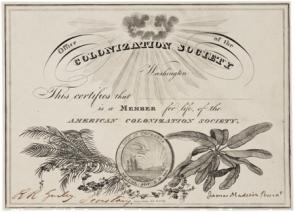
American Colonization SocietyCertificate (1833)
The authors mentioned above emigrated to Europe, but Ned also comments that some look to go back to Africa. Here, I want to give a little history into the debates surrounding emigrating to Africa. I do not wish to focus on the contemporary discussions that would have been going during the period when Gaines's wrote the novel. That is there, especially in the look towards African in the Black Arts Movement and elsewhere. Instead, I want to briefly look at debates from the 1820s surrounding the American Colonization Society (ACS)which started in 1816. The goal of the society was partly to find a way to confront the increasing population of free African Americans. To do this, the society sought to establish a colony in Africa where free people of color could emigrate. Some African Americans agreed with the idea, and some didn't.

John B. Russwurm, one of the editors of the first African American newspaper Freedom's Journal, initially opposed the plan. However, neat the end of the newspaper's two year run, his opinion changed. In fact, Russwurm emigrated to Liberia in the mid-1830s and became a governor there until his death in 1851. In a March 14, 1829, article in Freedom's Journal, Russwurm writes,
The subject of Colonization is certainly important, as having a great bearing of that of slavery: for it must be evident that the universal emancipation so ardently desired by us & all our friends, can never take place, unless some door is opened whereby the emancipated may be removed as fast as they drop their galling chains, to some other lands besides the free states; for it is a fact, that prejudices now in our part of the country, are so high, that it is often the remark of liberal men from the south, that their free people are treated better than we are, in the boasted free states of the north. If the free states have passed no laws as yet forbidding the emigration of free persons of color into their limits; it is no reason that they will not, as soon as they find themselves a little more burdened. (207)
Since free African Americans received derogatory treatment even though they did not live in the bondage of slavery, Russwurm argues that they should consider leaving for Africa. There, they could grow and become educated apart from the oppression that daily tormented them in the United States, north and south.  Russwurm's turn drew ire from those who felt that emigration to Liberia should not occur.

American Colonization Society
Coin (1833)
One such opponent of the ACS and emigration to African was David Walker. In his Appeal in Four Articles, Walker blasts the thought of leaving the United States. For Walker, the ACS's plan to colonize African with free people of color would pave the way for whites to continue the practice of slavery. He writes that the ACS's desire was “to fix a plan to get those of the coloured people, who are said to be free, away from among those of our brethren whom they unjustly hold in bondage, so they may be enabled to keep them the more secure in ignorance and wretchedness” (52). To counteract those that would say that emigration is good because it would provide free people of color with their own land, Walker states, “This country is as much ours as it is the whites, whether they will admit it now or not, they will see and believe it by and by” (62). Walker then asks what makes it so hard to fight institutions like the ACS and slavery, and he simply responds by saying that blacks “are too servile to assert [their] rights as men,” and to show this, he asks why whites do not use others as “body servants” (71).

Ned, in The Autobiography of Miss Jane Pittman, echoes these same sentiments in his speech down by the river. He tells his audience that they must not be cowards and that they must fight. Ned reinforces the  thought, too, that his audience should not leave because the earth is theirs. He tells them that men cannot own the earth, but he gives them pride by stating that the land is theirs because the bones of their ancestors reside there and the ancestors "sweat and their blood done drenched this earth" that they plowed and cultivated (112). America, and the specific land in Ned's speech, belongs to them because of the work they did and the lives they loved there. No one can take that away. 

This is just a brief discussion of the colonization movement, and its early beginnings. For more, follow the links above in the post. What other American literature texts, in the 19th century, can you think of that focus on colonization or on representations of Africa? Let me know in the comments below. 

Gaines, Ernest J. The Autobiography of Miss Jane Pittman. New York: Bantam Books, 1972. Print.
James, Winston. The Struggles of John Brown Russwurm: The Life and Writings of a Pan-Africanist Pioneer, 1799-1851. New York: New York University Press, 2010. Print. 


Thursday, April 2, 2015

"Dirt" in James Baldwin's "Go Tell It On the Mountain"


Writing about James Baldwin's, Charles Scruggs notes that "[n]o Afro-American writer in modern literature conveys better the sense of menace lying in wait in the urban streets 'outside.' Word such as 'menacing,' 'dreadful,' and 'unspeakable' are Baldwin's choices for describing those streets" (147). Later, Scruggs points out that for Baldwin "[s]mall, intimate spaces" take the place of "sacred space" within the city (147). This is where I would like to spend today's post, on Baldwin's description of those "small, intimate spaces," specifically the apartment of the Grimes family in Go Tell It On The Mountain.

As he wakes out of a bleary sleep on his birthday in 1935, John thinks about whether or not anyone will remember his birthday as he stares at "a yellow stain on the ceiling just above his head" that eventually transforms "into a woman's nakedness" (18). The stain becomes something that causes John to sin, making him feel guilty. The dinginess of the stain makes one think of Bigger Thomas's apartment in Native Son or of Gwendolyn Brooks's poem "Kitchenette Building." For me, the narrator's later descriptions of the apartment and the suffocating dirt that inhabits it. The use of "dirt" reminds me, of course, of Gaines's implementation of "dust" and "dirt" as an oppressive and stifling force in Of Love and Dust. In Baldwin's novel, "dirt" appears in the same way; however, instead of being outside in the fields, the "dirt" becomes a presences within the confines of the small apartment.

John must clean the constricting apartment, dusting and sweeping its interior. The cramped apartment served as a breeding ground for roaches, and it could never become clean. "Dirt was in the walls and floorboards," the narrator says (21). When John begins cleaning, he discovers that no matter how hard he tries, the apartment will never be rid of the "dirt."
Dirt was in every corner, angle, crevice of the monstrous stove, and lived behind it in delirious communion with the corrupted wall. Dirt was in the baseboard that John scrubbed every Saturday, and roughened the cupboard shelves that held the cracked and gleaming dishes. Under this dark weight the walls leaned, under it the ceiling, with a great crack like lightening in its center, sagged. The windows gleamed like beaten gold and silver, but now John saw, in the yellow light, how fine dust veiled their doubtful glory. Dirt crawled in the gray mop hung out of the windows to dry. John thought with shame and horror, yet in angry hardness of heart: He who is filthy, let him be filthy still. (22)
Within this section of a paragraph, "dirt" and "dust" appear four times. "Dirt" occupies the space, causing it to become a disheveled, oppressive space that does not even allow the light from outside to penetrate its darkness. Maintaining its constriction on the apartment, the "dirt" even takes on animalistic characteristics. It "crawled" into the mop and "veiled" the beauty of the light. These words connote something sinister that the "dirt" represents.

Later, the cleaning of the apartment becomes akin to Sisyphus continually rolling the boulder up the hill only to have it pushed back down for all eternity. Sweeping the carpet, "dust rose, clogging [John's] nose and sticking to his sweaty skin, and he felt that should he sweep it forever, the clouds of dust would not diminish, the rug would not be clean" (26). No matter how much John swept and cleaned the rug or the apartment, the dust remained, clogging every crevice and creeping into the implements whose sole purpose was the clean the apartment.

Scruggs views John's cleaning of the apartment as "a metaphor for Gabriel's morally untidy life, and John's pointless labor illustrates the circles of deception and self-deception which surround the father's authority" (151). I agree with Scruggs on this point, but I also see the "dirt" as a physical contagion that entraps not just John and his family but an entire community in a space of subjugation and oppression. It clogs their pours, in much the same way that the "dust" in Gaines's novel swirls, blisteringly around the characters causing them to seek shelter. Unlike Gaines's characters, the Grimeses cannot go inside to escape the "dust"; when they retreat inside, they encounter the "dirt" all around them.


More can, and should be said about this. What are your thoughts? If you recall, during John's passing through at the end of the novel, he feels like his mouth is filled with "dirt" and he can't breathe. What role does "dirt" play in this instance? What are some other places within Go Tell It On the Mountain or other Baldwin texts where "dirt" or other elements work as symbols of oppression?

Baldwin, James. Go Tell it On the Mountain. New York: Dell, 1985.
Scruggs, Charles. Sweet Home: Invisible Cities in the Afro-American Novel. Baltimore: John Hopkins University Press, 1993. Print.