Showing posts with label ned douglass. Show all posts

Tuesday, April 7, 2015

American Colonization Society

During his speech by the river in The Autobiography of Miss Jane Pittman, Ned Douglass speaks about dignity and respect. He also talks about the questions surrounding emigration and whether or not African Americans should leave, going to Africa or Europe or elsewhere. He says,
I left from here when I was a young man, but most people thought that was the best thing to do then. But I say to you now, don't run and do fight. Fight white and black for all of this place. You got black people here saying go back to Africa, some saying go to Canada, some saying go to France. Now, who munks y'all sitting here right now want be a Frenchman and talk like they do? Let me see his hand in the air. (115)
This short section of Ned's speech down by the river, around 1900, contains a few layers that need to peeled off. When I read this paragraph, I cannot help but think about Gaines's move to California then his subsequent trips back to Louisiana. I also think about his planned trip to Mexico is 1962 with his friends to escape the materialism and racism in the United States. After seeing James Meredith's strength in integrating the University of Mississippi in September 1962, Gaines decided to stay, and not run.

Culturally, the twentieth century saw African American writers emigrating to Europe and elsewhere, specifically Richard Wright, Chester Himes, and James Baldwin. While Baldwin returned periodically and had a presences in the Civil Rights Movement, he never the less resided in Europe and died there. To Ned, running away from the problem is tantamount to cowardice. One must stand and fight in order to see any change occur. I am not saying that Wright, Himes, and Baldwin should be considered cowards. As I said, Baldwin intellectually put himself in the fight.
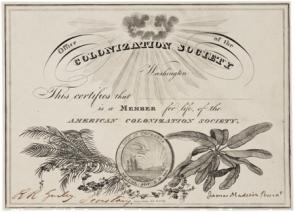
American Colonization SocietyCertificate (1833)
The authors mentioned above emigrated to Europe, but Ned also comments that some look to go back to Africa. Here, I want to give a little history into the debates surrounding emigrating to Africa. I do not wish to focus on the contemporary discussions that would have been going during the period when Gaines's wrote the novel. That is there, especially in the look towards African in the Black Arts Movement and elsewhere. Instead, I want to briefly look at debates from the 1820s surrounding the American Colonization Society (ACS)which started in 1816. The goal of the society was partly to find a way to confront the increasing population of free African Americans. To do this, the society sought to establish a colony in Africa where free people of color could emigrate. Some African Americans agreed with the idea, and some didn't.

John B. Russwurm, one of the editors of the first African American newspaper Freedom's Journal, initially opposed the plan. However, neat the end of the newspaper's two year run, his opinion changed. In fact, Russwurm emigrated to Liberia in the mid-1830s and became a governor there until his death in 1851. In a March 14, 1829, article in Freedom's Journal, Russwurm writes,
The subject of Colonization is certainly important, as having a great bearing of that of slavery: for it must be evident that the universal emancipation so ardently desired by us & all our friends, can never take place, unless some door is opened whereby the emancipated may be removed as fast as they drop their galling chains, to some other lands besides the free states; for it is a fact, that prejudices now in our part of the country, are so high, that it is often the remark of liberal men from the south, that their free people are treated better than we are, in the boasted free states of the north. If the free states have passed no laws as yet forbidding the emigration of free persons of color into their limits; it is no reason that they will not, as soon as they find themselves a little more burdened. (207)
Since free African Americans received derogatory treatment even though they did not live in the bondage of slavery, Russwurm argues that they should consider leaving for Africa. There, they could grow and become educated apart from the oppression that daily tormented them in the United States, north and south.  Russwurm's turn drew ire from those who felt that emigration to Liberia should not occur.

American Colonization Society
Coin (1833)
One such opponent of the ACS and emigration to African was David Walker. In his Appeal in Four Articles, Walker blasts the thought of leaving the United States. For Walker, the ACS's plan to colonize African with free people of color would pave the way for whites to continue the practice of slavery. He writes that the ACS's desire was “to fix a plan to get those of the coloured people, who are said to be free, away from among those of our brethren whom they unjustly hold in bondage, so they may be enabled to keep them the more secure in ignorance and wretchedness” (52). To counteract those that would say that emigration is good because it would provide free people of color with their own land, Walker states, “This country is as much ours as it is the whites, whether they will admit it now or not, they will see and believe it by and by” (62). Walker then asks what makes it so hard to fight institutions like the ACS and slavery, and he simply responds by saying that blacks “are too servile to assert [their] rights as men,” and to show this, he asks why whites do not use others as “body servants” (71).

Ned, in The Autobiography of Miss Jane Pittman, echoes these same sentiments in his speech down by the river. He tells his audience that they must not be cowards and that they must fight. Ned reinforces the  thought, too, that his audience should not leave because the earth is theirs. He tells them that men cannot own the earth, but he gives them pride by stating that the land is theirs because the bones of their ancestors reside there and the ancestors "sweat and their blood done drenched this earth" that they plowed and cultivated (112). America, and the specific land in Ned's speech, belongs to them because of the work they did and the lives they loved there. No one can take that away. 

This is just a brief discussion of the colonization movement, and its early beginnings. For more, follow the links above in the post. What other American literature texts, in the 19th century, can you think of that focus on colonization or on representations of Africa? Let me know in the comments below. 

Gaines, Ernest J. The Autobiography of Miss Jane Pittman. New York: Bantam Books, 1972. Print.
James, Winston. The Struggles of John Brown Russwurm: The Life and Writings of a Pan-Africanist Pioneer, 1799-1851. New York: New York University Press, 2010. Print. 


Tuesday, March 24, 2015

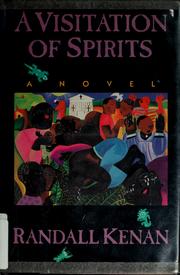
Randall Kenan's "A Visitation of Spirits"


On the surface, Randall Kenan's A Visitation of Spirits (1989) may not seem similar to works by Ernest J. Gaines, at least in regards to the writing style. Kenan's novel oscillates from narrative to narrative in a postmodernist stream-of-consciousness flow. Gaines, on the other hand, writes in a more straight forward narrative style that mirrors Hemingway, with the occasional stream-of-consciousness here and there. While styles do not necessarily link Gaines and Kenan, other similarities do arise here and there. What one sees when reading Gaines and Kenan in unison arises from the thematic similarities of two African American men from the South but born thirty years apart. Even though he was born in New York, Kenan grew up in North Carolina, and Chinquapin, NC, serves as the inspiration for Tims Creek, the community where Kenan sets his fiction. Along with the creation of specific space like Gaines's Bayonne and Faulkner's Yoknapatawpha County, he allows for a sense of reality in his fiction, even though the novel is very speculative, filled with demons and other spirits that occupy the mind of Horace Cross.

While reading, there are certain aspects of A Visitation of Spirits that make me think of Gaines and Southern writers. For one, I think about community. Gaines's works center on community, as I have noted before. The community in the quarters, to a certain extent, serves as a space where the African American occupants do not come face-to-face with racism and oppression as they do when they go to town. Think about Gaines's "The Sky is Gray" here. James does not experience overt subjugation in the quarters; he experiences community. When he goes to Bayonne, he starts to come more overtly into contact with the systems that keep him oppressed. In Gaines's work, the community struggles with the legacy of slavery, but they all form a system that supports and works together. However, as Trudier Harris argues, "the legacies of slavery are somewhat in the background" of Kenan's novel, and "a sense of black family tradition has become so all-consuming that it is perhaps worse than slavery" (115). At the center of this "all-consuming" community is Horace Cross, "the Chosen Nigger" (13). Harris points out that Horace's being labeled "the One" that will serve as a leader for the community mirrors numerous characters in Gaines's works, most specifically Ned Douglass and Jimmy Aaron in The Autobiography of Miss Jane Pittman (1971).  

While Ned and Jimmy both succeed in becoming "the one," Horace Cross cannot. He studies, maintains good grades, and works hard to become something extraordinary beyond the teachers, preachers, and lawyers that surround him. However, Horace is gay, and the patriarchal, heterosexual family lineage that values the conquering of "pussy"  does not allow for a homosexual leader (55). Instead of being lifted up and groomed to be the leader of the people, the community diminishes Horace's worth and condemns him vociferously. In the church at night, Horace envisions the pastor condemning him from the pulpit and calling him calling him "unclean." Then, Horace starts to hear voices from the congregation, including his family. They say,
Wicked. Wicked.
Abomination.
Man lover!
Child molester!
Sissy!
Greyboy!
Old men, little girls, widows and workers, he saw no faces, knew no names, but the voices, the voices . . .
Unclean bastard!
Be ashamed of yourself!
Filthy knob polisher! (86-87)
Through their name calling and other actions, the community that initially labels Horace as "the One" systematically tears him down, refusing to accept him as he is and leading him to his ultimate demise. In Kenan's novel, the downfall of "the One" does not come from the outside community, the white community that tries to maintain its rule over the African American community. Instead, the destruction occurs from the inside. This is not to say that the residual effects of slavery do not contribute to the people "othering" Horace. I would even argue that the labeling of Horace as "the Chosen Nigger" works to devalue his place as well. Instead of calling him "the chosen One," the epithet used completely reduces Horace to a person who will not become a savior for those around him but to someone who will go through life subjugated and beaten down by a system that continually strives to maintain control.

In the next post, I will talk about another similarity I see between Gaines and Kenan: the land. Both authors describe the land thoroughly, and its changing appearance. What similarities do you see between the two authors? Let me know in the comments below.

Harris, Trudier. The Scary Mason-Dixon Line: African American Writers and the South. Baton Rouge: LSU Press, 2009. Print. 
Kenan, Randall. A Visitation of Spirits. New York: Grove Press, 1989. Print.