Showing posts with label the autobiography of miss jane pittman. Show all posts

Tuesday, June 23, 2015

The Confederate Battle Flag and Its Portrayal in Gaines's Work


The horrendous events in Charleston, SC, last week at the Emmanuel African Methodist Episcopal Church cannot be erased from our collective consciousness. Following the attack on the church and the killing of nine innocent African American victims, debates over a continued symbol of hate and prejudice arose. That symbol, of course, is the Confederate Battle Flag which flew at full staff over the Confederate Soldier Monument near the State House. The pole lacks a pulley system, and in order to remove the flag, it has to be approved by two thirds of the state legislature. Approval by any part of the state legislature appears absurd, but two thirds means that nothing can be done to the flag in question unless sixty six percent of the elected officials in the legislature approve it. The flag stands for the South, yes, but it stands for the South that oppressed and kept others in chains to benefit its own avaricious desires. It stands for a South that labeled Africans and later African Americans as chattel, property that could be treated however the owner saw fit. It stands for a Jim Crow society that decided "separate but equalaccommodations for African and Anglo Americans. It stands for a reminder of a South that continually saw African Americans and others as inferior to themselves and strove to maintain its power through violence, intimidation, and coercion. 

For today's post, I just want to show a couple of examples where the Confederate Battle Flag appears in Gaines's works and the characters's reactions to it. Reading through Gaines's works, the flag flies above the courthouse in Bayonne, and various characters encounter it. In "The Sky Is Gray," the eight year old narrator James does not know what to make of the flag. As his mother, Octavia, walks him through the streets of the town, he stares up at the courthouse and sees the flag at the top. "We come up to the courthouse, and I see the flag waving there," James says, "This flag ain't like the one we got at school. This one here ain't got but a handful of stars. One at school got a big pile of stars--one for every state" (93). Even though James doesn't realize its meaning, he differentiates the flag from the United States flag that hangs in the classroom in the quarters. James does not comprehend that the flag represents hatred, oppression, and subjugation and flies as a symbol of what some wished still existed. This is James's only contact with the Confederate Battle Flag in "The Sky is Gray." 


Grant, in A Lesson before Dying, discusses the flag in more specific terms. From the very beginning of the novel, the segregation of African Americans and whites becomes evident. Speaking about Jefferson's trial, Grant comments that Miss Emma "never got up once to get water or go to the bathroom down in the basement" (3). When grant comes to the courthouse in Bayonne himself, he describes it by saying, "A statue of a Confederate soldier stood to the right of the walk that led up to the courthouse door. Above the head of the statue, national, state, and Confederate flags flew on long metal poles" (68-69). Grant understands what the Confederate flag represents because he has lived in its shadow everyday of his life. Like Miss Emma, he must go to the fountain and bathroom in the courthouse's basement, he must wait endlessly for Henri Pichot to speak with him, and he must endure other forms of subjugation as well. Grant knows these things, but he feels he does not have any power to change them. Through teaching Jefferson, and his own students, he works to rectify the situation and to escape the shadow casts by the flag that waves above Bayonne's courthouse. 


Earlier in the novel, Grant recalls leading the Pledge of Allegiance to the United States flag in his classroom in the quarters. There, the students stood and addressed the Stars and Stripes. "The flag," Grant recalled, "hung limp from a ten-foot bamboo pole in the corner of the white picket fence that surrounded the church" (emphasis added 33). The key words here are "hung limp." While the Confederate flag, and others, "flew" above the courthouse, indicating movement and agency, the flag hanging on the bamboo pole along the fence only hangs limply, not moving at all. Past the limp flag, Grant "could see smoke rising from the chimneys in the quarter, and beyond the houses and the chimneys [he] could hear the tractors harvesting sugarcane in the fields" (33). As the flag dangles, listlessly, on the pole, Grant sees beyond it to the people who occupy the quarters and to their impending displacement to agricultural expansion. In this instance, the flag appears powerless because it does not move, failing to provide power to those who pledge their allegiance to it.  


There are other instances where the Confederate Battle Flag appears in Gaines's works, but the ones discussed above are two of the main ones. Gaines does not delve into the historical context of the flag, he lets it wave above the courthouse as a symbol of what African Americans had to endure in the South before, during, and after the Civil War. He confronts the flag, and the past it represents, in his writing by showing that those who lived under its reign survived with dignity and power. Others, like Frank Laurent and Miss Jane's mistress, pleaded for it to remain. As Miss Jane's mistress watched the Confederate soldiers march away from her plantation, she cried, “Sweet, precious blood of the South; sweet precious blood of the South” (5).  She does not want her way of life to end, and those who argue that the Confederate Battle Flag represents a heritage of the South, as Lindsey Graham notes in the clip below, resemble her in some way. 


The clip is from John Oliver's Last Week Tonight where he discusses the flag and the debate surrounding its presence in South Carolina and the South in general.  What are your thoughts on this topic? Let us know in the comments below.    


Gaines, Ernest J. The Autobiography of Miss Jane Pittman. New York: Bantam Books, 1972. Print.
Gaines, Ernest J. A Lesson before Dying. New York: Vintage Books, 1993. Print.
Gaines, Ernest J. "The Sky is Gray." Bloodline. New York: W. W. Norton & Company, 1976. 83-117. Print.

Thursday, May 14, 2015

Aunt Clo in Ernest J. Gaines's "Just Like a Tree"


Ernest J. Gaines's "Just Like a Tree" concludes his short story collection Bloodline (1968).  It originally appeared in the Sewanne Review, and it tells the story of a gathering of people in the quarters as the say goodbye to the ninety-nine year old fixture Aunt Fe as her daughter and son-in-law plan to take her away to the North so she will not have to endure anything like the recent bombing that occurred in the quarters. Readers do not hear directly from Aunt Fe in the story, even though the story is essentially about her. Instead, multiple narrators from young to old tell the events of the gathering, similar to Faulkner's As I Lay Dying, which Gaines says served as influence, along with Chaucer's Canterbury Tales, for the story.

Today, I would just like to focus on one section of the story, Aunt Clo's. All of the narrators in the story focus on the events occurring in the room, moving to the past and looking to the future periodically. Aunt Clo, unlike the other narrators, does not provide any action that necessarily moves the narrative forward; her section is more philosophical and metaphorical, talking about Aunt Fe as a tree that is currently being uprooted and dragged reluctantly from her home. The section recalls, in many ways, Miss Jane Pittman's musings on the oak tree she speaks with in The Autobiography of Miss Jane Pittman. More similarities exist between Aunt Fe and Miss Jane. One interviewer even asked Gaines about their similar characteristics. Gaines replied that when he started Pittman he realized it was too much like Aunt Fe because others told the story, not allowing Jane to speak for herself. He said, "I've got the same characters telling the same thing. All I've done with Aunt Fe is that instead of her dying, I tell everything that happened before she died" (49-50). Looking at each work closely, similarities appear, but that is not my entire focus here.

Aunt Clo compares Aunt Fe to a tree that has a chain wrapped around it then someone is just a "jecking and jecking, and then shifting the chain little bit and jecking and jecking in some direction, and then shifting it some mo' and jecking and jecking in that direction" trying to wrestle the roots out of the ground so it can be moved (235). When the person extricates the tree from the ground, a big hole remains with a "piece of the taproot still way down in it--a piece you won't never get out no matter if you dig till doomsday" (236). The taproot grows deep, and removing it becomes difficult. Aunt Fe's daughter and son-in-law plan to take her away, to the North, but her roots run deep. Aunt Fe becomes like others who have left. They leave holes behind, but the taproot remains. Aunt Clo continues by explaining that once the tree leaves, two holes remain: "You get a big hole in the ground, sir; and you get another big hole in the air where the lovely branches been all these years. Yes, sir, that's what you get. The holes, sir, the holes. Two holes, sir, you can't never fill no matter how hard you try" (236). The holes, of course, represent what Aunt Fe will leave behind. She will not physically be in the quarters anymore, and the people who loved her will not see her again.

While the holes appear, the taproot remains. When the trees gets dragged to the North, Aunt Clo says that the person taking the tree has to find a space for it. She says, "You look in this corner and you look in that corner, but no corner is good. She kin o'stand in the was no matter where you set her. So finally, sir, you say, 'I just stand her up a little while and see, and if it don't work out, if she keep getting in the way, I guess we'll just have to take her to the dump'" (237). This quote, which ends Aunt Clo's section, is full of themes that I do not have time to explore in this post. The tree, like Aunt Fe, becomes a representation of the past, and specifically the South, that upon entering the North must be done away with or placed in a corner. Gaines speaks about this in his own experiences when he went to California in "A Very Big Order: Reconstructing Identity" and James, a Northerner, exemplifies it in his section in "Just Like A Tree."

At the end of the story, everyone has left Aunt Fe's house and Aunt Lou helps her get ready for bed. As she watched Aunt Fe, Aunt Lou notices "her making some kind o' jecking motion there, but I feel she crying 'cause this her last night here, and 'cause she got to leave ever'thing behind" (249). Important here is the word "jecking." Aunt Clo uses the word repeatedly in her section while she describes the tree being removed from the ground and transported North. Here, Aunt Lou uses it to describe Aunt Fe before she goes to bed, and ultimately dies. This key word links the image Aunt Clo speaks about with Aunt Fe. Unlike the tree, whose taproot remains, Aunt Fe doesn't leave in the end. She goes to bed and passes away in her sleep.

No matter how hard someone tries to relinquish the past, it remains. This in not necessarily a bad thing. The past is important, all of its tribulations and triumphs. When speaking about his grandmother's death, Gaines talks about the fact that "all she talked about was the South" (50). His grandmother maintained her insurance payments so she could be buried back home in the South because that mattered to her. Gaines continues,
When she died, there were no arguments as far as I was concerned that Momma was coming back to the place where she grew up. And there were other people in the family who said, "Well she's dead now, does it matter?" But to me it mattered and to her it mattered. She never did say, 'Send my body back home' or anything like that. We never did talk about death like that, but we knew. She'd say, "I'd like to be buried there" you know, but she never said "Send my body there." She'd just say "I'd like to be buried home." (52)
Even though his grandmother passed well after the story first appeared, Gaines's comments here reflect Aunt Clo's description of Aunt Fe. As well, they describe his thoughts regarding the continual pull of Louisiana and the South to his own writing and life.

What do you think of "Just Like A Tree"? Let us know in the comments below.

Gaines, Ernest J. "Just Like A tree." Bloodline. New York: W.W. Norton & Company, 1976. 221-249. Print.
Ingram, Forrest and Barbara Steinberg. "On the Verge: An Interview with Ernest J. Gaines." Conversations with Ernest Gaines. Ed. John Lowe. Jackson: University of Mississippi Press, 1995. 39-55. Print.

Tuesday, April 7, 2015

American Colonization Society

During his speech by the river in The Autobiography of Miss Jane Pittman, Ned Douglass speaks about dignity and respect. He also talks about the questions surrounding emigration and whether or not African Americans should leave, going to Africa or Europe or elsewhere. He says,
I left from here when I was a young man, but most people thought that was the best thing to do then. But I say to you now, don't run and do fight. Fight white and black for all of this place. You got black people here saying go back to Africa, some saying go to Canada, some saying go to France. Now, who munks y'all sitting here right now want be a Frenchman and talk like they do? Let me see his hand in the air. (115)
This short section of Ned's speech down by the river, around 1900, contains a few layers that need to peeled off. When I read this paragraph, I cannot help but think about Gaines's move to California then his subsequent trips back to Louisiana. I also think about his planned trip to Mexico is 1962 with his friends to escape the materialism and racism in the United States. After seeing James Meredith's strength in integrating the University of Mississippi in September 1962, Gaines decided to stay, and not run.

Culturally, the twentieth century saw African American writers emigrating to Europe and elsewhere, specifically Richard Wright, Chester Himes, and James Baldwin. While Baldwin returned periodically and had a presences in the Civil Rights Movement, he never the less resided in Europe and died there. To Ned, running away from the problem is tantamount to cowardice. One must stand and fight in order to see any change occur. I am not saying that Wright, Himes, and Baldwin should be considered cowards. As I said, Baldwin intellectually put himself in the fight.

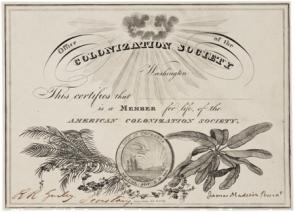
American Colonization SocietyCertificate (1833)
The authors mentioned above emigrated to Europe, but Ned also comments that some look to go back to Africa. Here, I want to give a little history into the debates surrounding emigrating to Africa. I do not wish to focus on the contemporary discussions that would have been going during the period when Gaines's wrote the novel. That is there, especially in the look towards African in the Black Arts Movement and elsewhere. Instead, I want to briefly look at debates from the 1820s surrounding the American Colonization Society (ACS)which started in 1816. The goal of the society was partly to find a way to confront the increasing population of free African Americans. To do this, the society sought to establish a colony in Africa where free people of color could emigrate. Some African Americans agreed with the idea, and some didn't.

John B. Russwurm, one of the editors of the first African American newspaper Freedom's Journal, initially opposed the plan. However, neat the end of the newspaper's two year run, his opinion changed. In fact, Russwurm emigrated to Liberia in the mid-1830s and became a governor there until his death in 1851. In a March 14, 1829, article in Freedom's Journal, Russwurm writes,
The subject of Colonization is certainly important, as having a great bearing of that of slavery: for it must be evident that the universal emancipation so ardently desired by us & all our friends, can never take place, unless some door is opened whereby the emancipated may be removed as fast as they drop their galling chains, to some other lands besides the free states; for it is a fact, that prejudices now in our part of the country, are so high, that it is often the remark of liberal men from the south, that their free people are treated better than we are, in the boasted free states of the north. If the free states have passed no laws as yet forbidding the emigration of free persons of color into their limits; it is no reason that they will not, as soon as they find themselves a little more burdened. (207)
Since free African Americans received derogatory treatment even though they did not live in the bondage of slavery, Russwurm argues that they should consider leaving for Africa. There, they could grow and become educated apart from the oppression that daily tormented them in the United States, north and south.  Russwurm's turn drew ire from those who felt that emigration to Liberia should not occur.

American Colonization Society
Coin (1833)
One such opponent of the ACS and emigration to African was David Walker. In his Appeal in Four Articles, Walker blasts the thought of leaving the United States. For Walker, the ACS's plan to colonize African with free people of color would pave the way for whites to continue the practice of slavery. He writes that the ACS's desire was “to fix a plan to get those of the coloured people, who are said to be free, away from among those of our brethren whom they unjustly hold in bondage, so they may be enabled to keep them the more secure in ignorance and wretchedness” (52). To counteract those that would say that emigration is good because it would provide free people of color with their own land, Walker states, “This country is as much ours as it is the whites, whether they will admit it now or not, they will see and believe it by and by” (62). Walker then asks what makes it so hard to fight institutions like the ACS and slavery, and he simply responds by saying that blacks “are too servile to assert [their] rights as men,” and to show this, he asks why whites do not use others as “body servants” (71).

Ned, in The Autobiography of Miss Jane Pittman, echoes these same sentiments in his speech down by the river. He tells his audience that they must not be cowards and that they must fight. Ned reinforces the  thought, too, that his audience should not leave because the earth is theirs. He tells them that men cannot own the earth, but he gives them pride by stating that the land is theirs because the bones of their ancestors reside there and the ancestors "sweat and their blood done drenched this earth" that they plowed and cultivated (112). America, and the specific land in Ned's speech, belongs to them because of the work they did and the lives they loved there. No one can take that away. 

This is just a brief discussion of the colonization movement, and its early beginnings. For more, follow the links above in the post. What other American literature texts, in the 19th century, can you think of that focus on colonization or on representations of Africa? Let me know in the comments below. 

Gaines, Ernest J. The Autobiography of Miss Jane Pittman. New York: Bantam Books, 1972. Print.
James, Winston. The Struggles of John Brown Russwurm: The Life and Writings of a Pan-Africanist Pioneer, 1799-1851. New York: New York University Press, 2010. Print. 


Tuesday, March 24, 2015

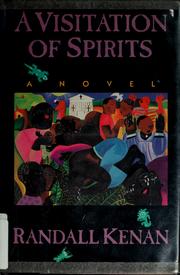
Randall Kenan's "A Visitation of Spirits"


On the surface, Randall Kenan's A Visitation of Spirits (1989) may not seem similar to works by Ernest J. Gaines, at least in regards to the writing style. Kenan's novel oscillates from narrative to narrative in a postmodernist stream-of-consciousness flow. Gaines, on the other hand, writes in a more straight forward narrative style that mirrors Hemingway, with the occasional stream-of-consciousness here and there. While styles do not necessarily link Gaines and Kenan, other similarities do arise here and there. What one sees when reading Gaines and Kenan in unison arises from the thematic similarities of two African American men from the South but born thirty years apart. Even though he was born in New York, Kenan grew up in North Carolina, and Chinquapin, NC, serves as the inspiration for Tims Creek, the community where Kenan sets his fiction. Along with the creation of specific space like Gaines's Bayonne and Faulkner's Yoknapatawpha County, he allows for a sense of reality in his fiction, even though the novel is very speculative, filled with demons and other spirits that occupy the mind of Horace Cross.

While reading, there are certain aspects of A Visitation of Spirits that make me think of Gaines and Southern writers. For one, I think about community. Gaines's works center on community, as I have noted before. The community in the quarters, to a certain extent, serves as a space where the African American occupants do not come face-to-face with racism and oppression as they do when they go to town. Think about Gaines's "The Sky is Gray" here. James does not experience overt subjugation in the quarters; he experiences community. When he goes to Bayonne, he starts to come more overtly into contact with the systems that keep him oppressed. In Gaines's work, the community struggles with the legacy of slavery, but they all form a system that supports and works together. However, as Trudier Harris argues, "the legacies of slavery are somewhat in the background" of Kenan's novel, and "a sense of black family tradition has become so all-consuming that it is perhaps worse than slavery" (115). At the center of this "all-consuming" community is Horace Cross, "the Chosen Nigger" (13). Harris points out that Horace's being labeled "the One" that will serve as a leader for the community mirrors numerous characters in Gaines's works, most specifically Ned Douglass and Jimmy Aaron in The Autobiography of Miss Jane Pittman (1971).  

While Ned and Jimmy both succeed in becoming "the one," Horace Cross cannot. He studies, maintains good grades, and works hard to become something extraordinary beyond the teachers, preachers, and lawyers that surround him. However, Horace is gay, and the patriarchal, heterosexual family lineage that values the conquering of "pussy"  does not allow for a homosexual leader (55). Instead of being lifted up and groomed to be the leader of the people, the community diminishes Horace's worth and condemns him vociferously. In the church at night, Horace envisions the pastor condemning him from the pulpit and calling him calling him "unclean." Then, Horace starts to hear voices from the congregation, including his family. They say,
Wicked. Wicked.
Abomination.
Man lover!
Child molester!
Sissy!
Greyboy!
Old men, little girls, widows and workers, he saw no faces, knew no names, but the voices, the voices . . .
Unclean bastard!
Be ashamed of yourself!
Filthy knob polisher! (86-87)
Through their name calling and other actions, the community that initially labels Horace as "the One" systematically tears him down, refusing to accept him as he is and leading him to his ultimate demise. In Kenan's novel, the downfall of "the One" does not come from the outside community, the white community that tries to maintain its rule over the African American community. Instead, the destruction occurs from the inside. This is not to say that the residual effects of slavery do not contribute to the people "othering" Horace. I would even argue that the labeling of Horace as "the Chosen Nigger" works to devalue his place as well. Instead of calling him "the chosen One," the epithet used completely reduces Horace to a person who will not become a savior for those around him but to someone who will go through life subjugated and beaten down by a system that continually strives to maintain control.

In the next post, I will talk about another similarity I see between Gaines and Kenan: the land. Both authors describe the land thoroughly, and its changing appearance. What similarities do you see between the two authors? Let me know in the comments below.

Harris, Trudier. The Scary Mason-Dixon Line: African American Writers and the South. Baton Rouge: LSU Press, 2009. Print. 
Kenan, Randall. A Visitation of Spirits. New York: Grove Press, 1989. Print.


Thursday, February 5, 2015

Sharecropping in Bontemps and Gaines


Following Reconstruction, Miss Jane talks about staying in the South, even with the oppression she would inevitably face, until she could find a place where she and Ned could live free of being subjected to subjection based on the color of their skin.  Eventually, Miss Jane calks the conditions after Reconstruction slavery: "It was slavery again, all right" (72). She mentions the fact that throughout the area there are no more "colored troops, colored politicians, or a colored teacher"; instead, only white teachers could be find and the "secret group[s]" became even more active (72). After the Civil War, sharecropping arose as a means of maintaining the agricultural output of the land and as means of keeping African Americans oppressed. Sharecropping involved a landowner supplying a farmer, typically an African American or a poor white, with land, tools, housing, seed, and other items necessary to farming the land. When the farmer harvested the crops, he would receive a portion of the crops to pay off the landowner, and the rest would go to the landowner. Through this system, landowners kept sharecroppers in perpetual debt, coming up with various fees that the farmer owed and making the farmer buy his or her goods through the plantation store using plantation money. The picture above is from the Ernest J. Gaines Collection, and it is River Lake Plantation store money.  

When trying to leave Colonel Dye's Plantation, Miss Jane and Joe Pittman experience the "slave-like" system discussed above. After numerous trips to Colonel Dye to tell him that they are leaving, the Colonel finally offers Joe and Miss Jane a prime piece of bottom land for Joe to sharecrop. Joe refuses, and the Colonel, who acts like he was losing his best friend at first, becomes furious. As he turns to leave, Colonel Dye speaks up, calling after Joe, "Ain't you forgetting something?" (85). The Colonel commences to tell Joe that he owes one hundred and fifty dollars before he can leave. Joe asks why, and the Colonel responds, "That hundred and that fifty to get you out of trouble when the Klux had you" (85). On top of providing tools, seed, food, housing, and other essentials, as the landowner, Colonel Dye could mitigate between Joe and the Klan. However, after leaving the plantation, the Colonel could not do a thing. The Colonel's persistence that Joe owes him $150 is, as Miss Jane hints at, a way for him to enact some kind of retribution on Joe for leaving. Joe and Miss Jane sell everything they have to pay the money, and then they leave for the Louisiana-Texas border. 

As mentioned in the previous post, Arna Bontemps' "A Summer Tragedy" also brings to light the horrendous conditions caused by sharecropping. Working the same land for forty five years, and not having anything to show for it, Jennie and Jeff decide to end their own lives by driving their car off a bridge into a river.  Driving to their watery grave, Jeff notices the bountiful crops of cotton, reflecting on what that meant. Thinking about the crops, his mind begins to drift towards Major Stevenson, the landowner. He thinks about the fact that the Major only supplied Jeff with one mule to work a thirty-acre plot of land. Jeff thinks, "It was an expensive notion, the way it killed mules from overwork, but the old man held to it" (140). In order to save money in the short term, the Major chose to supply Jeff with only one mule, causing Jeff to work the mule to death. Later, Jennie begins to waffle some regarding their plan. She asks Jeff how many bales of cotton he could get this year. For Jeff, the number does not "make a speck o' diff'ence" because not matter how much they get "[they] still gonna be in debt to old man Stevenson when he gets through counting up" (143). No matter what, the Major owns Jeff and Jennie, never allowing them to get a leg up. In essence, they are in a form of slaver, as Miss Jane says. 

These are not, of course, the only instances of sharecropping in African American, Southern, or American literature. Lyle Saxon has a discussion about it in Children of Strangers for instance. What are some other novels, short stories, or plays that discuss sharecropping in the South after the Civil War through the mid-twentieth century? How are their depictions of sharecropping similar or different to Gaines' and Bontemps'?

Bontemps, Arna. The Old South: "A Summer Tragedy" and Other Stories of the Thirties. New York: Dodd, Mead & Company, 1973. Print.
 Gaines, Ernest J. The Autobiography of Miss Jane Pittman. New York: Bantam Books, 1972. Print.


Tuesday, February 3, 2015

Arna Bontemps and Ernest Gaines Continued

Arna Bontemps African American Museum
Last Thursday, I wrote about Arna Bontemps' "Why I Returned (A Personal Essay)." How do Bontemps' experiences compare with those of Gaines as a young man. In many ways, they are similar. Gaines left Louisiana at the age of fifteen in 1948. Like Bontemps, Gaines migrated to California; however, unlike Bontemps, Gaines remained in California, settling eventually in San Francisco. It took Gaines a long time to even think about returning to the South or Louisiana. Eventually, he began returning to Louisiana in the early 1960s after James Meredith integrated the University of Mississippi. Unlike Bontemps, Gaines does not talk about the tensions between "folk heritage" and whether or that heritage should be presented in his works. Instead, in interviews, he talks about the conditions in the South, as Bontemps does as well.

Bontemps' father chose to move the family to California after an incident with  men one Saturday evening. Coming home with his pay and presents for his wife. Bontemps' father encountered two drunk white men. One of them, with slurred speech, muttered, "Let's walk over the big nigger" (5). His muscles tensing up, Bontemps' father began calculating all of the possible outcomes of the encounter. Even though he knew the two men didn't pose a threat to him, a number of questions raced through his mind: "Was something brewing? Racial tension again? . . . But was this the time for a showdown? Assuming he could handle the two-on-one, what then?" (5) If he assaulted the men, he would be chased down and become the victim of mob vengeance, regardless of the provocation" (5). After calmly stepping aside, Bontemps' father made his way home. On his walk home, he came to the decision that would change his family's lives forever.

Bontemps' father decided to move his family to California, eventually settling on San Francisco as their home. Bontemps does not mention any personal racial confrontations between himself and whites while he lived in Louisiana, partly because he was only three when he left. Instead, he talks about spending time with his grandmother in the back yard. Upon settling in California, he starts to pick up on the conversations his father has with his mother, grandmother, and others. He says, "I began to pick up comment about the place we had left, comment which had been withheld from young ears while we were still in Louisiana" (6). As he grew, Bontemps picked up in their conversation, and in some ways, I picture him sitting around the house on a Sunday afternoon much like the narrator in Baldwin's "Sonny's Blues" who fell asleep listening to his parents and others talk about the South and things that he did not comprehend yet.

Like Bontemps, Gaines moved to California at an early age. Even though he was about ten years older than Bontemps was when he left Louisiana, Gaines does not, very often if at all, mention experiences with racism that he encountered before leaving Louisiana. Just as Bontemps recalls walking with his grandmother in the back yard and picking pecans, Gaines talks about sitting on the porch listening to the older people and writing letters for them. In many ways, Bontemps' and Gaines' decision to focus on the community they grew up in instead of the society that would oppress them says a lot. The community, whether that be familial or literal community, provided each with a form of protection, shielding them from the racism outside. Gaines draws on this in Bloodline where the first story, "A Long Day in November," is told from a six-year-old boy's point of view. The boy experiences life in the quarters, surrounded by those who love him and have his best interests in mind. The second story, "The Sky is Gray," sees the encroachment of the outside world on the community when James and Octavia go to Bayonne.

There is more that could be said here. Perhaps I will have one more post on Bontemps and Gaines. Specifically, I want to think about Bontemps' "A Summer Tragedy" and Gaines' The Autobiography of Miss Jane Pittman. What other authors have similar narratives to those of Bontemps and Gaines, leaving the South and either returning or not? Let me know in the comments below.

Bontemps, Arna. The Old South: "A Summer Tragedy" and Other Stories of the Thirties. New York: Dodd, Mead & Company, 1973. Print.


Tuesday, January 13, 2015

Louisiana State Capitol and Gerald Duff's "Dirty Rice"


The Patriots
The Pioneers


A couple of weeks ago, I made a trip to the Louisiana State Capitol in Baton Rouge. While there, I took the opportunity to look at the architecture of "Huey Long's Monument." The outside contains two sculptures that flank the steps leading up to the capitol's entrance. On the left is the The Pioneers which depicts groups of people such as a Native American, a Spanish conquistador, a Franciscan friar, a backwoodsman, Hernando de SotoRené-Robert Cavelier Sieur de La Salle,and others who have contributed to Louisiana's history.  On the right, you will see The Patriots, a sculpture that displays a knight in armor standing on a fallen hero's coffin. Unidentified mourners surround the knight and coffin, and one mourner can be seen behind the knight placing a symbolic wreath to his back.

Why do I even bring up the architecture of the Louisiana State Capitol? I brought it up because in Gerald Duff's Dirty Rice: A Season in the Evangeline League the novel's protagonist, Gemar Batiste (from the Alabama-Coushatta Tribe), and his "Cuban" teammate Mike Gonzales visit the state capitol during their time in Baton Rouge, LA. Batiste and Gonzales were in Louisiana's capitol city because they were both set to take part in the Evangeline League's 1935 All Star Game. Upon approaching the monument, Mike points out the statues flanking the entrance to the building. Instead of the two sculptures mentioned above, Mike asks, "Ain't that a big old statue of an Indian man standing there with a bow and arrow in his hands? What's he doing in Louisiana at the capitol?" (156). Gemar answers by telling Mike that the Native American is doing "the same thing that statue of the colored man is doing" (156). Gemar elaborates by stating that whites put the two statutes there in order "to show what troubles they had to go through to take over the Louisiana country" (156).

The Native American sculpture depicts a man standing with a bow and arrow looking around, as if something is about to come upon him. The African American in the other sculpture is bent over pulling weeds and grass out of the ground. To Mike's observations that one is standing awaiting something that has not arrived and that one is bent over low to the ground extracting weeds and grass. Gemar intones that the statue of the slave "is supposed to let you know how the white man started planting rice and sugarcane and beans and stuff as soon as they could get the Indians herded up and out of the way. See, then that's when they had to bring in the colored folks to tend to the farming, Keep the weeds out so the good crops could grow. Pick that cotton, chop that cane, harvest that rice" (156). After hearing Gemar's description, Mike, who is not Cuban but "redbone," declines to enter the capitol and chooses to get ready for the All Star Game instead. The capitol holds nothing for him or Gemar. Being a redbone from Alabama, Mike knows about discrimination, and being from the Alabama-Coushatta Tribe, Gemar knows about it as well.

Just as John Kennedy Toole changed the geography of New Orleans to fit his needs in A Confederacy of Dunces, Duff erects two new sculptures on the capitol's steps: a Native American and an African American slave bent over working in the ground. These statues serve the purpose of showing how Gemar must navigate residing in a white society. Gemar's assessment that the statues represent the white's displacement of Native Americans and subjugation of African American echoes those of Ned Douglass in The Autobiography of Miss Jane Pittman. During his sermon by the river, Ned preaches," The red man roamed all over this land long before we got here. The black man cultivated this land from ocean to ocean with his back. The white man brought tools and guns" (115). Ned traces the same progression and role of Native Americans, African Americans, and whites that Gemar mentions in regard to the statues.

Along with pointing out the atrocities of white society in relation to its conquering of Louisiana and America, Ned points out that America incorporates all groups. Ned makes this point overtly by stating, "America is for red, white, and black men. . . . America is for all of us" (115). Gemar, on the other hand, does not comment that America is for everyone; in fact, Gemar's and Mike's actions lead towards the realization that it is not. Mike has to lie, as some other African American players did during the early part of the twentieth century, and claim to be from Cuba in order to even play in the Evangeline League, and Gemar has to endure stereotypes in the way that journalists and his teammates label him in order to survive. (Gemar's navigation of these issues will be discussed in the next post.) Mike and Gemar do not enter the capitol after looking at the outside. Gemar asks Mike if he would like to go in or if he has "seen enough to satisfy" his curiosity (156). Mike simply says, "I'm going to pass on walking through that door" (156). Mike's refusal is straight forward and concise; immediately following it, he says he want to go to the baseball field and drops the subject. Gemar and Mike do not have access to the "white" capitol in 1935; however, they do have access to the baseball field and they use that navigate the racist society they reside within.

What are some other instances in books, poems, plays, etc. where state capitols or government buildings are mentioned in a similar manner to how Duff uses them in Dirty Rice? I'm curious to know because I think it would make an interesting study or class.

Duff, Gerald. Dirty Rice: A Season in the Evangeline League. Lafayette: University of Louisiana at Lafayette Press, 2012. Print.
Gaines, Ernest J. The Autobiography of Miss Jane Pittman. New York: Bantam Books, 1972. Print.      


Tuesday, January 6, 2015

Second Annual Ernest J. Gaines Summer Teaching Institute


Last June, the Ernest J. Gaines Center hosted the First Annual Ernest J. Gaines Summer Teaching Institute. Over the course of a week, teachers from around the area gathered to read and discuss Gaines' works. We also took the time to talk about how they could teach those works, and others, in their own classrooms. The center provided them with access to archival materials and articles that would help in this endeavor.

This summer, the center, in conjunction with the Louisiana Endowment for the Humanities (LEH), will host the Second Annual Ernest J. Gaines Summer Teaching Institute. The institute will be held June 8-June 12, 2015 from 8:00-12:00 each day. The main goal of the institute is to provide area educators with the opportunity to explore, research, and discuss works by Ernest J. Gaines while focusing on how to bring the information garnered from the institute back to their own classrooms. To accomplish this, the institute will involve lectures from Dr. Marcia Gaudet and Dr. Darrell Bourque. Dr. Gaudet served as the founding director of the Ernest J. Gaines Center from 2008-2012, and she has authored, co-authored, and edited numerous books and articles on the work and life of Ernest J. Gaines. Some of her works include "This Louisiana Thing that Drives Me":The Legacy of Ernest J. Gaines (2009). Mozart and Leadbelly: Stories and Essays (2006), and Porch Talk with Ernest Gaines: Conversations on the Writer's Craft (1990). Dr. Bourque serves on the Ernest J. Gaines Center's Board of Directors, was the Louisiana Poet Laureate, and received the 2014 Louisiana Writer Award. He has written and presented on Gaines's work as well, including presentations on A Lesson before Dying and Catherine Carmier. Along with these, he has also written about Gaines and Modest Mussorgsky and on heroes in Gaines' fiction.  During the institute, Dr. Matthew Teutsch (Interim Director of the Ernest J. Gaines Center) and Jennifer Morrison (Graduate Assistant in the Ernest J. Gaines Center) will also provide insight and information about Gaines' work and the materials housed within the center.

The institute will involve numerous activities including lectures, discussions, use of archival materials, and most importantly the construction of materials for use in the classroom and in professional activities. The materials constructed by participants will also be available to other educators through the LEH. In conjunction with these items, participants will have the opportunity to visit New Roads, LA one afternoon. The trip will provide participants with the chance to see and to walk the landscape and the area that Gaines writes about in his fiction. These places include the cemetery and the church that play such a prominent role in Gaines' writing. Participants will examine four of Gaines' works: Bloodline, The Autobiography of Miss Jane Pittman, A Gathering of Old Men, and A Lesson before Dying.

The deadline to apply for the Second Annual Ernest J. Gaines Summer Teaching Institute is March 18, 2015. The institute will be limited to 10 participants, and each participant will receive a $200 stipend and a certificate showing their participation for professional development purposes. To apply, go the the Ernest J. Gaines Center's website and complete the application form. Participants will be notified by April 15, 2015 on the status of their status. Applicants must provide the following information:

  • name
  • school affiliation
  • phone number
  • email
  • a one page letter stating why you would like to participate in the institute, how you plan to incorporate the information learned into your classroom, and your previous experience (if any) with Gaines' work

For more information, contact Dr. Matthew Teutsch at (337)-482-1848 or at gainescenter@louisiana.edu


Thursday, November 27, 2014

Thanksgiving, William Apess, and Daniel Webster


I honestly debated about whether or not to write a blog post for Thanksgiving. Obviously, the part of my brain that told me to do it won out. So, here is today's post. For today, I thought I would do something a little different. Instead of focusing on Gaines' work or how he relates to other authors, I have chosen to focus on William Apess and his response to Daniel Webster's A Discourse, Delivered at Plymouth, December 22, 1820. (December 22 commemorated the arrival of the Pilgrims at Plymouth.) In his Discourse, Webster honors the Pilgrims and their arrival at Plymouth and even go as far as to say that they "impress[ed] this shore with the first footsteps of civilized man!" (6). The key word here, of course, is "civilized." Later, Webster intones, 
Poetry has fancied nothing, in the wanderings of heroes, so distinct and characteristic. Here was man, indeed, unprotected and unprovided for, on the shore of a rude and fearful wilderness; but it was politic, intelligent and educated man. Everything was civilized but the physical world. Institutions containing in substance all that ages had done for human government were established in a forest. Cultivated mind was to set on uncultivated nature; and, more than all, a government, and a country, were to commence with the very first foundations laid under the divine light of the [C]hristian religion. (42) 
According to Webster, the Pilgrims "cultivated" the previous "uncultivated" land. This included, of course, cultivating the Native Americans of that land as well. Speaking during the era of Manifest Destiny, Webster notes that eventually the Pilgrims, and other settlers, moved further inland from the coast to cultivate the "savage" land: "Two thousand miles, westward from the rock where their fathers landed, may now be found the sons of the Pilgrims; cultivating smiling fields, rearing towns and villages" (46). 

What Webster doesn't note is the people that the Pilgrims displaced and the "cultivation" they enacted upon those people and their communities. William Apess, a Pequot and Methodist minister, strove to counter Webster's view, and the dominant public view, of the Pilgrims as "civilized" cultivators and Native Americans as "savagely" uncultivated. In his Eulogy on King Philip (1836), Apess counters Webster, and others, by claiming that what they, and their forefathers, did in the name of Christianity did not represent what he knows about God. In effect, Apess takes the language of the master's house and uses it to dismantle the structure. Apess partly writes, 

But some of the New England writers say, that living babes were found at the breast of their dead mothers. What an awful sight! and to think too, that diseases were carried among them on purpose to destroy them. Let the children of the pilgrims blush, while the son of the forest drops a tear, and groans over the fate of his murdered and departed fathers. He would say to the sons of the pilgrims, (as Job said about his birthday,) let the day be dark, the 22d of December, 1622 let it be forgotten in your celebration, in your speeches, and by the burying of the Rock that your fathers first put their foot upon. For be it remembered, although the gospel is said to be glad tidings to all people, yet we poor Indians never have found those who brought it as messengers of mercy, but contrawise. We say, therefore, let every man of color wrap himself in mourning, for the 22d of December and the 4th of July are days of mourning and not of joy. Let them rather fast and pray to the great Spirit, the Indian's God, who deals out mercy to his red children, and not destruction. (14-15) 
Throughout the Eulogy, Apess uses Christian rhetoric to counter the atrocities that the Pilgrims and other perpetrated upon King Philp's people and other Native Americans. Ultimately, Apess calls on people to stop celebrating December 22nd because of its actual connotations in regards to the displacement and murder of the people who inhabited this land before "the first footsteps of civilized man" appeared.

While Gaines did not live and write during the time of Daniel Webster and William Apess, he still echoes them, at least in regards to so called "civilized" man taking the "savage" land and taming it. During Ned's speech by the river in The Autobiography of Miss Jane Pittman, Ned comments that "America is for red, white, and black men"; however, Ned falls into the trap of diminishing the Native Americans' role in the cultivation of the land (115). He continues by saying, "The red man roamed all over this land long before we got here. The black man cultivated this land from ocean to ocean with his back. The white man brought tools and guns" (115). Here, the African Americans, as slaves, cultivated the land under the white man's oppression. In a way, the history that Ned presents mirrors Webster more than Apess.

Further in the novel, when Miss Jane talks about the oak tree, she talks about the levees being built to "contain" the Mississippi River. She begins by talking about how Native Americans, once they caught a fish, ate it and threw the bones back in the river so it could become another fish. When the white man arrived, he told the Native Americans that bones could not become fish again. They did not believe him, so the white man "conquered" them and killed them. After this, he "tried to conquer the same river that they had believed in, and that's when the trouble really started" (155). The levees, of course, failed. The white man could not conquer the river and "civilize" it to adhere to his plans.  

Much, much more could be said about the topic of Webster and Apess in the 1830s and even about Gaines' representations of Native Americans. However, I think I should leave it here at this point. As usual, if you have any comments, leave them below. 

Apess, William. Eulogy on King Philip. Boston: William Apess, 1837. Print.
Gaines, Ernest J. The Autobiography of Miss Jane Pittman. New York: Bantam, 1972. Print.
Webster, Daniel. A Discourse Delivered at Plymouth, December 22, 1820. In commemoration of the First Settlement of New-England. Boston: Wells and Lilly, 1825. Print.

Tuesday, November 25, 2014

Trees and the Southern Landscape: James Baldwin and Ernest Gaines

James Baldwin, during an interview with Kenneth Parker immediately after they met with Robert Kennedy in 1963, commented on being a Southerner. At the beginning of the interview, when Parker asks Baldwin about his childhood, Baldwin says, "I am, in all but no technical legal fact, a Southerner. My father was born in the South. My mother was born in the South. And if they had waited like two more seconds, I might have been born in the south." In July, I wrote about pulp novelist Donald Goines and his turn to the South in Swamp Man. For this post, I would just like to speak some about African American authors and their relationship to the South in broad terms. More specifically, I would like to take this opportunity to look at, albeit briefly, at the image of the landscape of the South in regards to Northern writers who turn to the South and Southern writers, such as Gaines, who were born and raised, at least partly in the South.  

Trudier Harris, in The Scary Mason-Dixon Line: African American Writers and the South, begins her study by commenting on the fact that "[n]o matter where an African American writer is born in the United States, whether it is Boston or New York, or Idaho or California, or Texas or Georgia, or Alabama or Mississippi, he or she feels compelled to confront the American South and all its bloody history in his or her writings" (emphasis in original 1-2). While reading the introduction to Harris' study, I was struck by her discussion of how African American writers, depending on their place of origin, describe the Southern landscape. 

Harris makes a point to note that there is a "duality of attraction and repulsion" in these descriptions. The main aspect of these descriptions that grabbed my attention, though, was the image of trees. Northern writers, like Baldwin, see trees as spaces where black bodies become mutilated and murdered. Harris quotes Baldwin on a trip to Atlanta where he writes, "It was on the outskirts of Atlanta that I first felt how the Southern landscape--the trees, the silence, the liquid heat, and the fact that one always seems to be traveling great distances--seems designed for violence, seems, almost, to demand it. What passions cannot be unleashed on a dark road in a Southern night!" (Nobody Knows My Name 108). To Baldwin, the landscape resembles a foreboding that can unleash itself at any instant upon him because he is black. If someone chose to do something to Baldwin, who would even know? There is a "silence," "a great distance," that creates a space where no one would even know what occurred to him in that "Southern night." 

Later, Baldwin turns to a more specific comment on trees, saying, "Which of us has overcome his past? And the past of a Negro is blood dripping down through leaves, gouged-out eyeballs, the sex torn from its socket and severed with a knife" (Nobody 213).  For Baldwin, a black man traveling South, trees represent physical damage to the black body. This damage, as he succinctly describes, comes in the form of lynchings which mutilate and demolish the body for no other reason than the color of the body's skin. Unlike Baldwin, and others who I have discussed before, trees do not symbolize the fear of physical harm in Gaines' work. Instead, trees represent strength and a unification with nature. 

In The Autobiography of Miss Jane Pittman, Miss Jane states proudly that she converses with an Oak Tree. While some say she's crazy, she says she's not because that tree has been here for so long. It has seen and heard things that others could never, ever recall. While this is the most prominent mention of a tree in Gaines' work, I would be at fault if I did not mention Gaines' short story "Just Like A Tree." The story, told from multiple points of view. The story appears to be about Aunt Fe (the tree) and her family preparing to move her to the North out of harm's way of violence against civil rights demonstrators. However, Sister Mary Ellen Doyle argues that the story is more about the community. While true, I do not want to discuss that aspect right now. Instead, I want to talk about Gaines referring to Aunt Fe as a tree. 

Aunt Fe is strong like a tree, and her roots dig deep into the soil where she resides. Aunt Glo, one of the narrators, talks about Aunt Fe metaphorically, speaking of her as if she is a tree and someone is "jecking" her out of the ground with a chain tied around her trunk. Even when the tree escapes the confines of the dirt, a "big hole" remains, and deep down in the hole resides a "piece of the taproot" (236). The hole and the remaining taproot point at once towards something lost and also towards something that remains, part of Aunt Fe. She cannot be removed from the South. Part of her will remain. Later, Aunt Glo describes the mover dragging the tree along the paved road. It keeps getting caught on fences and other items, leaving pieces of itself along the journey. When he tree eventually makes it North, no place can be found for it, so the mover just says, "I just stand her up here and a little while and see, and if it don't work out, if she keep getting in he way, I guess we'll just have to take her to the dump" (237). Aunt Fe doesn't make it North. She dies peacefully the night before she is set to depart. In "Just Like A Tree," the tree does not symbolize the dismemberment of black bodies as it does in Baldwin. Instead, it represents strength and history, a indomitable spirit that will maintain even in the face of unequaled oppression and racism.

In regards to the South, Gaines, in 1973, said he would have a hard time moving back permanently because he was not sure what he would do in certain situations. Elsewhere, he has stated that the two most important moments in his life were when he moved to California in 1948 and when he made the decision to start returning to Louisiana for visits and to write in 1963. He even famously says, "My body went to California, but my soul stayed in Louisiana." The South, for Gaines, contains different connotations and feelings than it does for Baldwin. Later, I will explore this topic some more, but for now, if you have any comments you would like to add, please share them below. The video below is of Mississippi John Hurt singing "I Shall Not Be Moved," the "old Negro spiritual" that provides the epigraph for "Just Like A Tree."      

Baldwin, James. Nobody Knows My Name. New York: Dial, 1961. Print. 
Gaines, Ernest. "Just Like A Tree." Bloodline. New York: W.W. Norton & Company, 1976. Print.  Harris, Trudier. The Scary Mason-Dixon Line: African American Writers and the South. Baton Rouge: LSU Press, 2009. Print. 


Tuesday, November 18, 2014

Dilsey and Miss Jane

Scene from James Farnco's adaptation of The Sound and the Fury (2014).
Lorretta Devine plays Dilsey. 
The previous post, "Benjy Compson and Sonny" explores the correlations between William Faulkner's The Sound and the Fury and Ernest Gaines' "A Long Day in November," specifically focusing on the stylistic similarities between Benjy's section and Sonny's narration. For this post, I would like to focus on another aspect of Faulkner's novel that some have brought up in relation to Gaines' The Autobiography of Miss Jane Pittman. This aspect deals with the "similarities" between Faulkner's Dilsey and Gaines' Miss Jane. 

In 1945,  Faulkner added an appendix to The Sound and the Fury (1929) to help clarify some aspects of the novel. Entitled "Compson: 1699-1945," the appendix chronicles the Compson family lineage from 1699 through World War II. The events of the novel conclude in 1928, so the appendix helps to fill in the information about what happens to Mrs. Compson, Benjy, Jason, Caddy, and others. Faulkner concludes the appendix with a section on Dilsey and her family. Even after he goes into detail about what happens to the other characters in the novel, Faulkner simply states, before discussing Dilsey's family, "And that was all. These others were not Compsons. They were black." Here, he only provides a couple of sentences for T.P., Frony, Luster, and Dilsey. He doesn't even provide information for Roskus or Versh. For Dilsey. all Faulkner says is "They endured."

Dilsey, throughout The Sound and the Fury, is the mainstay. She even comments in the final section, "I've seed de first en de last" (297). Dilsey takes care of the Compson family, looking after Mrs. Compson, making sure Benjy is taken care of, stepping in between Quentin and Jason at certain points, and ultimately keeping the house in order. While she deals with the decaying Compson household, Dilsey maintains strength; she endures. Even though Dilsey endures, Faulkner does not provide her with a large amount of space in the novel. She remains, for the most part, in the background, more specifically in the kitchen.  Divided into four sections, the Compson sons (Benjy, Quentin, and Jason) narrate the first three sections of the novel and the fourth section is told by an omniscient third person narrator. Many call this section "Dilsey's section"; however, I have qualms with that label because the final section, while focusing on Dilsey partly, mainly revolves around Jason's attempt to retrieve the money from Quentin and the man she ran off with. Compounding Dilsey's lack of voice in the final section, Faulkner tells the other three sections from the first person point-of-view of male protagonists, not providing Dilsey, or even the Compson women, an adequate voice throughout the narrative. Herman Beavers notes, "Faulkner's decision not to provide [Dilsey] a section of her own in the novel, while it marks off her moral strength, likewise swears her to secrecy," concluding that Dilsey's narrative "will take place in the world beyond" (129).

Ad for The Autobiography
of Miss Jane Pittman
Even though Faulkner does not portray Dilsey as intricately as he could have, she remaines a memorable character in modern American literature. During its promotion of The Autobiography of Miss Jane Pittman, The Dial Press used a quote from Geoffery Wolff's Newsweek review that compares Miss Jane to Dilsey. Wolff writes: 
This is a novel in the guise of the  tape-recorded recollections of a black woman who has  lived 110 years, who has been both a slave and a  witness to the black militancy of the 1960's. In this  woman Ernest Gaines has created a legendary figure,  a woman equipped to stand beside William  Faulkner's Dilsey in  The Sound And The Fury. Miss Jane Pittman, like Dilsey, has  'endured,' has seen almost everything and foretold the rest.
While understandable for marketing purposes, Wolff even compares the novel to Homer's The Odyssey and Mark Twain's Huckleberry Finn in its scope and subject matter, the comparisons between Dilsey and Miss Jane can only go so far. Gaines makes known that as a Southern writer and an African American writer he cannot escape writing back to Faulkner

Gaines told John Lowe in 1994 that an interviewer once asked him if he had Disley in mind when writing Miss Jane's Story. Gaines simply replied, "No, I did not have Dilsey in mind" (313). Gaines goes on to say that Dilsey tells her story not from her own kitchen but from Compson's, and "Miss Jane is talking to a black teacher in her kitchen" (313). Essentially, Gaines allows Miss Jane to tell her own story, unlike Faulkner who fails to provide Dilsey with a voice in his novel like Benjy, Quentin, and Jason. Disley becomes relegated, as stated earlier, to the background, the servant who maintains the family's secrets and endures as they wither away.

More could be said here, but I would like to leave the discussion here to see what you have to say. Make sure to post your thoughts and comments down below.

Beavers, Herman. Wrestling Angels into Song: The Fictions of Ernest J. Gaines and James Alan McPherson. Philadelphia: University of Pennsylvania Press, 1995. Print.
Faulkner, William. The Sound and the Fury. New York: Vintage, 1994. Print.
Lowe, John. "An Interview with Ernest Gaines." Conversations with Ernest Gaines. Ed. John Lowe. Jackson: University of Mississippi Press, 1995. 297-328. Print.


Thursday, November 6, 2014

Ukawsaw Gronniosaw and the Oak-Tree


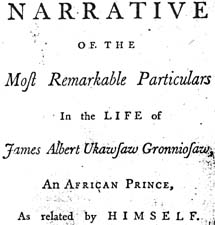
Recently, I read Ukawsaw Gronniosaw's A Narrative of the Most Remarkable Particulars in the Life of James Albert Ukawsaw Gronniosaw, An African Prince, Written by Himself (1770?). While classified as a slave narrative because Gronniosaw experiences slavery and movement from master to master, the narrative could be more closely called a conversion narrative in much the same was as Briton Hammon's narrative. At this time, I do not wish to discuss these classifications in regards to Gronniosaw's account of his life; instead, I want to discuss a minor paragraph that occurs while Gronniosaw relates his time spent in New England.  As he struggled with the thought of going to Hell if he did not experience a conversion, Gronniosaw attempted to end his life; however, he thought he shouldn't kill himself because he would probably go to Hell. Gronniosaw continued in this state until his teacher, Mr. Vanosdore, worked with him towards conversion.

During this period, Gronniosaw recounts a place that he used to visit and speak with God. This is the point I would like to share with you today because it is reminiscent of Miss Jane Pittman and her discussions about the old oak tree she speaks with. I am going to quote section at length.
About a quarter of a mile from my master's house stood a large, remarkably fine oak-tree, in the midst of a wood; I often used to be employed there in cutting down trees, (a work I was very fond of) I seldom failed going to this place every day; sometimes twice a day if I could be spared. It was the highest pleasure I ever experienced to sit under this oak; for there I used to pour out all my complaints to the LORD: And when I had any particular grievance I used to go there, and talk to the tree, and tell my sorrows, as if it had been a friend. (38)
Gronniosaw goes on to states that he "used to come here [to the oak-tree] to find peace" (39). In many ways, this short account appears similar to the way that Miss Jane speaks of the oak tree in The Autobiography of Miss Jane Pittman. I am not, with this observation, claiming that Gaines read Gronniosaw while writing his novel. I am merely pointing out an instance from a text written around 1770 that appears similar, at least in sentiment, to Gaines' novel.

What does all of this similarity say? Is there something here that could be explored further? At this point, I'm not sure. What are your thoughts?

Gronniosaw, Ukawsaw. A Narrative of the Most Remarkable Particulars in the Life of James Albert Ukawsaw Gronniosaw, An African Prince, Written by Himself. Black Atlantic Writers of the 18th Century: Living the New Exodus in England and the Americas. Eds. Adam Potkay and Sandra Burr. New York: St. Martin's Press, 1995. 27-63. Print.

Tuesday, November 4, 2014

Modest Mussorgsky and Ernest Gaines

Short Plantation Sketches "Two Women"
Gaines is fond of quoting Friedrich Nietzsche on music. Nietzsche wrote, "Without music, life would be a mistake." To Gaines, and myself, this quote rings true. Last Wednesday, the UL Symphony performed selections from Modest Mussorgsky's Pictures at an Exhibition, and this led me to reflect on the inspiration Gaines received from that piece of music. "Visual Art and the Art of Writing Fiction" is one of the earlier blog posts on this site. In it, I discuss how Van Gogh's The Potato Eaters and Bedroom of Arles inspired Gaines and his writing. Here, I would like to explore how a piece of classical music, Modest Mussorgsky's Pictures at an Exhibition served as an inspiration for one of Gaines' most accomplished works, The Autobiography of Miss Jane Pittman.  Gaines says that Mussorgsky's suite served as part of the original inspiration for the novel; however, once he realized that Miss Jane would begin to tell her own story, other influences arose.

Pictures at an Exhibition, essentially, is a tribute to one of Mussorgsky's friends, Russian artist and architect Viktor Hartmann. In fact, the translation of the piece from Russian is Pictures at an Exhibition-Memories of Viktor Hartmann. Mussorgsky and Hartmann both saw themselves as working to create distinctly Russian art, thus drawing them towards one another. Gaines can be seen as doing the same thing, creating literature that intrinsically shows the land and people that he writes about, thus forming art that represents a distinct area and carries that area's feeling. After Hartmann died suddenly in 1873, Vladimir Stasov organized an exhibition of over 400 of Hartmann's works, and Mussorgsky donated some pieces from his personal collection for the exhibition. After viewing the paintings, Mussorgsky became inspired and began to compose Pictures at an Exhibition.

The suite takes the listener through a gallery of Hartmann's works. Beginning with the recognizable Promenade that replicates the listener moving around the gallery and stopping before paintings, the ten pieces in the suite move the participant through eleven different Hartmann watercolors. There are six surviving works by Hartmann that scholars have identified as pieces that Mussorgsky used for his suite. The painting that accompanies "The Great Gate of Kiev" is below. Listening to the pieces, one moves through various emotions such as joy, fear, despair, etc. Reading Gaines' work produces the same types of emotions. For example, one cannot help but laugh when Tee Bob causes Jane's horse to run across the fields while she holds on for dear life. Likewise, one cannot help but feel sadness when Jane and the others receive news of Jimmy Aaron's death.

Hartmann's Plan for a City Gate in Kiev
Speaking with Darrell Bourque and Marcia Gaudet in 2002, Gaines talks about the inspiration he received from Mussorgsky's work. Originally having Miss Jane's story told from multiple points of view, then moving on to a concept he titles Sketches of a Plantation, Gaines ultimately settled on having Miss Jane tell her own story. In the early stages, Gaines mentions the suite as carrying a theme throughout it (the Promenade), and that is what he wanted with Sketches of a Plantation, a common theme. Mentioning this, Gaines says, after stating that the novel has four sections, "And if you listen to Pictures at an Exhibition, all of these characters are going through this piece of music. And at the very end, it's loud, loud Russian crazy music. "At Hell's Gate," ["The Great Gate at Kiev"] I think it's called" (Mozart 145). Music taught Gaines structure and how to use repetition, in much the same way that Hemingway did with the written word. There is more that can be said about this topic, and hopefully in the coming posts I will delve into Mussorgsky and Gaines even more. Until then, what music inspires you?

Bourque, Darrell, Ernest J. Gaines, and Marcia Gaudet. "A Literary Salon: Oyster/Shrimp Po'Boys, Chardonnay, and Conversation with Ernest J. Gaines." Mozart and Leadbelly. Eds. Marcia Gaudet and Reggie Young. New York: Vintage Books, 2005. 131-159. Print.