Showing posts with label southern literature. Show all posts

Tuesday, July 14, 2015

Farewell Blog Post

Today, we are going to do something a little different. At the end of the month, Dr. Matthew Teutsch, the Interim Director of the Ernest J. Gaines Center, will say goodbye to us and move on to other endeavors. Before he leaves, we thought it would be a good idea to ask his about his time here, what Gaines means to him, and why Gaines's work is important today. Make sure to keep an eye out for Dr. Teutsch's own blog, Interminable Rambling, which he plans to start in August. As we get closer, we will let you know more about it. 


How long have you been at the Ernest J. Gaines Center?

I have been at the center for a total of three and a half years. I started as a graduate assistant in January 2012. At that time, I finishing up my comprehensive exams for my PhD program and starting to focus on the dissertation. As the graduate assistant, I worked on organizing archival materials, creating lists of scholarship on Gaines, leading tours of the center, conducting lectures, and other tasks. In April of 2014, after the director of the center took a new job, I became the Interim Director of the Ernest J. Gaines Center. Since then, I have, among other things, acquired new items for the collection, organized the 50th anniversary celebration for Catherine Carmier, worked with NEA Big Read recipients, hosted a concert by Irvin Mayfield, and lectured to classes across the nation. 

What was your first encounter with Ernest J. Gaines?

That depends, do you mean with his writing or with him specifically? With his writing, I picked up A Gathering of Old Men about ten years ago. I read it because I knew Gaines is from Louisiana, and that appealed to me. Afterwards, I thought, “Is this it?” It didn’t really do a lot for me then. I read A Lesson before Dying after that. The story moved me; however, I kind of felt the same way, “Is this it?” I’m not sure what I was expecting—Dante, Shakespeare, Hawthorne, Ellison, or something else. Who knows what I thought.

When I picked him up again, around my PhD coursework, I started to reread Gaines, and I really examined him closer when I started working at the center as a graduate assistant. Then, I realized that Gaines writes what I like to call “deceptively easy” texts. He is very accessible, and for that reason, he has both a popular and academic audience. In this way, Gaines recalls one of his inspirations, Ernest Hemingway, who placed 10% on the surface of the text and another 90% underneath (the iceberg theory). Digging through the surface, we see that Gaines does a lot more than it may appear at first. For me, this keeps me coming back because like any good piece of art each time I come back I see something entirely new and enlightening.

My first encounter with Gaines specifically, I think, came at the cemetery beautification in 2009. There, I worked in the cemetery, which in and of itself provides a very unique perspective on Gaines and his writing. He came out there in his golf cart, and I, as most people would be, approached him tentatively. I don’t recall much from the first meeting, but I do know that I discovered ways to speak with him. For me, I talked about sports, and as time went on, I began to loosen up. Eventually, I realized that for all of his fame, Gaines is a person just like me. He likes his Olde Tyme shrimp po-boys and sitting around and talking. Things I like to do as well.   

Once I got past the initial awe of being in his presence, conversation became easier. We would speak about baseball, literature, or food. Hearing stories about Juan Marichal or Hank Aaron always made my day. Hearing him talk about literature, his own writing and that of others, always taught me something new. Hearing him speak about shrimp po-boys, well, just made me hungry. 

What has Gaines taught you?

Gaines has taught me a lot of things. Specifically, he has solidified my thoughts regarding art and the multitudinous ingredients that go into the creation of a piece of literature, a painting, a song, or anything. Gaines speaks about Vincent Van Gogh inspiring him. He speaks about Modest Mussorgsky. He speaks about William Faulkner. All of these influences, and more, had a part in the finished project, whether they appear noticeable or not. For me, the interconnections between all of these things and Gaines's work highlights that life, and art, does not exist in an insular bubble. Everyone, and everything, converses together in one way or another. Today, we need conversation and dialogue on numerous issues, and to me, Gaines provides an avenue to begin some of those conversations.


Along with highlighting the interrelatedness of art, Gaines has also taught me history. He has shown me the lives of individuals (African American, white, Cajun, & Creole) in Louisiana. When most people think bout Louisiana, the "exotic" New Orleans comes to mind. Gaines, unlike many other authors who write about Louisiana, does not focus on New Orleans; in fact, the city rarely appear sin his works, and no action takes place there. Instead, Gaines focuses on the lives of rural Louisianians,  similar to the ways Arna Bontemps does in regards to the central Louisiana region. Gaines writes about a people who do not, as the editor in The Autobiography of Miss Jane Pittman points out, "Do not appear in the history books." I would not have known about people like Miss Jane, Copper Laurent, Mathu, Lou Dimes, Candy Marshall, Grant Wiggins, Tee Bob Samson, or others without Gaines's work.

What is Gaines’s importance?

With everything going on in the nation today, I feel that Gaines's work serves a specific purpose. Reading Gaines, it becomes easy to separate the contemporary from the past that Gaines presents. For instance, A Lesson before Dying takes place in 1948, so a reader can look at the novel and say, "That's a terrible story, but it's in the past. Today we don't have to worry about someone like Jefferson experiencing the same trials and tribulations." However, if we look at what has occurred recently, this sentiment does not hold a lot of water. Was Trayvon Martin like Jefferson? I think Gaines shows us that even though slavery ended, "officially," in 1865 and Jim Crow ended during the 1960s, we still have a long way to go.

Gaines's importance comes from the fact that he does not shy away from showing that the "rules," these unwritten laws that work to keep wealthy whites in power and African Americans, and I would even argue poor whites (think Sydney Bonbon and Gil Boutan), in subjugation still exist. They may not appear on the books, but they remain. Matthew Antoine, Grant's former teacher, tells him that no matter how hard Grant tries he cannot scrape away three hundred years of slavery and hate when teaching his students. The students exist in the shadow of the past, and until we confront that past, head on, we will continue the cycle.

Do you have any final thoughts about your time at the center? 

The Ernest J. Gaines Center has been a part of my life for the past three years. I never would've thought, when I first picked up Gaines's work, that I would have the opportunity to work at the center and to explore his works in the ways that I have done over the past couple of years. Looking back, I think my time can be summed up by Aunt Clo's description of Aunt Fe in "Just Like a Tree." The story, told from multiple points of view, tells about the last night Aunt Fe spends in the quarters before her family moves her North. Every section carries the narrative forward, except for Aunt Clo's. Her section poetically compares Aunt Fe to a tree being "jecked" out of the ground and dragged to the North. After removing the tree from the ground, one looks into the hole created and sees the taproot remaining. For me, the center is that taproot. I may leave, but a part of me will always be a part of this place.


Thursday, July 2, 2015

Stream-of-Consciousness in Bontemps and Toomer

Last post, I wrote about a stylistic element in Arna Bontemps's Black Thunder (1936) that I found interesting and similar to Gaines's description of the arrival of Gruesome Gertie into Bayonne in chapter 30 of A Lesson before Dying. Today, I want to briefly continue with that discussion by looking at a couple of section from Bontemps's novel where the third person narrator gives way to a stream-of-consciousness narration. This move, in many ways, reminds me of parts of Jean Toomer's Cane (1923) where we see inside the characters's heads. These sections occur mostly in the second and third sections of Toomer's novel and are punctuated like drama, providing the character's name then a period.


During the torrential storm that ultimately thwarts Gabriel's rebellion, Ben sits in the house with Marse Sheppard and thinks about their relationship, how much they understand one another and how satisfied they are together. All of this in the third person; until he begins to think about his freedom and what that means.
Then suddenly another thought shouted in his head.
Licking his spit because he done fed you, hunh? Fine nigger you is. Good old Marse Sheppard, hunh? Is he ever said anything about setting you free? He wasn't too good to sell them two gal young-uns down the river soon's they's old enough to know the sight of a cotton-chopping hoe. How'd he treat yo' old woman befo' she died? And you love it, hunh? Anything what's equal –
"Get the toddy bowl, Ben."
"Yes, suh." (94)
Here, the narration moves into Ben's head as he considers his relationship with Marse Sheppard and whether or not he should even think about freedom. Bontemps moves seamlessly from the third person narrator into Ben's head for a stream-of-consciousness section. Ben begins by asking himself questions regarding Sheppard's respect for him then moves into the past thinking about the way Sheppard treated his family, selling them when they were old enough to work in the fields. Ben's thoughts, however, get interrupted when Sheppard asks him for the "toddy bowl," and the narrator returns to third person, providing an overview of the action. Bontemps does this periodically throughout the novel, delving into the thoughts of multiple characters as he tells the story of Gabriel Prosser's failed insurrection.

In "Bona and Paul," Toomer incorporates interior monologue, delving into the character's thoughts to illuminate the action taking place. At the very beginning of the story, Bona watches Paul dance dance during class.
Bona: He is a candle that daces in a grove swung with pale balloons.
Columns of the drillers thud towards her. He is in the front row. He is in no row at all. Bona can look close at him. His red-brown face —
Bona: He is a harvest moon. He is an autumn leaf. He is a nigger. Bona! But dont all the dorm girls say so? And dont you, when you are sane, say so? That's why I love — Oh, nonsense. You have never loved a man who didnt first love you. Besides — (70)
The excerpt above shows a small sample of what Toomer does with stream-of-consciousness narration. Bona thinks about the way that Paul looks as he dances in front of her, and as she contemplates his appearance in relation to the moon and a leaf, she begins to drift back in to what others say about him. Her thoughts go from a metaphorical image of Paul to a depiction that hinges on what others say, and that tension can be seen in her thoughts. She abruptly stops twice, as indicated by the em-dashes. Bona moves from abstract, metaphorical images of Paul to examining him in relation to how her fellow dorm girls view him to wondering whether or not she actually loves him. This is just a brief example of stream-of-consciousness in Toomer's novel, there are more throughout the work.

What are some other novels that employ this technique? What is its purpose? How does this technique relate to modernism, which both authors were a part of? Let me know in the comments below.

Bontemps, Arna. Black Thunder. Boston: Beacon Press, 1968. Print.
Toomer, Jean. Cane. New York: Liveright, 1975, Print.

Thursday, June 25, 2015

The Migrant and Washington in Jean Toomer's "Cane"

"When one is on the soil of one's ancestors, most anything can come to one" (17). This line, from Jean Toomer's Cane (1923), immediately made me think of Ernest J. Gaines and the land he writes about. As I reread Cane last week, I couldn't help but think about the Toomer's descriptions the South and the North and Gaines's descriptions as well. I have written about Toomer and Gaines before, so I will not touch on that aspect in great detail here. Instead, I would like to take the time to write about two specific vignettes ("Seventh Street" and "Rhobert") from the Washington section of Toomer's masterpiece. These two sketches open up the second section of Cane and both highlight the hustle and bustle of the urban space that many African Americans encountered during the Great Migration.


"Seventh Street," a prose poem, begins and ends with a four line verse that sums up both the means of advancement and the speed within the urban landscape. Unlike the South, where "[t]ime and space have no meaning in a canefield," the North buzzes with people moving too and fro, always being propelled by money and time. The verse that opens and closes "Seventh Street" sums this up perfectly. Toomer writes,
Money burns the pocket, pocket hurts,
Bootleggers in silken shirts,
Ballooned, zooming Cadillacs,
Whizzing, whizzing down the street-car tracks. (39)
The languid, sonorous sounds that constitute the southern section of Cane give way at the opening of the northern section to movement through the sights and sounds of the metropolis. Farah Jasmine Griffin notes, "Assonance and consonance further enhance the sense of motion, but the repetition of the harsh double consonants gg and zz . . . speed the passage towards a swift conclusion" (65). These aspects of "Seventh Street" create an image of movement and harshness that does not appear in the southern section.

The vignette continues its movement through the cityscape by bringing the reader/migrant face to face with the underworld of the urban environment. "Seventh Street is," the reader hears, "a bastard of Prohibition and the War. A crude-boned, soft-skinned wedge of nigger life breathing its loafer air, jazz songs and love, thrusting unconscious rhythms, black red-dish blood into the white and whitewashed wood of Washington" (39). These opening sentences ooze with numerous images of what an African American migrant to the North, around the time of World War I, would encounter. Prohibition, which of course led to crime, returning soldiers, and the proliferation of jazz all await the incoming migrant. Sexual verbs constitute the movement of the reader down "Seventh Street," words like thrusting, breathing, shed, pouring, etc. populate the space. Along with this imagery, the city also becomes infused with an African American presence. The narrator says that black and red blood thrust themselves into the "whitewashed wood of Washington." While the southern section ends with death in "Blood Red Moon," the northern section sees migrants rising from the blood-stained soil of the South to the promises, false or real, of the North.

The second vignette in the northern section, "Rhobert," comments on the materialistic, consumerist pull of the North to new migrants. "Rhobert" focuses on a man who becomes constricted and suffocated by his material possessions. The house resembles "a monstrous diver's helmet" that extricate the life out of him by continually constricting around his head (40). Rhobert's "house is a dead thing that weights him down" (40). It drags him into the mud where he wiggles to free himself but ultimately perishes. At the end of "Rhobert," the narrator says that after Rhobert sinks into the ground we should "build a monument and it in the ooze where he goes down," and the monument should be "of hewn oak" (41). The urban leads to Rhobert's demise, but he returns, figuratively in death, to the South. The monument is made of oak and his mourners sing "Deep River" as he perishes underneath the ground. Throughout the northern section, the characters reflect back to the South, continually returning figuratively to the space.


The North, and the drive to acquire material things like the house, subsume Rhobert and his life. Griffin points out that we should view "Rhobert" in relation to Leadbelly's "Bourgeois Blues," a song that chronicles the African American migratory experience to the North, and specifically to Washington. "Bourgeois Blues" epitomizes the struggles that African Americans endured when moving North, and it highlights the "Promised Land" of the North was not all it was cracked up to be. The narrator of the song attempts to find housing for him and his wife, but the white property owners turn them away. Even though America is "the land of the free and the home of the brave," no one will provide a place to stay. To acquire that space, the migrant must purchase it, and that creates other problems. "Rhobert" purchases a house, and that purchase drives him to death. There is more that could be said here, and I am not quite sure, at this point, what that may be. Let me know what you think in the comments below.

I would like to end this post with a video of Gil Scott-Heron & Brian Jackson sing "Cane" (1978), a song based off of Toomer's novel and specifically off of "Carma" and "Karintha."

 
Griffin, Farah Jasmine. "Who set you flowin'?": The African-American Migration Narrative. New York: Oxford University Press, 1995. Print.
Toomer, Jean. Cane. New York: Liveright, 1975, Print.
  

Thursday, June 18, 2015

Gaines and Visual Art: Depicting Social Landscapes in "A Gathering of Old Men"

Today's blog post comes to us from the Ernest J. Gaines Center's Summer Research Fellow from Cal State LA Katharine Henry. Her previous post, "'Deep in You:' Encountering Gaines," was the June 2, 2015 entry.  In today's post, she speaks Gaines's reference to Pieter Brueghel in A Gathering of Old Men. For further information on Gaines and visual art, see our post on Gaines and Van Gogh from June 5, 2014.  

In Jeanie Blake’s 1982 interview with Ernest J. Gaines, the author describes writing the massacre scene in The Autobiography of Miss Jane Pittman as “a [Pieter] Brueghel painting scene, a very violent scene” (141). One year later, A Gathering of Old Men is published and much of the novel’s violence is psychological with physical abuse chronicled after the fact. Marshall plantation’s brutal Cajun farmer, Beau Boutan, is shot before the novel begins. Once his younger brother, star LSU quarterback Gil Boutan, learns of his death, Gil’s close friend and fellow athlete, Sully, drives them to the crime scene where eighteen old black men with shotguns await the Boutan family patriarch, Fix, to take swift revenge. Sully describes the scene of these men gathered in Mathu’s yard as surreal, “Something like looking at a Brueghel painting. One of these real weird, weird Brueghels” (Gaines 118). Where Gaines aims for “the reader to hear the sounds of people being clubbed to death, to hear how the small animals and birds leave” (Blake 141) in The Autobiography of Miss Jane Pittman, Bruegel is useful for thinking how the old men gathered in Gaines’s subsequent novel commemorate their silencing and vocalize an alternative communal narrative of survival and transcendence.  

The Brueghel family was talented, spawning four generations of Flemish painters that began with the most famous, Pieter Bruegel the Elder. This eldest Brueghel, who later changed his name to Bruegel, produced art in the 16th century, crafting bizarre, masterful landscapes of ordinary peasant life. The Fight Between Carnival and Lent (1559) and The Wine of St. Martin’s Day (1565-1568) are two oil paintings that encapsulate his fascination with mass gatherings of people. The crowding of people and their small scale conveys the public as a chaotic, while coherent, organic machine akin to an ant colony. Musicians, nuns, upper class men, bakers, old and young alike, the impoverished and the disabled all pursue their individual missions on Bruegel’s canvases. The disorder of these gatherings creates a whole, complete vision of European society during the Renaissance. Four centuries later, Gaines’s old men with “Cataracts. Hardly any teeth. Arthritic. Old men. Old black men…Who have been hurt…Tired old men trying hard to hold up their heads” are not the clamored folk of Bruegel’s artworks, but their contradictory testimonies explaining why and how they killed Beau, similarly bolster their collective strength (Gaines 137). Each confession while not the “real” story the sheriff seeks, is just as true, adding a layer to the oral patchwork of American history from the post-emancipation to the post-Civil Rights movement eras.

Netherlandish Proverbs
In Netherlandish Proverbs (1559), Bruegel illustrates his theory of how private and public life continually melt into one another. No edifice, home or barn is safe from his paintbrush, each has an opening, porous to voyeurs and any figures, human or animal, that climbs in through every window and squeezes out from every crevice. Animals and humans dine alongside each other; the pastoral and urbanized blend smoothly. In the plantation quarters, private and public life are equally indistinguishable.  Cherry, who reflects upon the community cemetery, clearly articulates this, “Back there when I was growing up, people didn’t even mark the graves…They had all come from the same place, they had mixed together when they was alive, so what’s the difference if they mixed together now?” (Gaines 44)

Bruegel’s Fall of Icarus recasts the focus away from its mythic, epic title character in favor of the simple farmer and shepherd. These pastoral figures grace the foreground of the composition while Icarus is nearly lost from the painting, were it not for two nearly imperceptible legs splashing humorously in the water. Icarus’s fate is not a dramatic descent from the heavens but a humorous flop into the ocean where he is relegated to a miniature figure and appears to have sooner fallen off the nearby ship than to have fallen from the sky. While Bruegel selects a classical tale for his painting, his composition subverts the mythological narrative to validate human labor and harmony with nature as a worthier existence than a prideful rebellion against nature. In Gaines’s novel, the land is at the center of the community’s sense of identity and those who work it with their bodies, rather than with tractors, better recognize its value as a living organism all its own, not distinct from their human community. Johnny Paul declares he killed Beau because, “I’m the last one left…I just didn’t do it for my own people. I did it for every last one back there under them trees. And I did it for every four-o’clock, every rosebush, every palm-of-Christian ever growed on this place” (Gaines 92). Johnny Paul upholds the trees, plants, flowers, the dead and the living as equals to himself, worth his protection and self-sacrifice. Mapes, the white sheriff and witness to the gathering, is not the only audience for their testimony. Yank “wasn’t talking to us now. He was thinking back, back when he was a younger man,” Coot “was over by the garden fence, looking down the quarters toward the fields,” and Charlie is talking “Not to Mapes, not to us, but to himself” (Gaines 98, 103, 188). Johnny Paul also “wasn’t looking at Mapes, he was looking toward the tractor and the trailers of cane out there in the road” narrating to the land what it has already seen and knows (Gaines 88). His love letter to the land expresses that there is no distinction between the human and natural world and reaches its most intimate gentleness in his claim that he killed Beau, ‘To protect them little flowers. But they ain’t here no more’ (Gaines 90).

The Fall of Icarus
Like Johnny Paul, Yank ‘ain’t thinking ‘bout no progress’ as Mapes and Beau see it, but about how “progress” has lead to regression for blacks (Gaines 99). Johnny Paul most strongly identifies the limits of white knowledge and authority in his simple, powerful statement: ‘No, you don’t see’ (Gaines 88). This moment is the community’s sit-in, their demonstration in a time and place where the Civil Rights movement seems to have never touched fifteen years later—there are no references in the novel to the movement other than local bar owner Tee-Jack’s brief dismissal of “all that desegregation crap” (Gaines 152). The men do not march to a “Whites only” water fountain as one of Jimmy’s protestors does in The Autobiography of Miss Jane Pittman but stand their ground for the younger, vulnerable, fearful men they used to be and for the old men that they are now. Uncle Billy, Gable, Mathu, Dirty Red, Johnny Paul, Yank, Tucker, Coot and others share stories of endurance that challenge how the law and the Old South—via Mapes and Candy, respectively—have viewed them as weeds.

Preceding Sully’s parallel of the gathering of old men to a Bruegel painting, he compares it to “that old TV play Twilight Zone…You would be driving through this little out-of-the-way town, and suddenly you would come upon a scene that you knew shouldn’t be there” (Gaines 118). There is a distinct bizarreness, perversion, and unnaturalness in Bruegel’s paintings—pigs carry knives, foxes sit at the dinner table ready to eat with a bib around their necks, human limbs peak out the crevice of one edifice while the rest of their bodies remain cloistered, eggs walk on tiny feet. The strangeness that Sully witnesses and connects to Bruegel is a conception of black self-defense as a foreign notion, which Mat echoes: ‘Anytime we say we go’n stand up for something, they say we crazy’ (Gaines 37). Akin to Bruegel’s figures who sprawl in every direction in constant movement, against the classical impulse towards order, the old men disband from the orderly and oppressive rules and reassemble into a community of their own making, not Candy’s army but a self-regenerative, dignified, self-sustaining community that boldly claims, as Charlie does, ‘I’m a man’ (Gaines 187).


Blake, Jeanie. “Interview with Ernest Gaines.” Conversations with Ernest Gaines. Ed. John
Lowe. Jackson: University of Mississippi Press, 1995. 137-148. Print.
Gaines, Ernest J. A Gathering of Old Men. New York: Vintage, 1992. Print.

Tuesday, June 16, 2015

Reflections of the Second Annual Ernest J. Gaines Summer Teaching Institute


Last week, the Ernest J. Gaines Center, in conjunction with the Louisiana Endowment for the Humanities (LEH), hosted the Second Annual Ernest J. Gaines Summer Teaching Institute. In June 2014, the center hosted the inaugural institute with four participants from area schools. This year, the institute included nine participants from area schools and universities. One participant even came from Texas to take part. Participants read four of Gaines's works during the week: Bloodline, The Autobiography of Miss Jane Pittman, A Gathering of Old Men, and A Lesson before Dying. Each day, participants heard from the center's staff and two Gaines scholars who are also Gaines scholars: Marcia Gaudet and Darrell Bourque. Participants also had the opportunity, each day, to look at items from the collection and to work on lesson plans that would incorporate their discussion and items from the collection into their lesson plans. These lesson plans will be available on the LEH's website soon. Midway through the institute, on Wednesday, the participants had the opportunity to head out to Oscar and New Roads, LA. There, they sat with Gaines in his house, explored the cemetery and the church, and had the opportunity to eat with Gaines at local restaurant.

Overall, the institute provided lively discussion not just on Gaines's works but also on how to incorporate those works, and the themes he discusses, into the middle and high school classroom as well the university classroom. These discussions arose when the group thought about the importance of Gaines's work in relation to the recent incidents involving African American men and women in the news today. During the discussions, one of the questions that came up felt extremely important. A participant, who taught Gaines in her classroom last year, mentioned that her class was predominately African American. While teaching Gaines, white students in her class asked her why they were reading about the African American experience and used the term "reverse racism" to express how they felt. This anecdote reminded me of my own experiences teaching African American literature in the university classroom. Once, when teaching Langston Hughes, I had a student approach me after class to inquire, and to complain, about why we were reading so much African American literature. Truth be told, Hughes and others were a small part of the class.

What my encounter with that student and the participant's story showed me was that when people come face-to-face with the realities of their situation and place within society they either recognize it and work to make society better from their position or they completely reject the idea that they come from a position of driveler and claim that everyone has a chance at the American Dream. When talking about how to help students who reject the image they see in the mirror, we thought about approaching a text like Gaines through another angle. Gaines recognizes that while the African American experience is unique there are others in the world who have suffered for various reasons as well based on ethnicity or class. He writes about this in "A Very Big Order: Reconstructing Identity" and in Catherine Carmier. With that in mind, a teacher could have students think about Gaines's influences and how they affected his own writing. Russian, Irish, and American writers influenced Gaines. Turgenev, Tolstoy, Joyce, Steinbeck, Cather, and others wrote about the lower classes, and the peasants in their societies. When Gaines read those works, he saw similarities between the people he knew and the ones the other authors wrote about. What he did not see, though, was his own people, the African American community he grew up in rural Louisiana.

Another way to possibly approach Gaines's work, or other African American texts, with students who want to push back because they claim we reside within a post-racial society is to incorporate music. Historically, people viewed punk music as an "other," a subculture of outsiders. Having students enter into Gaines's work through a music that others ostracized and that created a community for its listeners is a way to think about how to help students understand the universality to Gaines's works. Bands like The Descendents, NOFX, Rancid, Reagan Youth, Misfits, Black Flag, Minor Threat, etc. would be good places to look. There are other ways to address students' reluctance to reading authors like Gaines, but these are just a couple we thought of.

Many other discussions took place during the week, but the one above is what really stuck out to me because it is something that I have thought about, especially when teaching Gaines in the region that he writes about. Doing that creates a whole new group of reactions to Gaines and his work. What are your thoughts on getting reluctant students, who feel you are representing one group too much, to understand that we need to read African American, Asian, Chicano, and other literature? How do you respond? I would like to know because this is something I think we all deal with at one point or another in the classroom, or in community talks, and it is something that needs to be addressed.

Thursday, June 11, 2015

Kiese Laymon's "Long Division" and Words


While Mitchell S. Jackson's The Residue Years ultimately won the 2014 Ernest J. Gaines Award for Literary Excellence, there were a few books on the short list for the award. One of those books was Kiese Laymon's Long Division (2013), a novel reminiscent, in some ways, to Octavia Butler's Kindred. Laymon's novel ostensibly takes place in 2013; however, characters oscillate between three different years: 2013, 1985, and 1964. The characters' movements through these varying years works to show that we should pay attention to our history and work to understand it; their time travel also highlights that even though things look like they have gotten better, a lot of the same issues still remain, just in varying ways. In this aspect, Laymon's novel treats some of the same themes that Gaines's work does, that of the changing, yet unchanging, times. I wrote about this last week in regards to In My Father's House.

Laymon's focus on language, and the use of it, should be seen as a discussion of the changing, yet unchanging, times. The 2013 section of the novel begins with the narrator City and LaVander Peeler preparing for a national contest entitled "Can You Use That Word in a Sentence," a contest that started "after states in the Deep South, Midwest, and Southwest complained that the Scripps Spelling Bee was geographically biased" (7). The judges give contestants a word, and the contestants must provide "correct sentence usage, appropriateness, and dynamism" to advance (7). The contest presents an interesting scene because while it supposedly represents those who do not have representation at the spelling bee, it ultimately just parades African Americans, Mexicans, and others in front of a national audience to essentially, as Billy says in Gaines's novel, to give lip service to change while not necessarily adhering to it.  

Part of that change relates to words and language as well. Throughout the novel, the usage and role of specific words gets discussed. Typically, the discussion centers around derogatory words that cause hurt and pain when spoken or written.  When City gets called in to the principal's office at the beginning of the novel, he ruminates on why Ms. Reeves summoned him there. He concludes that LaVander Peeler told her that City "called him a 'nigger'--not'nigga,' 'negroid,' 'Negro,' 'African American,' or 'colored'" (13). I do not want to get into too much detail about the novel, but the "er" at the end of the word above struck me, especially when thinking about it in relation to what happens at the conclusion of the novel when LaVander asks a chained up white man to spell the word. The man spells it with an "er," and LaVander simply replies, "All things considered, I don't think that's right" (252).

City deduces that LaVander turned him in because earlier someone turned LaVander in for calling City a "faggot." After the incident, LaVander began to use the term "homosexual" when taunting City "because he knew Principal Reeves couldn't punish him for using that word without seeming like she thought there was something wrong with being homosexual in the first place" (13). City muses about other derogatory words as well and their semiotic meanings. Ultimately, I think that these thoughts about the role of words, their meanings, and the way the power they have to construct and form people's perceptions of others is partly at the heart of Laymon's novel. Words, and even the correct usage of words, becomes a way that the past remains the same, as I mentioned earlier.

This discussion can be summed up by briefly discussing the "Can You Use That Word in a Sentence" finals. City gets eliminated on the word "niggardly." City provides a sentence that attacks the judges and the system they are perpetuating, using the word colloquially. He says, "I truly hate LaBander Veeler sometimes more than some of y'all hate President Obama and I wonder if LaBander Veeler should behave like the exceptional African-American boy he was groomed to be by his UPS-working father, or the, um, weird, brilliant, niggardly joker he really is when we're the only ones watching" (38). City's sentence gets him eliminated because the term means "stingy, cheap," and he does not use it in that way. Now, when providing a suitable example of the word, the judges highlight the power of language and how, without even referring to the color of the woman being spoken about, they perpetuate stereotypes even when using the term correctly. Their sentence is, "Perspiration covered the children who stared incessantly at the woman in the head wrap since she insisted on being so niggardly with the succulent plums and melons" (38). The sentence oozes with stereotypes by referring to the woman in a "head wrap" who protects her "plums and melons." City knows the word provided a catch 22, and as he leaves the stage, he extols, "I mean, even if I used the word right, I still would've lost" before he goes on a vociferous tirade where he calls out the judges and the audience on their fears (38).

This post barely touches on the role of language and semiotics in Laymon's novel, but I hope it provides a little glimpse into the way we use words and how they have an effect on people. If you haven't already done so, I would strongly suggest picking up a copy of Laymon's essays How to Slowly Kill Yourself and Others in America (2013). (The title essay can be found here.) They are excellent, and extremely reminiscent of James Baldwin and Richard Wright.

Laymon, Kiese. Long Division. Chicago: Bolden, 2013. Print.


Tuesday, June 9, 2015

"The Tenant" in Gaines's "In My Father's House"


There are varying things I could discuss for today's post in regards to In My Father's House (1978). However, I think for right now I just want to focus on a stylistic element of the novel that caught my attention on this read through. Specifically, I became intrigued by the elements of mystery and suspense that permeate the first parts of the novel but also continue through until the end of the novel. These elements appear in relation to the mysterious character who knocks on Virginia Colar's door on a rainy, winter night.

The stranger knocks on Virginia's door, and when she opens it, she sees "a thin, brown-skinned young man standing before her in a wet overcoat" with a "scraggly beard" and "Army field cap" asking if she has any rooms available (3). Virginia questions whether or not she should entertain providing a room for the young man, but her conscience overcomes her because she does not know where else he will go. Even though by-law the white motel should accept him, she knows that they will not do it. After agreeing to rent a room out to the man, he provides Virginia with some information. He tells her he is from Chicago, and she doesn't believe him. He tells her his name, Robert X, and she thinks about which group of people use "X" for their last name. At this point, Virginia again questions her decision to let Robert stay, but she acquiesces by continuing to wonder where else he will go.

From the opening scene, we, as readers, are left asking who Robert X is and why he has come to St. Adrienne. People see him walking through town at all hours of the night, Virginia hears him screaming in his sleep, and he stands out in the cold and rain in various spots throughout the community. All of this arouses suspicion among St. Adrienne's inhabitants, causing them to continually ask why Robert X has come to town. Robert tells them that he came to St. Adrienne to attend a men's conference and to meet a man. Robert X's appearance creates a sense of mystery at the beginning of the novel, and the continued lack of references to him by the name of Robert X throughout the first few chapters adds to this. We learn his supposed name on the third page of the novel, but after that initial introduction, he becomes referred to as "the tenant" by the novel's narrator.

When Elijah meets Robert on the street in chapter two, the men begin to talk. Every time Robert speaks, "the tenant" or "he" follows the verbal words. The act of referring to Robert not by the name he provides but by a generic term such as "tenant" essentially erases his agency at this point of the story because the narrator does not even acknowledge that Robert has a name, even it is not his given name. What does this do? If we think about the rest of the novel, the erasure of Robert's agency plays in to the struggles of Robert/Etienne in the text. He fails to protect his sister, and he fails, ultimately, to accomplish his mission in St. Adrienne. The "tenant" does not act, he only causes people to question.

More could be said here, but right now I'm not completely sure what I could say. What are your thoughts on this topic? Why is it important that he only becomes "the tenant" and not Robert X or Etienne at these early stages? Let me know in the comments below.

Gaines, Ernest J. In My Father's House. New York: W.W. Norton & Company, 1978. Print.

Thursday, June 4, 2015

Gaines's "In My Father's House" and the Changing Times

Unfortunately, Gaines's 1978 novel In My Father's House is not one of his works that gets read very often in the classroom. In light of recent events throughout our country from Ferguson to Baltimore, In My Father's House should be read with an eye reflecting back on what happened during the Civil Rights Movement and with an eye towards what has occurred since then. The novel focuses on the "generational gaps" between fathers and sons created by the legacy of slavery, Jim Crow, and racial oppression in the United States over that past four hundred years. This is something Gaines mentions throughout his oeuvre, and it shows up in A Lesson Before Dying when Matthew Antoine talks to Grant about teaching the children in the quarters: "You'll see that it'll take more than five and a half months to wipe away--peel--scrape away the blanket of ignorance that has been plastered and replastered over those brains in the past 300 years" (64).

In My Father's House begin with Etienne/Robert X returning to St. Adrienne to confront his absent father turned Civil Rights leader Philip Martin. Initially, the narrative focuses on the mysterious character of Etienne who arrives in town on a rainy night during the winter. Once there, his behavior causes the community to question who he is, why he is there, and why he acts the way he does. They find out that his appearance in St. Adrienne has to do with Philip Martin. Martin is Etienne's father, in name only. Etienne comes to St. Adrienne to kill Martin because he feels that Martin has neglected him, his siblings, and his mother. After this revelation, the narrative shifts to focus on Martin and his struggles to mend the gap between Etienne and himself as he struggles to confront his past and maintain his leadership of the movement in St. Adrienne. While this is only a brief summary of the novel, it provides you with an indication of the novel's focus on mending the gaps created by the abominable institution of slavery in this country.

The novel shows, as does other post-Civil Rights novels by Gaines, that the strides made during the mid-twentieth century in regards to voting rights and other actions caused a shift in the forms of subjugation from legally sanctioned Jim Crow to other forms of containment. Billy, a young man that Martin picks up while driving around Baton Rouge, expresses these thoughts in his discussions with Martin. Billy explains that even though strides have been made in regards to Civil Rights things remain the same, if not worse. Speaking on this, he tells Martin,
Niggers can vote. Vote for what? Voting can't fill your belly when you hungry. Another nigger sit up there in the capital. Doing what? Another one go up to Washington. For what? They put another couple on television to broadcast news--them the changes you talking about? I'm talking about changes that keep white men from coming into South Baton Rouge and shooting down our people. If it happen, we pick up guns, we pick up torches, and we hit back. That's the changes I want to see. (163-164)
Billy embodies the feelings, I would argue, of the Black Power and Black Arts Movements. Even with strides in regards to things like voting rights, the situation remained the same. According to Billy, there may be some "token" African Americans in government and on television, but that does not accomplish anything according to Billy. He goes on to speak about the changes occurring in regards to agriculture and how those changes affect the people's relationship with the hegemonic system that works to keep them down. He says, "Go over all this place--empty fields, empty houses, empty roads. Where the people used to be--nothing. Machines. Every time they build another machine that takes work from the people, they hire another hundred cops to keep the people quiet" (168). Since they cannot work the land, the African American population Billy speaks of either left or remained struggled to find employment. While the sharecropping system worked to maintain control of the community, with that gone, what remained? For Billy, "cops" became the system's answer to maintaining "quiet."

Billy vocally espouses his beliefs, but in A Gathering of Old Men, the same ideas provide an undercurrent at the end of the novel. As the men wait at Marshall Plantation for Fix to arrive and lynch someone, the old men do not get the opportunity to stand up to him. Instead, they confront Luke Will, a new representation of racism and subjugation that contrasts with Gil and Cal in the novel. Discussing the anticlimactic nature of the novel, Gaines told Mary Ellen Doyle in 1983, "So Fix's kind of vigilante vengeance is dying out, but there will be the new Luke Will type. The Luke Wills are in the police department. Fix is seventy or eighty and can't shoot straight, but Luke will do it for him" (168-169). The "separate but equal" segregation of Fix and Jim Crow may not exist anymore, and because of this, Luke Will's form of subjugation does.

I could not help but think about recent events while reading In My Father's House, specifically when reading Billy and Philip's conversation in the car. Gaines's post-Civil Rights novels deals with these issues, sometimes subtly and sometimes overtly. In light of the incidents that have been occurring throughout the nation, we need to read Gaines in conversation with them because he provides us with insight into how the events in northern, urban cities affect people in southern, rural places like St. Raphael Parish. What are your thoughts? What are other aspects of Gaines are relevant to recent events? Share in the comments below and make sure you check out and add to the Baltimore Syllabus for resources regarding the events in Baltimore.

Doyle, Mary Ellen, S.C.N. "A MELUS Interview: Ernest J. Gaines--'Other Things to Write About.'" Conversations withe Ernest Gaines. Ed. John Lowe. Jackson: University of Mississippi Press, 1995. 149-171. Print.
Gaines, Ernest J. In My Father's House. New York: W.W. Norton & Company, 1978. Print.


Tuesday, June 2, 2015

‘Deep in You:’ Encountering Gaines—Katharine Henry

Today's blog post comes to us from the Ernest J. Gaines Center's Summer Research Fellow from Cal State LA Katharine Henry. She will be with us at the center helping to transcribe manuscripts, conduct research, and encounter Gaines's works. In today's post, she speaks about her initial encounters with Gaines and his work. 


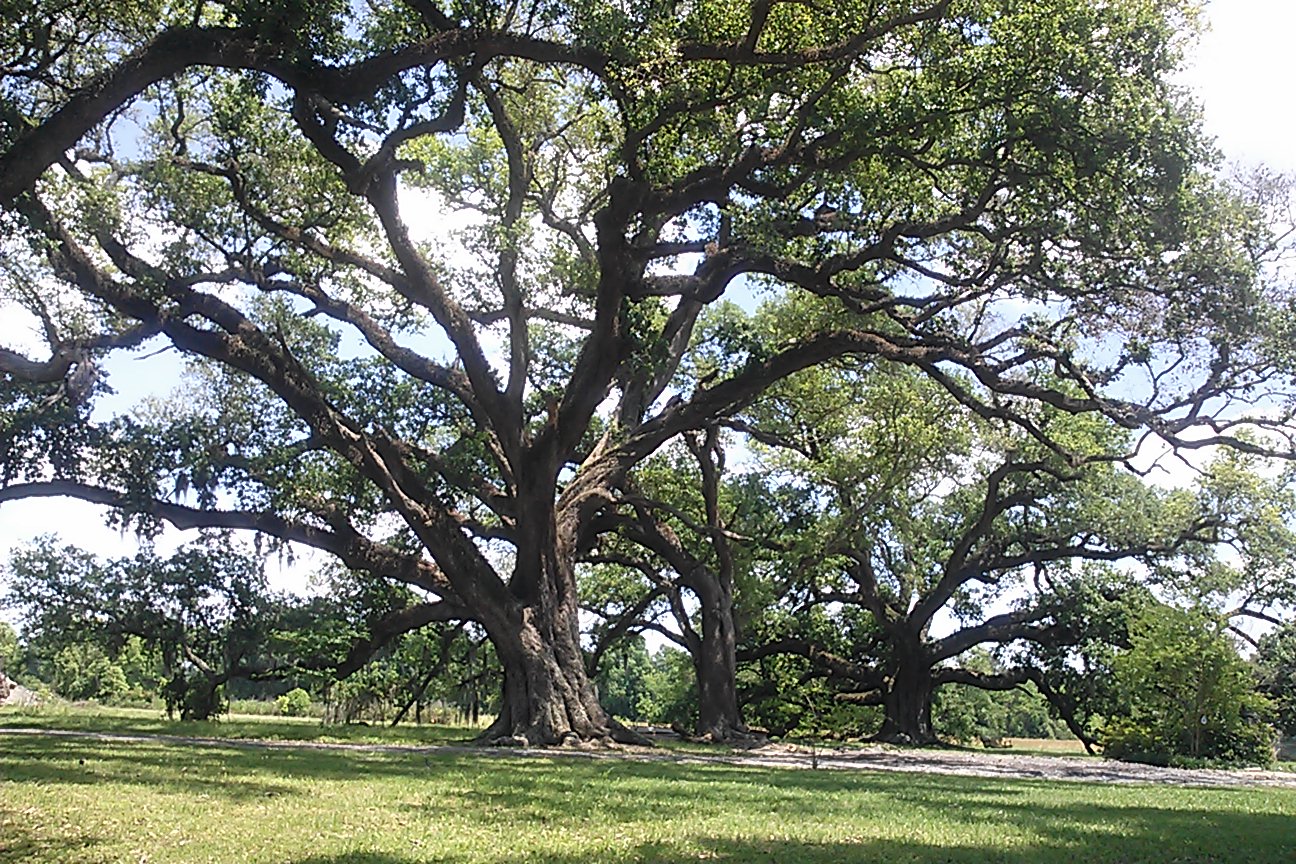
Katharine's Picture of the Miss Jane Pittman Oak

"Deep in you, what you think? Deep in you?" (A Lesson Before Dying 100)

My first encounter with Ernest J. Gaines’s literary work was earlier this year with A Lesson Before Dying (1993). In my undergraduate and graduate studies, I deeply admired the works of William Faulkner who became a gateway for my strong desire to explore more literature written by Southern authors, especially in Louisiana, a place whose astounding natural beauty was quite different from my native California desert and immediately captured my admiration. During my frequent travels from one “LA” (Los Angeles) to another (Louisiana), I was captivated by the unique culture of Acadiana and thrilled to discover another treasure in the region: a profound and extraordinary writer living near New Roads, Louisiana. Born and raised in Louisiana until he left at the age of 15 for California, Gaines returned decades later following what he stated as, “this Louisiana thing that drives me” (Rowell 87). I thought it special that I might have this small fact in common with Mr. Gaines, that we have moved back and forth between California and Louisiana. Turning the pages of A Lesson Before Dying, I was immediately drawn to its deceptively simple narration, vernacular dialogue and its compassion, each ingredient endowing the work with poetic power. Hungry for more stories like these, I pursued Gaines’s masterful storytelling through Catherine Carmier (1964), Of Love and Dust (1967) and Bloodline (1968).

When I consider one of the most powerful underpinnings of Gaines’s works thus far, I recall Reverend Mose Ambrose in A Lesson Before Dying. Concerned with the soul of Jefferson, a young death row inmate whose execution is set the second Friday after Easter, Rev. Ambrose emerges out of the darkness of Miss Emma’s kitchen to ask Grant Wiggins about Jefferson. He asks Grant, “What’s he thinking? What’s he thinking deep in him? Deep in you, what you think?” (100). There are levels of depth, not just deep, but deep deep, and those private ideas and desires that dwell within Grant, Jefferson and so many of Gaines’s characters are frequently in conflict with their community’s immediate needs for security. In Of Love and Dust, Marcus Payne is at war against the world once he is bailed from jail by a wealthy plantation owner and exchanges the imprisonment of his cell for indentured servitude. In return, Marcus seeks revenge on his unyielding Cajun overseer Sidney Bonbon and for whomever else may suffer in that scheme, he cares not. But when his vengeful plans to take Bonbon’s wife, Louise, materialize, his impulse towards her evolves immediately into a feeling the novel challenges us to accept as love. Marcus imagines and plans for a life lived with and for Louise, her daughter Tite and himself as husband and father. With Marcus we find that isolation is not the means to self-validation. Stripping ourselves from all people and things to recover a bare, authentic, solitary self is a fiction. Rather, getting to the soul, ‘deep in you,’ requires community with others so that Rev. Ambrose’s challenge to Grant, “You think a man can’t kneel and stand?”, proves itself true (A Lesson Before Dying 216).

The mode through which many of Gaines’s characters take a stand in their newfound dignity is through acts of love. While violence is at the start of Jefferson’s and Marcus’s journeys, Jefferson’s movement towards a love of self allows him to recognize that he is no hog and that he can stand, walk to and sit in the electric chair, fulfilling his godmother’s insistence, “I want a man to go to that chair, on his own two feet” (A Lesson Before Dying 13). The possibility of transforming the rules that place Jefferson in jail, Grant in the schoolhouse, Marcus on the plantation, and Louise on the porch into circumstances of love underlie Gaines’s self-described interest in exposing how one endures—and might still find possibilities to flourish—under pressure (Rowell 91).

Communities and individuals under an almost intolerable pressure are at the core of Gaines’s dramas. His work illustrates how the ways society sees us, and forces us to see each other, fails to be a language in which we can accurately describe a human person. One particularly powerful example is the mystifying and unsettling relationship between Bonbon and his black mistress Pauline Guerin in Of Love and Dust. Their affair begins forcefully and violently but Bonbon and Pauline quickly fall in love and have been in love for years. Marcus is baffled, as readers are, asking how she could love him. His anger that he cannot have Pauline for himself and his inability to understand her feelings manifests itself in savagery, he knocks her to the ground and denunciates her, “You white man bitch” (Of Love and Dust 98). Reenacting a denial of her agency akin to Bonbon’s initial cruelty, Marcus’s denunciation of Pauline is echoed twenty-eight chapters later when he recounts his youth where he observed that white man have their “number one nigger” who receives special treatment at the expense of other black men and women (250). For Marcus, Pauline holds this role as Bonbon’s mistress and mother to his twins. And she leverages their relationship and is promoted from a field hand to a more comfortable duty as cook in the big house. Her advancement results in the firing of Marcus’s godmother, Miss Julie Rand, who worked on the plantation for 40 years.

Pauline is Bonbon’s pawn and yet this coincides with the uncomfortable acknowledgement that the novel tells us in so many ways that the couple really is in love. Jim Kelly, the young narrator who is trusted and respected within the community, observes how intimate their feelings are. We can be skeptical of each character’s perspectives while simultaneously acknowledging that Marcus simplifies Pauline and Bonbon’s bond in ways that the narrative complicates for readers. In the novel we find that white and black communities accept that black female bodies are the property of men and tolerate sexual violence and yet cannot imagine interracial love. The rules dictate that men can do anything to black women but love them. When Bonbon leaves the plantation and Pauline follows so that they may live together as husband and wife, how do we come to terms with Marcus’s paradigm now? It seems insufficient to working through this complex relationship, especially when Pauline does not see herself as the passive, abused woman that Marcus demonizes her as. We are witnesses to what happens when one begins to see themselves as more than what society first allowed them to be—when Pauline loves Bonbon and endures Marcus’s violence, when Bonbon loves her and becomes the laughing stock of the town and when Louise leaves Bonbon to pursue a life with Marcus at the risk of her father and brothers forcefully dragging her back to her home. Perhaps we might consider the possibility that each person transforms a relationship that the rules deemed should have remained wholly exploitative and violent, into one of care? It’s a challenging and necessary discussion. We become Louise on the porch of her home, staring out to consider the agency and humanity of others at the same time they question and consider her own.

Gaines is a brave writer, writing with critique and compassion in equal parts, asking his readers to think deep about the apparatus which Jim calls “this big thing that said Yes” (Of Love and Dust 269) and which Munford Bazille in “Three Men” calls “they” (140). Yet rather than succumb to the doom inherent in facing this giant, Gaines writes with humanity about the “little people” who endure, acknowledge their participation in the making of tragedies and learn to kneel, stand, walk and sit with dignity like Jefferson (Of Love and Dust 258).

Gaines, Ernest J. A Lesson Before Dying. New York: Vintage, 1994. Print.
 ---. Of Love and Dust. New York: W.W. Norton & Company, 1979. Print.
 ---. “Three Men.” Bloodline. 159-220. New York: W.W. Norton & Company, 1976. Print.
Rowell, Charles. “This Louisiana Thing That Drives Me: An Interview with Ernest J. Gaines.” Conversations with Ernest Gaines. Ed. John Lowe. Jackson: University of Mississippi Press, 1995. 86-98. Print.

Katharine's Picture of Trees Surrounding Area Where
The Overseer's House Was on River Lake Plantation

Thursday, May 28, 2015

First Ever Ernest J. Gaines Society Panel at ALA 2015

May 23, 2015, saw the first ever panel of the Ernest J. Gaines Society. The panel took place at the American Literature Association and involved three papers on the continued importance of the works of Ernest J. Gaines. Each paper brought new perspectives to Gaines scholarship and opened new avenues for examining Gaines's works in relation to the American and African American literary tradition. The panel, entitled "Rethinking Race and Culture in the Fiction of Ernest J. Gaines," explored differing thematic elements in Gaines;s works. Covering "A Long Day in November," The Autobiography of Miss Jane Pittman, and Catherine Carmier, the papers varied from discussing marital traditions, literary genres, and social hierarchies. Overall, the panel presented eye-opening avenues to expand Gaines scholarship. For this post, I would just like to briefly discuss the papers, providing a little information about each of them.

Pearlie Peters's "Rekindling Old Marital Traditions in African American Folk Culture, Southern Style: Domestic Violence in Selected Fiction of Ernest J. Gaines and Zora Neale Hurston" opened up the panel. In her paper, Peters discussed the closing scene of Gaines's "A Long Day in November" where Amy tells Eddie that he needs to beat her in order to save face in the community. When Amy threatens to leave Eddie again at the end of the end of the story, she tells him that he better stop her before she leaves for good. Eddie picks a switch off the floor and hits her twice. Amy tells him, "Beat me," and he proceeds to beat her even harder (74). After he beats her, Eddie runs towards Amy and picks her up to take her to bed. At dinner, Amy's face is swollen and she's been crying. Eddie finally asks Amy why she wanted him to beat her, even when he didn't beat her for that thing with Freddie Jackson; she responds by saying, "Because I don't want you to be a laughingstock of the plantation" (75).

Upon first reading this scene, it confounded me because I did not understand why Amy wanted Eddie to beat her so he would not be the laughingstock of the community. Perters's presentation covered this topic in some detail, even bringing in examples from Zora Neale Hurston's Their Eyes Were Watching God. Amy's request, as Peters argues, comes from a space that conflates the public and the private. Everything in the quarters becomes public in some form or another, so if Eddie does not rectify the situation of his wife deciding to leave him, the whole community will see him as a laughingstock because his masculinity has been contested. Peters draws on Robert Hemenway's "Are You a Flying Lark or a Setting Dove" and Hurston's "Story in Harlem Slang" and "Characteristics of Negro Expression" to show that the domestic violence portrayed at the end of "A Long Day in November" and in Hurston's novel was once perceived as being good, respectful domestic violence. This does not justify domestic violence in any way; she just maintains that the situations shown within these texts have precedent in socio-cultural folk communities.

Erin Salius's "Rethinking Historical Realism in The Autobiography of Miss Jane Pittman" argues that the way we typically read Gaines's famous 1971 novel needs to be altered. Instead of reading Pittman as historical realism, Salius proposes that we read it as a precursor to more disruptive neo-slave narratives such as Octavia Butler's Kindred, Charles Johnson's Middle Passage and Ishmael Reed's Flight to Canada. Scholars place Gaines's novel at the forefront of the neo-slave narrative genre; however, they do not typically see it as novel that mirrors either Butler's or Toni Morrison's Beloved because it is a straightforward, chronological narrative. Other neo-slave narratives contain disruptions and temporal overlap, and they work to, as Dubey argues, to fill gaps in existing historical narratives. Salius argues that we should read The Autobiography of Miss Jane Pittman in this way.

Salius proposes that we should read Gaines's novel like a "palimpsest novel." Ashraf Rushdy argues that this form of neo-slave narrative is a novel "in which a contemporary African American subject describes modern social relations that are directly conditioned or affected by an incident, event, or narrative from the time of slavery" (535). This comes from the fact that during Part III of the novel there are numerous references to characters appearing possessed by forces beyond their control. During the scenes with Tee Bob and Mary Agnes this possession appears. Ultimately, the residual effects of slavery come into play withing the novel in regards to the "rules" that Jules Raynard and Jimmy Caya espouse in regards to what Tee Bob can, and should, do with Mary Agnes. To find out more about Salius's argument, check out the summer 2015 issue of Callaloo where her paper will appear.

Matthew Teutsch's "'They want us to be Creoles. . . There is no in-between': Creole Representations in Gaines's Catherine Carmier and Lyle Saxon's Children of Strangers" looks at what Keith Byerman calls "the death of the Creole" in Gaines's and Saxon's novels. To highlight the decline of the Creole community, Teutsch focuses on the trope of passing in both novels. He looks at Famie's son Joel in Children of Strangers and how Joel's desire to pass for white in California ultimately causes him to lose all contact with his mother Famie. He essentially separates himself from her and from the rest of the community in order for him to pass as white. Lillian does the same thing in Gaines's Catherine Carmier. She talks about being unable to live a life between the black and white world, so she ultimately decides to pass as well, leaving her family behind.

Teutsch opens up new ways to look at Gaines's work by exploring it in relation to other writers in Louisiana their treatment of Creole communities. Both Saxon and Gaines explore Creole communities in their works, and both discuss the insular aspects of the people, shunning both black and white penetration into the group. This insulation leads to a gradual decline that ultimately causes the death of the community. Both Joel and Lillian show this because they both decide to pass, and in so doing, they sever all ties with the community itself.

This is just a brief overview of the first annual Ernest J. Gaines Society panel. Next year, there will be two panels at the American Literature Association in San Francisco, CA and one at the Society for the Study of Southern Literature Conference in Boston, MA. Make sure to check back on the center's website for the CFPs.

Gaines, Ernest J. "A Long Day in November." Bloodline. New York: W.W. Norton & Company, 1976. 3-79. Print.

Thursday, May 21, 2015

Langston Hughes's "Mulatto: A Tragedy of the South" and Gaines's "Bloodline"

Ambassador Theater
Playbill for Hughes's Mulatto
Last post, I wrote about Frank Laurent being a representation of the decaying South in Ernest J. Gaines's "Bloodline." Today, I would like to continue that conversation by showing how a similar image can be seen in the character for Colonel Thomas Norwood from Langston Hughes's Mulatto: A Tragedy of the South (1935). Like "Bloodline," Hughes's play takes place on a Southern plantation and involves a mulatto character, Robert, returning and starting to create trouble for the owner of the land, Colonel Norwood. In this case, though, Norwood is Robert's father with Cora, an African American woman who works in the house and has been Norwood's mistress, moving into the house when Norwood's wife passed away. Norwood and Cora have four children together, and Norwood refuses to recognize any of them. He does, however, continually try to support them by providing them with educational opportunities on the property (building a school and staffing it) and allowing them to go North to attend school, even helping to pay for their education there. While he does these things, he refuses to completely recognize them as his progeny, always referring to them as "Cora's kids." Robert, home for the summer, resents this, and the play centers around him seeking recognition from his father.

The character list for the play describes Colonel Norwood as "a still vigorous man of about sixty, nervous, refined, quick-tempered, and commanding" (2). Norwood does embody all of these qualities throughout the play, but I would also say that he becomes a representation of the plantation past losing its grip on the present. At the very beginning of the play, we see Norwood becoming frustrated when he experiences the same things that Frank Laurent does in "Bloodline." Norwood questions whether or not he actually has any control over his house. after ringing for his servant Sam and having to wait for him to arrive, Norwood intones, "Looks like he takes his time to answer that bell. You colored folks are running the house to suit yourself nowadays" (emphasis added 5). After Sam arrives, Norwood asks about the delay; Sam simply says that he was helping Sallie, one of Norwood and Cora's children, with her bags. This leads Norwood to explode: "Huh! Darkies waiting on darkies! I can't get service in my own house" (5). This brief exchange mirrors that of Little Boy and Frank Laurent discussed in the last post. Norwood notices that he does not have the same power he once did.

Part of the conflict surrounding Norwood's recognition of Robert revolves around Robert's arguments that he should be able to enter the house through the front door and Norwood's staunch refusal to allow him to do that. Robert does enter and leave through the front door, and when he goes to the front door and encounters Norwood walking in the front door, the two square off. At the beginning, Norwood only "points toward the door at the rear of the house" when he tells Robert which door to walk through (19). Robert refuses, and he confronts his father, remaining adamant that he will leave through the front door, not the back door. The stage directions during this confrontation are important:
The COLONEL raises his cane to strike the boy. CORA screams. BERT draws himself up to his full height, taller than the old man and looking very much like him, pale and proud. The man and the boy face each other. NORWOOD does not strike. (19)  
As the two continue to square off, Norwood becomes rattled and tells Robert  "(In a hoarse whisper) Get out of here. (His hand us trembling as he points)" (19). Norwood goes from being confident and strong to weak, and as the stage direction says later, filled with "impotent rage." Norwood must look up to Robert in the same way that Frank Laurent does with Copper. He does not have anymore power over Robert or the rest of the people who reside on his plantation.

When Norwood enter for what will become the final confrontation with his son, he looks "bent and pale" (21).   He starts towards Robert and "[s]uddenly he straightens up. The old commanding look comes into his face. He strides directly across the room towards his son" (21-22). This movement causes Robert to become afraid yet still defiant, and when he rises to his full stature, "the white man turns, goes back to a chair near the table, right, and seats himself" (22). Norwood knows that he cannot intimidate Robert with his physical appearance, so he decides to sit and tell Robert what he has done for Cora's children. Robert remains standing, again the tableau resembles the scene between Copper and Frank in "Bloodline." When Robert attempts to leave by the front door, the symbolic threshold of the play, Norwood steps between his son and the door. The two tussle, and Robert grabs his father by the throat, choking the life out of him. Robert symbolically kills the old South that Norwood represents, but in the process, he condemns himself to death as well. The play ends with white men chasing him into the house. He retreats upstairs and shoots himself in a bedroom.

There is a lot, and I mean a lot, more in this play and in Gaines's story. I have not even touched on Cora's thoughts regarding her relationship with Colonel Norwood. The way she describes it appears similar to the relationship between Pauline and Bonbon in Of Love and Dust. Their relationship also contains residual elements of slavery when a slave master could do whatever he wanted to do to his "property." In this way, we could read Hughes and Gaines in relation to someone like Harriett Jacobs. Finally, I do not completely discuss the progeny that arise from the relationships in these texts. Their position, as has been seen some, is precarious at best, existing not as a Creole community but as illegitimate children that the white fathers will never acknowledge, no matter how much people know. Lansgton Hughes tackles this aspect in the play and in his poem "Mulatto." The video below is Hughes reading the poem.

What other items should we discuss with these works? What other works could we examine in correspondence with them? Let us know in the comments below.

Hughes, Langston. Mulatto: A Tragedy of the South. Five Plays by Langston Hughes. Ed. Webster Smalley. Bloomington: Indiana University Press, 1968. 1-35. Print.


Tuesday, May 19, 2015

The Decaying South in "Bloodline"

River Lake Plantation 1938 
This past weekend, I read Gaines's "Bloodline" (1968) alongside Langston Hughes's Mulatto: A Tragedy of the Deep South (1935). Reading these two pieces together, one can see many thematic similarities even though they are ostensibly different genres and appear about thirty three years apart. I do not have time to touch on every similarity between each text. Instead, I just want to focus on one essential aspect that appears in each text, namely the appearance of the central white characters in each story. Both texts center around the return of a "mulatto" character who comes back to the plantation, either to move people to action as in "Bloodline" or to seek what is rightfully his and recognition from his father as in Mulatto.

Frank Laurent owns the plantation in Gaines's "Bloodline," a story that centers of the return of Copper Laurent to the quarters. Frank fears that Copper, who is his nephew from a relationship that Walter Laurent had with Copper's mother, has come back to rile up the inhabitants of the quarter and to start trouble. One must keep in mind that the story appeared in 1968, during the Civil Rights Era, and throughout Gaines's work, whites fear demonstrations occurring on their land and African Americans continually comment that the movement has not reached them yet. Typically, a student who has left the quarters and returns tells the inhabitants about the movement taking place. (Think of Jimmy Aaron in The Autobiography of Miss Jane Pittman.) Felix, the narrator of "Bloodline," even says, "They doing that [demonstrating] everywhere else, 'Mailia. Everywhere else but here" (161).

Over the years, Frank's grip on the plantation fades, representing the changing times that have made their way  into the Deep South. Felix describes "the last of the old Laurents" as feeble and struggling "to look hard" when those around him knew "that hardness had gone" (164, 165). The people who still live on the plantation and work in the big house notice Frank's decline and challenge his "rules" in small ways. For example, whenever Frank tells Little Boy and Joby to go down to the quarters and retrieve Copper, Little Boy looks in the corner to Miss Amalia and asks her if it she is all right with him forcefully bringing her nephew up to the big house to see Frank. The exchange is worth quoting at length:
"You're asking her if it's all right when I told you to do something?" Frank asked him.
"I wouldn't want to do nothing she might not--" Little Boy stopped again before he finished.
"Do like Mr. Frank say," 'Malia said, with her head down.
"Just a minute," Frank said. "Who the hell's running this place, me or Amalia?"
"I guess you, Mr. Frank," Little Boy said.
"You guess, nigger?" Frank said. "You guess?"
Little Bot lowered his head, but Frank kept on looking at him. Then all of a sudden his face changed. Like only now he re'lized maybe he wasn't running the place. Maybe somebody else was running it after all. Or, maybe nobody was running it. Maybe it was just running down." (emphasis in original 173-174)
These types of exchanges also occur between Frank and Felix. One could assume that Little Boy's deference to Miss Amalia does not occur because of Copper's appearance on the plantation; instead, he asks her blessing because he respects her and knows that the man he is about to confront is her nephew.

 Little Boy and Jorby fail to bring Copper back to the big house. In fact, Copper beats them up and ties them together with a chain. Furious, Frank tells Felix to gather up another group of men to go fetch Copper. Like Little Boy and Jorby, the group of six men fail to get Copper to return to the house. Ultimately, Frank must descend to leaving the big house in order to meet Copper; he rides out the quarters and speaks with Copper on the porch of Amalia's house. When he arrives, Felix describes Frank's movements as he extricates himself from the automobile: "The tall, sick, white man went in the yard with his head high. . . Frank stood before Copper, leaning on the cane and breathing hard" (203). Even though Frank's power deteriorates, he remains adamant that he will maintain control until he dies. He approaches the house "with his head high" and at the end of the story he convinces Copper to leave the plantation. However, Copper still reminds Frank that his time has come to an end. Copper looks down at a seated Frank, not on an equal level or up at him, and he informs him, "Your days are over, Uncle" (217). Frank knows that his way of life has come to an end, and he even mentions this at various points throughout the story. Felix's descriptions of Frank, and Frank's comments, illuminate the changing times taking place on the plantation in much the same way that the description of Colonel Thomas Norwood does in Hughes's Mulatto.      

On Thursday, I talk about Hughes's play and how it relates to "Bloodline," specifically in regards to the changing South and to the decaying plantation traditions. Until then, what are your thought's on Gaines's "Bloodline"? What other themes do you see in the story?

Gaines, Ernest J. "Bloodline." Bloodline. New York: W.W. Norton & Company, 1976. 159-217. Print.


Thursday, May 14, 2015

Aunt Clo in Ernest J. Gaines's "Just Like a Tree"


Ernest J. Gaines's "Just Like a Tree" concludes his short story collection Bloodline (1968).  It originally appeared in the Sewanne Review, and it tells the story of a gathering of people in the quarters as the say goodbye to the ninety-nine year old fixture Aunt Fe as her daughter and son-in-law plan to take her away to the North so she will not have to endure anything like the recent bombing that occurred in the quarters. Readers do not hear directly from Aunt Fe in the story, even though the story is essentially about her. Instead, multiple narrators from young to old tell the events of the gathering, similar to Faulkner's As I Lay Dying, which Gaines says served as influence, along with Chaucer's Canterbury Tales, for the story.

Today, I would just like to focus on one section of the story, Aunt Clo's. All of the narrators in the story focus on the events occurring in the room, moving to the past and looking to the future periodically. Aunt Clo, unlike the other narrators, does not provide any action that necessarily moves the narrative forward; her section is more philosophical and metaphorical, talking about Aunt Fe as a tree that is currently being uprooted and dragged reluctantly from her home. The section recalls, in many ways, Miss Jane Pittman's musings on the oak tree she speaks with in The Autobiography of Miss Jane Pittman. More similarities exist between Aunt Fe and Miss Jane. One interviewer even asked Gaines about their similar characteristics. Gaines replied that when he started Pittman he realized it was too much like Aunt Fe because others told the story, not allowing Jane to speak for herself. He said, "I've got the same characters telling the same thing. All I've done with Aunt Fe is that instead of her dying, I tell everything that happened before she died" (49-50). Looking at each work closely, similarities appear, but that is not my entire focus here.

Aunt Clo compares Aunt Fe to a tree that has a chain wrapped around it then someone is just a "jecking and jecking, and then shifting the chain little bit and jecking and jecking in some direction, and then shifting it some mo' and jecking and jecking in that direction" trying to wrestle the roots out of the ground so it can be moved (235). When the person extricates the tree from the ground, a big hole remains with a "piece of the taproot still way down in it--a piece you won't never get out no matter if you dig till doomsday" (236). The taproot grows deep, and removing it becomes difficult. Aunt Fe's daughter and son-in-law plan to take her away, to the North, but her roots run deep. Aunt Fe becomes like others who have left. They leave holes behind, but the taproot remains. Aunt Clo continues by explaining that once the tree leaves, two holes remain: "You get a big hole in the ground, sir; and you get another big hole in the air where the lovely branches been all these years. Yes, sir, that's what you get. The holes, sir, the holes. Two holes, sir, you can't never fill no matter how hard you try" (236). The holes, of course, represent what Aunt Fe will leave behind. She will not physically be in the quarters anymore, and the people who loved her will not see her again.

While the holes appear, the taproot remains. When the trees gets dragged to the North, Aunt Clo says that the person taking the tree has to find a space for it. She says, "You look in this corner and you look in that corner, but no corner is good. She kin o'stand in the was no matter where you set her. So finally, sir, you say, 'I just stand her up a little while and see, and if it don't work out, if she keep getting in the way, I guess we'll just have to take her to the dump'" (237). This quote, which ends Aunt Clo's section, is full of themes that I do not have time to explore in this post. The tree, like Aunt Fe, becomes a representation of the past, and specifically the South, that upon entering the North must be done away with or placed in a corner. Gaines speaks about this in his own experiences when he went to California in "A Very Big Order: Reconstructing Identity" and James, a Northerner, exemplifies it in his section in "Just Like A Tree."

At the end of the story, everyone has left Aunt Fe's house and Aunt Lou helps her get ready for bed. As she watched Aunt Fe, Aunt Lou notices "her making some kind o' jecking motion there, but I feel she crying 'cause this her last night here, and 'cause she got to leave ever'thing behind" (249). Important here is the word "jecking." Aunt Clo uses the word repeatedly in her section while she describes the tree being removed from the ground and transported North. Here, Aunt Lou uses it to describe Aunt Fe before she goes to bed, and ultimately dies. This key word links the image Aunt Clo speaks about with Aunt Fe. Unlike the tree, whose taproot remains, Aunt Fe doesn't leave in the end. She goes to bed and passes away in her sleep.

No matter how hard someone tries to relinquish the past, it remains. This in not necessarily a bad thing. The past is important, all of its tribulations and triumphs. When speaking about his grandmother's death, Gaines talks about the fact that "all she talked about was the South" (50). His grandmother maintained her insurance payments so she could be buried back home in the South because that mattered to her. Gaines continues,
When she died, there were no arguments as far as I was concerned that Momma was coming back to the place where she grew up. And there were other people in the family who said, "Well she's dead now, does it matter?" But to me it mattered and to her it mattered. She never did say, 'Send my body back home' or anything like that. We never did talk about death like that, but we knew. She'd say, "I'd like to be buried there" you know, but she never said "Send my body there." She'd just say "I'd like to be buried home." (52)
Even though his grandmother passed well after the story first appeared, Gaines's comments here reflect Aunt Clo's description of Aunt Fe. As well, they describe his thoughts regarding the continual pull of Louisiana and the South to his own writing and life.

What do you think of "Just Like A Tree"? Let us know in the comments below.

Gaines, Ernest J. "Just Like A tree." Bloodline. New York: W.W. Norton & Company, 1976. 221-249. Print.
Ingram, Forrest and Barbara Steinberg. "On the Verge: An Interview with Ernest J. Gaines." Conversations with Ernest Gaines. Ed. John Lowe. Jackson: University of Mississippi Press, 1995. 39-55. Print.