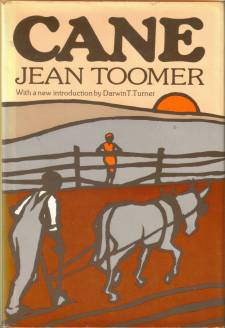
Welcome to the Ernest J. Gaines Center's blog. Here, you will find information relating to ongoing projects at the Ernest J. Gaines Center. Along with information about the Center, this blog will serve as a spot to elaborate on Gaines' work and his relation to American literature, Southern literature, African American literature, and world literature.
Last post, I wrote about a stylistic element in Arna Bontemps's Black Thunder(1936) that I found interesting and similar to Gaines's description of the arrival of Gruesome Gertie into Bayonne in chapter 30 of A Lesson before Dying. Today, I want to briefly continue with that discussion by looking at a couple of section from Bontemps's novel where the third person narrator gives way to a stream-of-consciousness narration. This move, in many ways, reminds me of parts of Jean Toomer's Cane(1923) where we see inside the characters's heads. These sections occur mostly in the second and third sections of Toomer's novel and are punctuated like drama, providing the character's name then a period.
During the torrential storm that ultimately thwarts Gabriel's rebellion, Ben sits in the house with Marse Sheppard and thinks about their relationship, how much they understand one another and how satisfied they are together. All of this in the third person; until he begins to think about his freedom and what that means.
Then suddenly another thought shouted in his head.
Licking his spit because he done fed you, hunh? Fine nigger you is. Good old Marse Sheppard, hunh? Is he ever said anything about setting you free? He wasn't too good to sell them two gal young-uns down the river soon's they's old enough to know the sight of a cotton-chopping hoe. How'd he treat yo' old woman befo' she died? And you love it, hunh? Anything what's equal –
"Get the toddy bowl, Ben."
"Yes, suh." (94)
Here, the narration moves into Ben's head as he considers his relationship with Marse Sheppard and whether or not he should even think about freedom. Bontemps moves seamlessly from the third person narrator into Ben's head for a stream-of-consciousness section. Ben begins by asking himself questions regarding Sheppard's respect for him then moves into the past thinking about the way Sheppard treated his family, selling them when they were old enough to work in the fields. Ben's thoughts, however, get interrupted when Sheppard asks him for the "toddy bowl," and the narrator returns to third person, providing an overview of the action. Bontemps does this periodically throughout the novel, delving into the thoughts of multiple characters as he tells the story of Gabriel Prosser's failed insurrection.
In "Bona and Paul," Toomer incorporates interior monologue, delving into the character's thoughts to illuminate the action taking place. At the very beginning of the story, Bona watches Paul dance dance during class.
Bona: He is a candle that daces in a grove swung with pale balloons.
Columns of the drillers thud towards her. He is in the front row. He is in no row at all. Bona can look close at him. His red-brown face —
Bona: He is a harvest moon. He is an autumn leaf. He is a nigger. Bona! But dont all the dorm girls say so? And dont you, when you are sane, say so? That's why I love — Oh, nonsense. You have never loved a man who didnt first love you. Besides — (70)
The excerpt above shows a small sample of what Toomer does with stream-of-consciousness narration. Bona thinks about the way that Paul looks as he dances in front of her, and as she contemplates his appearance in relation to the moon and a leaf, she begins to drift back in to what others say about him. Her thoughts go from a metaphorical image of Paul to a depiction that hinges on what others say, and that tension can be seen in her thoughts. She abruptly stops twice, as indicated by the em-dashes. Bona moves from abstract, metaphorical images of Paul to examining him in relation to how her fellow dorm girls view him to wondering whether or not she actually loves him. This is just a brief example of stream-of-consciousness in Toomer's novel, there are more throughout the work.
What are some other novels that employ this technique? What is its purpose? How does this technique relate to modernism, which both authors were a part of? Let me know in the comments below.
Bontemps, Arna. Black Thunder. Boston: Beacon Press, 1968. Print.
Toomer, Jean. Cane. New York: Liveright, 1975, Print.
"When one is on the soil of one's ancestors, most anything can come to one" (17). This line, from Jean Toomer's Cane (1923), immediately made me think of Ernest J. Gaines and the land he writes about. As I reread Cane last week, I couldn't help but think about the Toomer's descriptions the South and the North and Gaines's descriptions as well. I have written about Toomer and Gaines before, so I will not touch on that aspect in great detail here. Instead, I would like to take the time to write about two specific vignettes ("Seventh Street" and "Rhobert") from the Washington section of Toomer's masterpiece. These two sketches open up the second section of Cane and both highlight the hustle and bustle of the urban space that many African Americans encountered during the Great Migration.
"Seventh Street," a prose poem, begins and ends with a four line verse that sums up both the means of advancement and the speed within the urban landscape. Unlike the South, where "[t]ime and space have no meaning in a canefield," the North buzzes with people moving too and fro, always being propelled by money and time. The verse that opens and closes "Seventh Street" sums this up perfectly. Toomer writes,
Money burns the pocket, pocket hurts,
Bootleggers in silken shirts,
Ballooned, zooming Cadillacs,
Whizzing, whizzing down the street-car tracks. (39)
The languid, sonorous sounds that constitute the southern section of Cane give way at the opening of the northern section to movement through the sights and sounds of the metropolis. Farah Jasmine Griffin notes, "Assonance and consonance further enhance the sense of motion, but the repetition of the harsh double consonants gg and zz . . . speed the passage towards a swift conclusion" (65). These aspects of "Seventh Street" create an image of movement and harshness that does not appear in the southern section.
The vignette continues its movement through the cityscape by bringing the reader/migrant face to face with the underworld of the urban environment. "Seventh Street is," the reader hears, "a bastard of Prohibition and the War. A crude-boned, soft-skinned wedge of nigger life breathing its loafer air, jazz songs and love, thrusting unconscious rhythms, black red-dish blood into the white and whitewashed wood of Washington" (39). These opening sentences ooze with numerous images of what an African American migrant to the North, around the time of World War I, would encounter. Prohibition, which of course led to crime, returning soldiers, and the proliferation of jazz all await the incoming migrant. Sexual verbs constitute the movement of the reader down "Seventh Street," words like thrusting, breathing, shed, pouring, etc. populate the space. Along with this imagery, the city also becomes infused with an African American presence. The narrator says that black and red blood thrust themselves into the "whitewashed wood of Washington." While the southern section ends with death in "Blood Red Moon," the northern section sees migrants rising from the blood-stained soil of the South to the promises, false or real, of the North.
The second vignette in the northern section, "Rhobert," comments on the materialistic, consumerist pull of the North to new migrants. "Rhobert" focuses on a man who becomes constricted and suffocated by his material possessions. The house resembles "a monstrous diver's helmet" that extricate the life out of him by continually constricting around his head (40). Rhobert's "house is a dead thing that weights him down" (40). It drags him into the mud where he wiggles to free himself but ultimately perishes. At the end of "Rhobert," the narrator says that after Rhobert sinks into the ground we should "build a monument and it in the ooze where he goes down," and the monument should be "of hewn oak" (41). The urban leads to Rhobert's demise, but he returns, figuratively in death, to the South. The monument is made of oak and his mourners sing "Deep River" as he perishes underneath the ground. Throughout the northern section, the characters reflect back to the South, continually returning figuratively to the space.
The North, and the drive to acquire material things like the house, subsume Rhobert and his life. Griffin points out that we should view "Rhobert" in relation to Leadbelly's "Bourgeois Blues," a song that chronicles the African American migratory experience to the North, and specifically to Washington. "Bourgeois Blues" epitomizes the struggles that African Americans endured when moving North, and it highlights the "Promised Land" of the North was not all it was cracked up to be. The narrator of the song attempts to find housing for him and his wife, but the white property owners turn them away. Even though America is "the land of the free and the home of the brave," no one will provide a place to stay. To acquire that space, the migrant must purchase it, and that creates other problems. "Rhobert" purchases a house, and that purchase drives him to death. There is more that could be said here, and I am not quite sure, at this point, what that may be. Let me know what you think in the comments below.
I would like to end this post with a video of Gil Scott-Heron & Brian Jackson sing "Cane" (1978), a song based off of Toomer's novel and specifically off of "Carma" and "Karintha."
Griffin, Farah Jasmine. "Who set you flowin'?": The African-American Migration Narrative. New York: Oxford University Press, 1995. Print.
Toomer, Jean. Cane. New York: Liveright, 1975, Print.
The last blog post pointed out the influence that Ernest Hemingway
had on Gaines and his writing. Hemingway influenced numerous black authors from
Claude McKay, Ralph Ellison, Gloria Naylor, and Derek Walcott. What some may
not know, however, is that an African American author influenced Hemingway
himself. Jean Toomer’sCane(1923) appeared at a time when the
short story cycle arose more predominantly in the literary scene.
Sherwood Anderson, the author of the short story cycleWinesburg, Ohio(1919) told Gertrude Stein in 1924
that she should read Toomer’sCane.
Stein and Anderson both mentored Hemingway, so "it is a virtual
certainty," asGary
Holcombwrites, that
"Hemingway was acquainted with Toomer's book" (311). Gaines has stated that African American authors such as Richard
Wright did not have an influence on his writing when he started. He has cited
Ivan Turgenev, Fydor Dostoyevsky, Leo Tolstoy, James Joyce, Ernest Hemingway,
William Faulkner, John Steinbeck, Willa Cather, Sherwood Anderson, and others
as influences. Gaines states, “I didn’t read Cane until
after I got out of college. I didn’t read Cane until about ’59
or ’60. By then I had developed what I suppose is my way of writing” (Gaudet
and Wooton 35). In a 1994 interview with John Lowe, Gaines outlines the
relationship between Hemingway and Toomer explicitly:
I discoveredCanein the sixties. I thought it was so
poetic—you know, Sherwood Anderson knew about that book, and I’m almost certain
he mentioned it to Gertrude Stein and Hemingway because of those little things
in Hemingway’s first collection of stories,In
Our Time—he has those little breaks between each one of those stories, and
I wonder if he didn’t get that from having read Toomer’sCane; and of course,Canecame out much earlier. (317)
Hemingway taught Gaines structure and understatement among other
things, and Gaines sites those as characteristics in regards to Toomer’s
writing inCane. Looking
at “Karintha” and “Esther” fromCanein comparison withCatherine Carmierone can see how Gaines, through his
admiration for Hemingway, indirectly received inspiration from Toomer.
Gary Holcomb's book, which he
co-edited with Charles Scruggs, Hemingway
and theBlack Renaissancecontains
10 essays that lay out the literary connections between Ernest Hemingway and
black authors such as Claude McKay, Ralph Ellison, James Baldwin, Toni
Morrison, and others.
Holcomb, Gary Edward. "Race and Ethnicity: African
Americans." Ernest Hemingway in Context. Eds.
Debra A. Moddelmog and Suzzane del Gizzo. Cambridge: Cambridge University
Press, 2013. 307-314. Print.
Lowe, John. "An Interview with Ernest Gaines." Conversations with Ernest Gaines.Ed. John Lowe. Jackson: University of
Mississippi Press, 1995. 297-328. Print.
.jpg/220px-Arna_Bontemps_(1939).jpg)