Showing posts with label "a long day in November. Show all posts

Thursday, November 13, 2014

Benjy Compson and Sonny

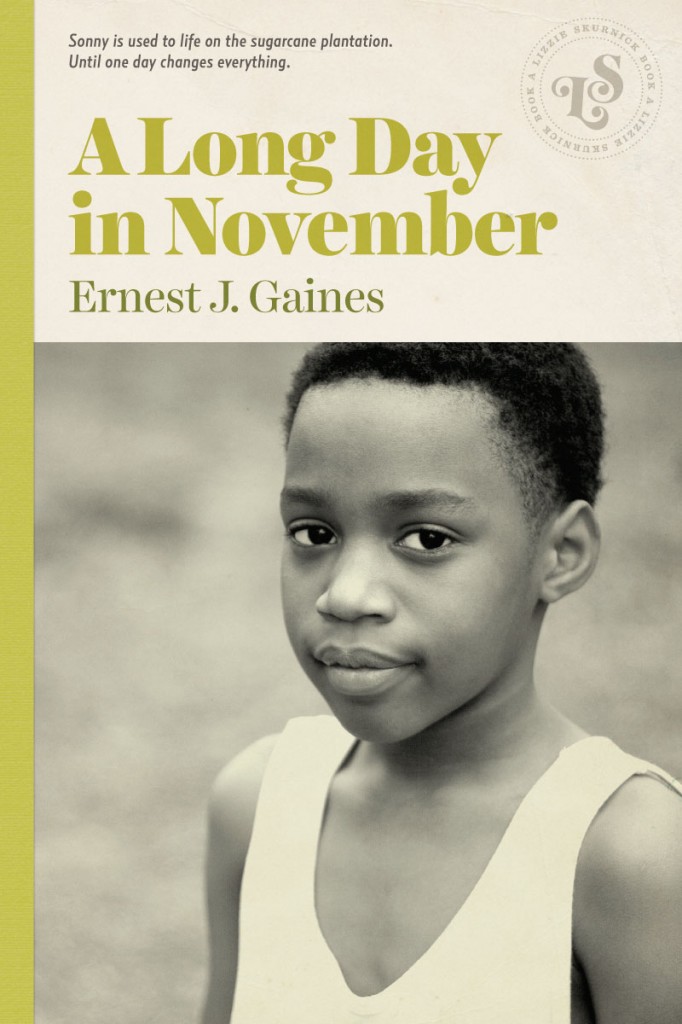
"Somebody is shaking me but I dont want get up now, because I'm tired and I'm sleepy and I don't want get up now" (Bloodline 3). So begins Gaines' short story "A Long Day in November," a story narrated by five-year-old Sonny. The boy tells about the relationship between his father and mother, their conflicts then their eventual reconciliation. For this post, I do not want to focus on the narrative of the story. Instead, I want to talk briefly about the narrative voice that Gaines constructs to tell the story.

Reading Sonny's voice for the first time, I could not help but think that something felt eerily similar to me. As I kept reading, I finally began to figure out that Sonny's narration reminded me of Benjy Compson's from William Faulkner's The Sound and the Fury. In fact, a couple of pages into "A Long Day in November," I scribbled "kinda like Benjy narrating" in the margins. Specifically, what sparked this connection came from Sonny's narration when describes his dream the waking up from it. There are not clues that Sonny awakes. The narration moves fluidly from sleeping dreams of Billy Joe Martin, Sonny, and Lucy playing to "Somebody's beating on the door. Mama, somebody's beating on the door" (7). Sonny's seamless movement from sleep to being awake is not as abrupt as Benjy's leaps over the course of thirty years, but it is similar. Along with this type of subtle shift, Sonny also takes on some of Benjy's linguistic style.

Even though Benjy is thirty three, his decreased mental capacity makes him appear as if he is merely a child. For example, he can only mumble and cry when he hears Caddy's named mentioned. In fact, the family doesn't even say her name when she is gone so Benjy will keep quiet. Opening his section, Benjy states, "Through the fence, between the curling flower spaces, I could see them hitting. They were coming towards where the flag was and I went along the fence" (3). Just like Sonny's initial sentence, Benjy's contains a simplicity, even though both also have a subordinate clause. Their apparent simplicity arises from the structure (a subject followed directly by a verb). This structure allows both Sonny and Benjy to sound like a five-year-old boy and a thirty-three year old man child respectively.

Responding to a question about writing from the point of view of a young boy in "A Long Day in November," Gaines responded by saying "we have all been children once" and because of that, the viewpoint is there somewhere. Even though this voice resided within Gaines, and us, he had to find out a way to bring it out. To do that, he received help from both Joyce and Faulkner. Joyce helped Gaines write about events that span a day. From Faulkner, Gaines said he found out how to write in the voice of a five-year-old Sonny.
In the first part of Faulkner's The Sound and the Fury the Benjy part, Benjy uses the simplest terms to express his feelings: "the gate is cold," "the fire is good," "I stamped my shoes on," all this sort of thing. This childlike section is so convincing that I really fell in love with it. I really did. (Fitzgerald and Marchant 11)    

I am in the process of rereading The Sound and the Fury, so in a couple of days I may have more to say about the novel and Gaines. However, at this point, I just wanted to note the similarities in regards to the way that Gaines structures Sonny's narration and the way Faulkner structures Benjy's. If you have any comments or questions, remember to leave them below. 

Faulkner, William. The Sound and the Fury. New York: Vintage, 1994. Print.
Fitzgerald, Gregory and Peter Marchant. "An Interview: Ernest J. Gaines." Conversations with Ernest Gaines. Ed. John Lowe. Jackson: University of Mississippi Press, 1995. 3-15. Print.
Gaines, Ernest J. "A Long Day in November." Bloodline. New York: W.W. Norton & Company, 1976. 3-79. Print.

Thursday, July 17, 2014

"I was crying."

A Lesson before Dying concludes with a simple, three word statement from Grant: "I was crying" (256). Gaines' works deal with manhood, and the achievement of manhood. A Lesson before Dying focuses on Jefferson gaining the strength to walk like a man, and not a hog, to the electric chair. The novel even traces Grant's movement towards manhood. What does crying have to do with the stereotypical view of manhood that society and the media has concocted for us? If we go by the constructed prescription of manhood, crying has nothing to do with it. In fact, crying represents the opposite of manhood. Speaking with John Lowe in 1994, Gaines said, "I think that we think that being a big tough guy, like a football player, or a bully, is being a man" (321). However, this is not the case according to Gaines. Manhood involves taking responsibility: "This is the responsibility of man; taking responsibility for the whole, all humanity, is what I think manliness is" (321). Thinking about Grant in this aspect, he starts to, throughout the novel, take responsibility for the whole. The novel concludes with him in front of his students after Jefferson's execution. He knows that he has a responsibility to the community and to those students to not let Jefferson's death be in vain or forgotten.

Gaines' short story collection Bloodline (1968) can be read partly as a short story sequence that traces the growth of a boy through manhood, even though characters do not repeat in the stories. Crying can be seen throughout the stories, and the majority of the time the ones crying are either boys or men. In "A Long Day in November," Sonny cries when he pees himself at school, and Eddie cries when Gran'mon shoots at him: "We all run out on the gallery, and I see Daddy out in the road crying" (35). Eventually, Eddie realizes that in order to get his wife back he must grow up. He burns his car and Gran'mon says, "I must be dreaming. He's a man after all" (71). Near the end of the story, Amy forces Eddie to grow up and take responsibility for Sonny's education by going to the school and speaking with the teacher. Eddie's crying works towards his realization that he needs to take "responsibility for the whole," not just for himself.

James, in Bloodline's second story "The Sky is Gray," tries his hardest not to cry because he believes it shows weakness and will lower his mother's perception of him. He knows that he must be strong not only for himself but for her as well. At the beginning of the story, he says,
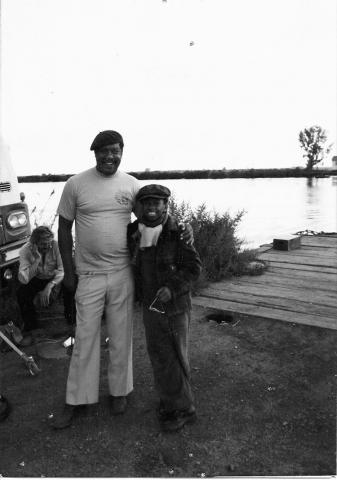
Gaines with James Bond III (Jimmy in film)
I make 'tend I ain't [sacred of ghosts] 'cause I'm the oldest, and I got to set a good sample for the rest. I can't ever be scared and I can't ever cry. And that's why I never said nothing 'bout my teeth. It's been hurting me and hurting me close to a month now, but I never said it. I didn't say it 'cause I didn't want act like a crybaby, 'cause I know we didn't have enough money to go have it pulled. (84) 
Later, as Jimmy and his mother leave the dentist's office, the sleet begins to really fall. Jimmy says, "I look at Mama standing there. I want stand close 'side her, but she don't like that. She say that's crybaby stuff. She say you got to stand for yourself, by yourself" (105-106). Throughout the story, Jimmy learns to stand by himself. He learns to take responsibility and how to mature into manhood. The only time he physically cries is when his mother whips him for not killing the birds. Even in this instance, his crying occurs during a lesson that his mother is trying to teach him, how to stand by himself.

In the third story from Bloodline, "Three Men," Procter Lewis can be seen crying after he decides to take Munford's advice to not let Roger Medlow bail him out of jail. Procter says he got up on the bunk and looked out at the stars. While looking at the heavens, he says, "I felt my throat hurting. I felt water running down my face. But I gripped my mouth tight so I wouldn't make a sound. I didn't make a sound, but I cried. I cried and cried and cried" (151). Even though he cries in his bunk, the paragraph ends with Procter affirming that he "wanted to stand. Because they never let you stand if they [bailed] you out" (152). Procter takes Munford's advice and goes to the pen standing so other will see him as an example. He takes "responsibility for the whole."

This post will possibly turn into something more down the line, but for now I hope it provides you with a little idea concerning manhood and the achievement of it in Gaines' writings. Please leave any thoughts on this topic or on previous topics in the comments below.

Gaines, Ernest. Bloodline. New York: W.W. Norton, 1976. Print.
Gaines, Ernest. A Lesson before Dying. New York: Vintage Books, 1993. Print.
Lowe, John. "An Interview with Ernest Gaines." Conversations with Ernest Gaines. Jackson: University of Mississippi Press, 1995. 297-328. Print.