Showing posts with label " "the sky is gray. Show all posts

Tuesday, September 23, 2014

Film Version of "A Lesson before Dying"

Last week, to kick off the celebration of the 50th anniversary of Ernest Gaines' first novel publication, Catherine Carmier, Dr. Matthew Teutsch and the Ernest J. Gaines Center's graduate assistant Jennifer Morrison appeared on KRVS's Apres Midi and WRKF's The Jim Engster Show. Follow the links above to listen to those interviews.

Last Wednesday, the center kicked off it's events with the film showing of The Sky is Gray at Lafayette Public Library's South Regional Branch. Tomorrow night (September 24), there will be a film screening and discussion of the film version of Gaines' 1993 classic A Lesson before Dying. The film earned two Emmy's in 1999 for Outstanding Made-for-Television Movie and for Outstanding Writing for a Mini-Series or Movie. Around the same time as the film's premier, playwright Romulus Linney, in 2000, premiered the stage adaptation of A Lesson before Dying at the Alabama Shakespeare Festival. A video of him discussing the adaptation is below.

A Lesson before Dying, as has been discussed on this blog previously, is an important book. It was chosen, in 1997, to be part of Oprah Winfrey's Book Club, and it won the National Book Critic's Circle Award in 1993.

Make plans to join us to celebrate the 15th anniversary of this monumental film. Details of the upcoming events can be found on last Tuesday's blog post.


Thursday, September 18, 2014

"You a man, James"

Final page of
"The Big Gray Sky"
"'You not a bum,' she says. 'You a man'" (117). These words conclude the second short story in Gaines' Bloodline. As Octavia and James get ready to leave Bayonne for their return trip home, and as the air becomes chilly, with sleet falling and the wind howling, James turns his collar up to try to maintain some warmth. However, his mother quickly tells him to turn the collar down because, as she says, "You a man," not a bum. In the early drafts of the story, this final line does not appear. Instead, Octavia only says, "You not a bum." What does the addition of "You a man" add to our understanding of "The Sky is Gray"? Does it add anything? Would the story have the same impact if those words never made it into the final version?


I would argue that those three words," You a man," serve as the focal point of the story. Throughout, Octavia strives to teach James how to become a man, what he needs to do to survive. At the outset, James flashes back to a time when he struggled to kill two small birds that he and his brother caught. He didn't want anything to do with killing them, even if it means that the family will have food. Octavia berated him and hit him while his Aunt pleaded for Octavia to "[e]xplain to him. Just don't beat him. Explain to him" (90). Eventually, James understands why he must kill the birds. Even though he isn't much older than eight, James sees that the others are proud of him for killing, cleaning, and cooking the birds. He must learn how to do these things now because if he doesn't he may not survive if his mother goes away like his father did.

After the lesson with the birds, James begins to act more like a man. While his teeth continually hurt him throughout the story, he bears the pain for his mother. He wants to prove he is a man, or at least in the process of becoming one. While waiting on the bus to take him and his mother to Bayonne, James ruminates on what constitutes a man. The passage is worth quoting at length:
I look at my mama and I love my mama. She's wearing that black coat and that black hat and she's looking sad. I love my mama and I want to put my arm round her and tell her. But I'm not supposed to do that. She say that's weakness and that's crybaby stuff, and she don't want no crybaby round her.She don't want you to be scared, either. 'Cause Ty's scared of ghosts and she's always whipping him. I'm scared of the dark, too, but I make 'tend I ain't. I make 'tend I ain't 'cause I'm the oldest, and I got to set a good sample for the rest. I can't ever be scared and I can't ever cry. And that's why I never said nothing 'bout my teeth. It's been hurting me close to a month now, but I never said it. I didn't say it 'cause I didn't want act like a crybaby, and 'cause I know we didn't have enough money to go have it pulled. But, Lord, it been hurting me. And look like it wouldn't start till at night when you was trying to get yourself little sleep. Then soon 's you shut your eyes--ummm-ummm, Lord, look like it go right down to your heartstring. (84)   
James' desire to show he is a man stems partly from the fact that he has to display his manhood in order to help those who cares about to survive if anything happens to the adults. Octavia spends the entirety of the story teaching the eight-year-old James how to navigate a racist society and how to survive in a cruel landscape. During their time in Bayonne, Octavia provides James with mini-lessons on how to navigate the area, telling him to keep his eyes forward. At one point, James even thinks about the lessons he may be missing in school, remembering when he learned about Poe's "Annabel Lee."

In the comments below, tell me what you think about the last line of the story. Does the power of that line change if you take out "You a man"? Also, two of the original titles of the story were "A Little Southern Town" and "The Big Gray Sky." Would the story be any different one of these was the title?

Gaines, Ernest J. "The Sky is Gray." Bloodline. New York: W. W. Norton & Company, 1976. 83-117. Print.

Thursday, July 17, 2014

"I was crying."

A Lesson before Dying concludes with a simple, three word statement from Grant: "I was crying" (256). Gaines' works deal with manhood, and the achievement of manhood. A Lesson before Dying focuses on Jefferson gaining the strength to walk like a man, and not a hog, to the electric chair. The novel even traces Grant's movement towards manhood. What does crying have to do with the stereotypical view of manhood that society and the media has concocted for us? If we go by the constructed prescription of manhood, crying has nothing to do with it. In fact, crying represents the opposite of manhood. Speaking with John Lowe in 1994, Gaines said, "I think that we think that being a big tough guy, like a football player, or a bully, is being a man" (321). However, this is not the case according to Gaines. Manhood involves taking responsibility: "This is the responsibility of man; taking responsibility for the whole, all humanity, is what I think manliness is" (321). Thinking about Grant in this aspect, he starts to, throughout the novel, take responsibility for the whole. The novel concludes with him in front of his students after Jefferson's execution. He knows that he has a responsibility to the community and to those students to not let Jefferson's death be in vain or forgotten.

Gaines' short story collection Bloodline (1968) can be read partly as a short story sequence that traces the growth of a boy through manhood, even though characters do not repeat in the stories. Crying can be seen throughout the stories, and the majority of the time the ones crying are either boys or men. In "A Long Day in November," Sonny cries when he pees himself at school, and Eddie cries when Gran'mon shoots at him: "We all run out on the gallery, and I see Daddy out in the road crying" (35). Eventually, Eddie realizes that in order to get his wife back he must grow up. He burns his car and Gran'mon says, "I must be dreaming. He's a man after all" (71). Near the end of the story, Amy forces Eddie to grow up and take responsibility for Sonny's education by going to the school and speaking with the teacher. Eddie's crying works towards his realization that he needs to take "responsibility for the whole," not just for himself.

James, in Bloodline's second story "The Sky is Gray," tries his hardest not to cry because he believes it shows weakness and will lower his mother's perception of him. He knows that he must be strong not only for himself but for her as well. At the beginning of the story, he says,
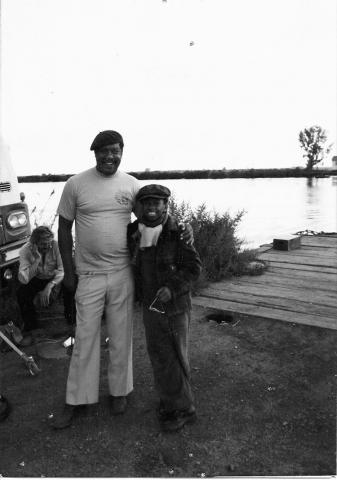
Gaines with James Bond III (Jimmy in film)
I make 'tend I ain't [sacred of ghosts] 'cause I'm the oldest, and I got to set a good sample for the rest. I can't ever be scared and I can't ever cry. And that's why I never said nothing 'bout my teeth. It's been hurting me and hurting me close to a month now, but I never said it. I didn't say it 'cause I didn't want act like a crybaby, 'cause I know we didn't have enough money to go have it pulled. (84) 
Later, as Jimmy and his mother leave the dentist's office, the sleet begins to really fall. Jimmy says, "I look at Mama standing there. I want stand close 'side her, but she don't like that. She say that's crybaby stuff. She say you got to stand for yourself, by yourself" (105-106). Throughout the story, Jimmy learns to stand by himself. He learns to take responsibility and how to mature into manhood. The only time he physically cries is when his mother whips him for not killing the birds. Even in this instance, his crying occurs during a lesson that his mother is trying to teach him, how to stand by himself.

In the third story from Bloodline, "Three Men," Procter Lewis can be seen crying after he decides to take Munford's advice to not let Roger Medlow bail him out of jail. Procter says he got up on the bunk and looked out at the stars. While looking at the heavens, he says, "I felt my throat hurting. I felt water running down my face. But I gripped my mouth tight so I wouldn't make a sound. I didn't make a sound, but I cried. I cried and cried and cried" (151). Even though he cries in his bunk, the paragraph ends with Procter affirming that he "wanted to stand. Because they never let you stand if they [bailed] you out" (152). Procter takes Munford's advice and goes to the pen standing so other will see him as an example. He takes "responsibility for the whole."

This post will possibly turn into something more down the line, but for now I hope it provides you with a little idea concerning manhood and the achievement of it in Gaines' writings. Please leave any thoughts on this topic or on previous topics in the comments below.

Gaines, Ernest. Bloodline. New York: W.W. Norton, 1976. Print.
Gaines, Ernest. A Lesson before Dying. New York: Vintage Books, 1993. Print.
Lowe, John. "An Interview with Ernest Gaines." Conversations with Ernest Gaines. Jackson: University of Mississippi Press, 1995. 297-328. Print.