
Candy's phrase, "my people," struck me when I first encountered it. Even though slavery had ended close to 110 years before the events in the novel take place, the 1970s, Candy still sees Mathu and the others as "her people." She "must" protect them, making sure that neither Fix nor Mapes harms them. Through this stance, Candy maintains a position of authority that becomes reminiscent of slave owners who saw their slaves as property and of being incapable or protecting themselves. I am not saying that Candy is completely like a slave owner; however, her paternalistic stance towards Mathu and the others is worth interrogating. In fact, Gaines editor, Dorthea Oppenheimer, specifically asked Gaines about Candy's role in the novel. She wrote, "Candy: what's her role? She's the last of her line. She's an old fashioned type of slaveowner, although she thinks she's very modern and liberal. She finds out these men have minds of their own and doesn't like it."
Even at the end of the novel, after everything has happened, Candy still cannot let go of "her people." When the trial ends, she asks Mathu if he needs a ride home. He declines, saying that Clatoo is there with the truck and "he would go back with Clatoo and the rest of the people" (214). Candy waves to Mathu and the others then searches for Lou's hand, for comfort. When asked about this scene and whether or not Candy undergoes a "learning process" throughout the book, Gaines responds:
I really don't think she understood [why Mathu left with the people]. She knows she needs Lou for support; that's why she reaches for his hand when Mathu leaves. But Mathu's turned his back on her, and I don't think she knows why. Lou tells her in the car; that's why she slaps him, because she doesn't want to understand. In another draft, she gives a big speech, "When you needed medicine, who went to the store? When you went to the doctor, who took you? When you were hungry, who fed you? And they must all say, Yes, Candy did it. I cut that out, but I hope people can still get the feeling of her role. (Doyle 171)
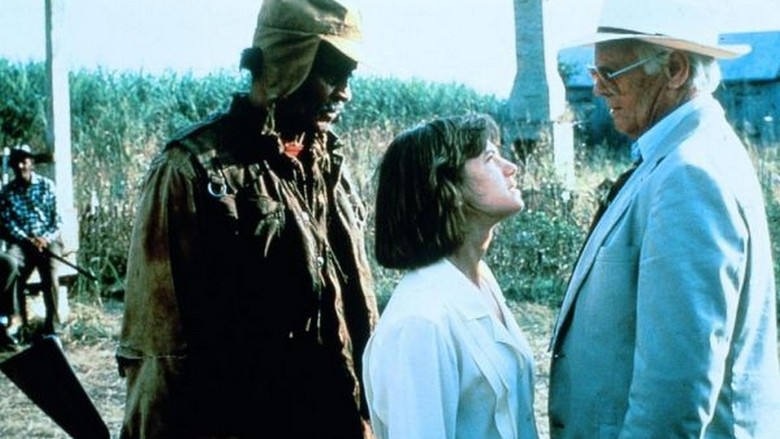 |
| Holly Hunter as Candy in the film version |
Doyle, Mary Ellen, S.C.N. "A MELUS Interview: Ernest J. Gaines--'Other Things to Write About.'" Conversations withe Ernest Gaines. Ed. John Lowe. Jackson: University of Mississippi Press, 1995. 149-171. Print.
Gaines, Ernest J. A Gathering of Old Men. New York: Vintage Books, 1984. Print.
