Tuesday, October 7, 2014

Salt and Pepper in the Same Backfield

I apologize for not not following up the "James Meredith and Ole Miss" post with one on Gil and Cal from A Gathering of Old Men as I said I would. This post will focus on "Salt and Pepper" from Gaines' 1983 novel. Speaking about the violence and prejudice that appears in a novel set in the 1970s, Gaines says, in a 1991 interview, that racism and oppression still exist. He continues by using Gil and Cal as a symbol of progress and hope in the novel. His comments are worth quoting at length:
Another one of the themes running around this story is the idea of working together. The football players are very important in the novel. The only way you can really do things and the only way we are going to be Americans is that we have to work together. While many of the other characters in the novel are trapped in the past, the only ones who live in the present are Salt and Pepper.They're the ones living in the present and they're the ones who must make American work. We've got to block for each other and do all kinds of things to get to the goal. The football players are a symbol for how we must do this together. (Saeta and Skinner 250)
While Gil and Cal represent progress, Cal appears in the novel only once. As Gil prepares to leave LSU after getting word of his brother's murder, Cal tries to console Gil and tries to figure out what happened. At this moment, Gil turns his anger upon Cal: "Then suddenly [Gil] just turned against Cal. Out of the blue, he looked at Cal like he suddenly hated him. It surprised the hell out of both me [Sully] and Cal" (113). Gil leaves, and all Cal can do is just stand "there looking hurt" (114). After this encounter, Cal does not enter the novel again, except as a character removed from the action.

Ultimately, while Gil and Cal represent progress, there is something sort of unsettling about Gil and his role in the groundbreaking duo of "Salt and Pepper." When speaking with his father Fix, Gil continues to intone that if the family does anything to retaliate against the murder of Beau it will hurt his chances of becoming an All American. Here, it feels like Gil's dreams and desires supersede his family as well as Cal.However, this is all part of Gil's awakening, as Sister Mary Ellen Doyle says, because even after Gil rejects Cal and "has accepted rejection himself can he begin fully to see that what he does on the football field has wider implications than his own fame and glory" (184). Russ, the deputy who Mapes sends to Fix's house to keep him and his men there, says as much to Gil.

Upon leaving, Gil tries to decide whether or not he should play in the game against Ole Miss. Russ stops him and convinces him that he should, telling Gil, "Tomorrow you can do something for yourself, and for all the rest of us" (150). Russ begins by saying what Gil can do for himself then he moves on to what he can do for the country and for the next generation of Cajuns in South Louisiana. Russ tells Gil that millions of people will see the game on TV, and most of them will be pulling against LSU because "Salt and Pepper" are in the same backfield; however, that makes Gil and Cal that much more important. Gil doesn't respond to this argument, and Russ move on to argue how Gil can help his family: "You want to do something for your dead brother? Do something for his son's future--play in that game tomorrow" (151). Gil then asks about how this help Fix, not realizing that Fix possibly can't be helped. Russ concludes by reinforcing that Gil can help Tee-Beau, the country, and himself by playing in the game.

There is more to Gil in the novel, but this provides a good starting point for discussing not just Gil's role but also the role of sports in the novel. Football, and other sports, serves as a tool that bring together social change. Just take a look at Jim Brown for an example of this in the NFL or Jerry LeVias at SMU (a video of him is below). In the comments, let's continue this conversation. How do you see sports affecting social change? How do sports play into other novels, not necessarily those of Gaines or other African Americans?

Doyle, Mary Ellen. Voices from the Quarters. Baton Rouge: Louisiana State University Press, 2003. Print.
Gaines, Ernest J. A Gathering of Old Men. New York: Vintage Books, 1983. Print.
Saeta, Elsa and Izora Skinner. "Interview with Ernest Gaines." Conversations with Ernest Gaines. Ed. John Lowe. Jackson: University of Mississippi Press, 1995. 241-252. Print.


Thursday, October 2, 2014

"No, I won't let them harm my people."

Upon first reading A Gathering of Old Men, Candy presented a conundrum for me. At first, I wanted to appreciate her desire to protect Mathu from Mapes and the inevitable appearance of Fix and his men. However, her continued comments regarding Mathu and those gathered at Marshall Plantation caused me to have a different view of her. Speaking with Miss Merle early in the novel, Candy tries to remind her interlocutor that Fix has continuously caused problems for the African American community on Marshall Plantation. Candy tells Miss Merle that Janey can remind her about "what Fix has done to these people around here" (19). After telling Miss Merle this, Candy emphatically states, "I will not let Mapes or Fix harm my people" (emphasis added 19). Candy continues by exclaiming, "No, I won't let them harm my people. . . . I will protect my people. My daddy and all them before him did" (emphasis added 19). In the span of five sentences, Candy refers to Mathu and the others on Marshall Plantation as "her people."

Candy's phrase, "my people," struck me when I first encountered it. Even though slavery had ended close to 110 years before the events in the novel take place, the 1970s, Candy still sees Mathu and the others as "her people." She "must" protect them, making sure that neither Fix nor Mapes harms them. Through this stance, Candy maintains a position of authority that becomes reminiscent of slave owners who saw their slaves as property and of being incapable or protecting themselves. I am not saying that Candy is completely like a slave owner; however, her paternalistic stance towards Mathu and the others is worth interrogating. In fact, Gaines editor, Dorthea Oppenheimer, specifically asked Gaines about Candy's role in the novel. She wrote, "Candy: what's her role? She's the last of her line. She's an old fashioned type of slaveowner, although she thinks she's very modern and liberal. She finds out these men have minds of their own and doesn't like it."

Even at the end of the novel, after everything has happened, Candy still cannot let go of "her people." When the trial ends, she asks Mathu if he needs a ride home. He declines, saying that Clatoo is there with the truck and "he would go back with Clatoo and the rest of the people" (214). Candy waves to Mathu and the others then searches for Lou's hand, for comfort. When asked about this scene and whether or not Candy undergoes a "learning process" throughout the book, Gaines responds:
I really don't think she understood [why Mathu left with the people]. She knows she needs Lou for support; that's why she reaches for his hand when Mathu leaves. But Mathu's turned his back on her, and I don't think she knows why. Lou tells her in the car; that's why she slaps him, because she doesn't want to understand. In another draft, she gives a big speech, "When you needed medicine, who went to the store? When you went to the doctor, who took you? When you were hungry, who fed you? And they must all say, Yes, Candy did it. I cut that out, but I hope people can still get the feeling of her role. (Doyle 171)
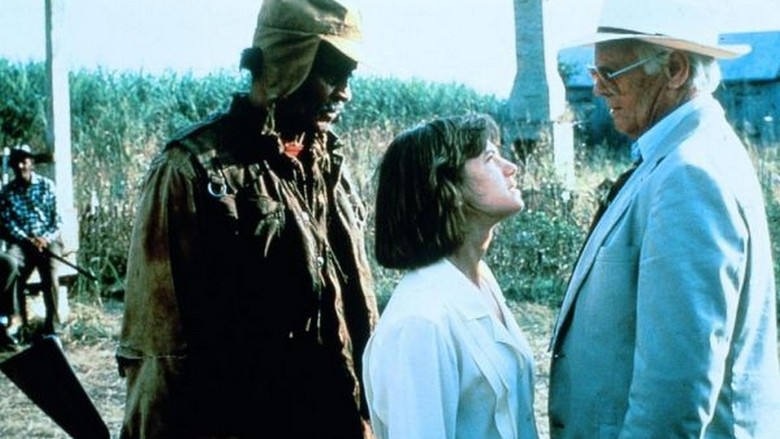
Holly Hunter as Candy in the film version
What is her role? Is she the "old fashioned type of slaveowner" that Oppenheimer mentions? Does she learn about herself and the community as Sister Mary Ellen Doyle suggests when she asked Gaines about Candy? Is she really progressive in her thoughts? These are all questions that should be explored because Candy provides an interesting type of character in A Gathering of Old Men, one that feels like she is helping but is ultimately hindering the progress of those she "loves and cares for." What do you think? As usual, add your own comments below.

Doyle, Mary Ellen, S.C.N. "A MELUS Interview: Ernest J. Gaines--'Other Things to Write About.'" Conversations withe Ernest Gaines. Ed. John Lowe. Jackson: University of Mississippi Press, 1995. 149-171. Print.
Gaines, Ernest J. A Gathering of Old Men. New York: Vintage Books, 1984. Print.